 Guide On Map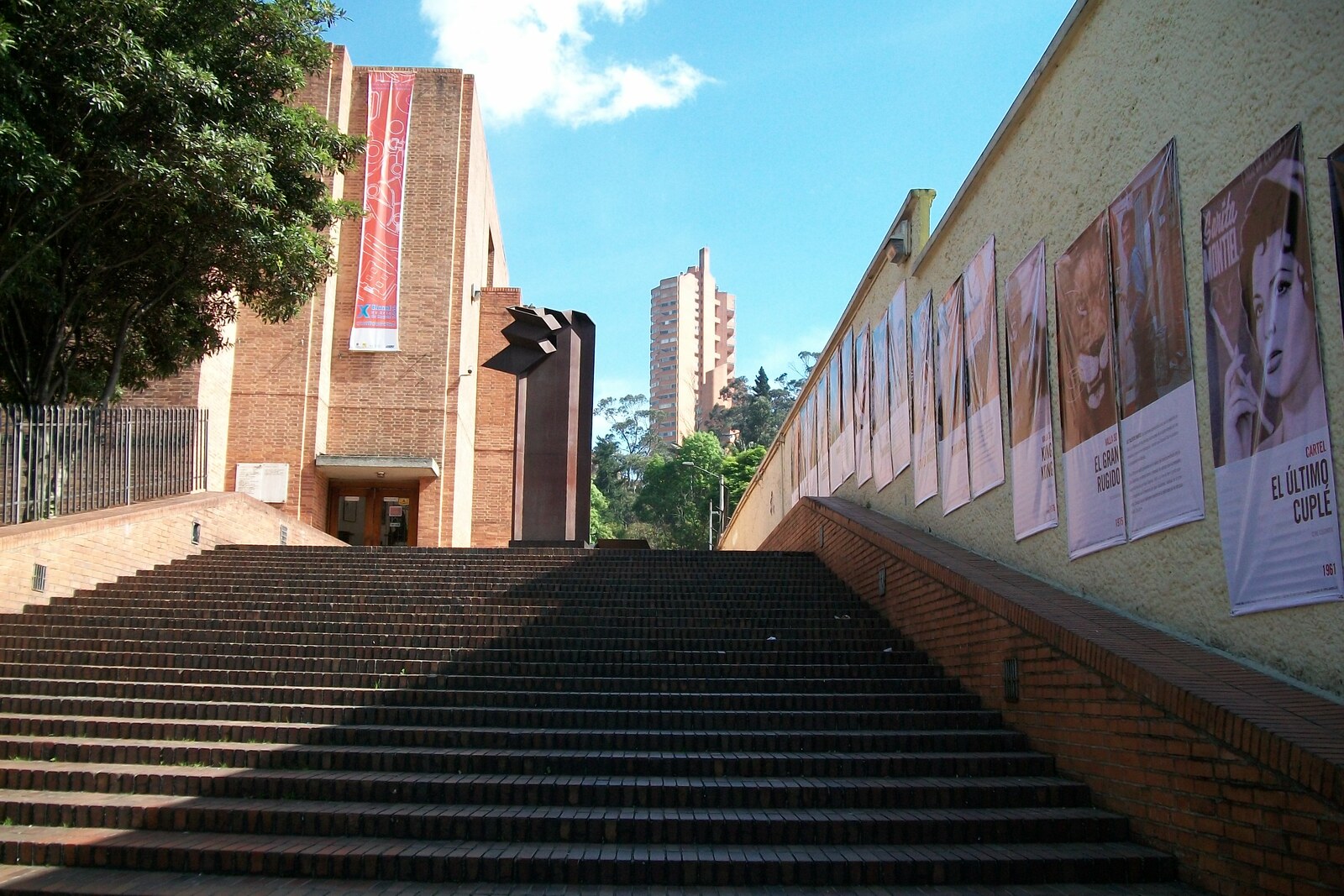
Look around first
What to notice
- Southern staircase
- Northern bridge
- Brick walls
- Four levels
The story of the place
On the strip of land between the National Library of Colombia and Independence Park stands the brick building of the Museum of Modern Art of Bogotá. The plot was left after the construction of the bridges on Twenty-sixth Street: it has to be approached uphill from the south, while on its northern side it opens onto the park. The almost cubic building has two entrances—one by staircase and one by bridge—and four levels linked by passageways around a central space. Inside are six exhibition halls, collection storage, workshops, a library, and a cinema hall where Colombian and foreign contemporary art is shown.
By the early nineteen eighties, Gloria Zea, director of the Museum of Modern Art of Bogotá, still had two upper floors to complete here. The lower ones were already receiving visitors, but there was no money to continue. The architect Rogelio Salmona reworked the design several times, removing what the museum could not afford. He charged nothing for his drawings.
Zea took over the museum in nineteen sixty-nine from the art historian Marta Traba, who had been seeking a permanent place for modern art in Bogotá. According to Zea's recollections, the institution's entire property then fit into a list of eighty works and a cardboard box containing its charter, catalogs, and legal papers. It had no building of its own. The paintings and sculptures were stored at the National University of Colombia, then moved to the Bavaria Building and the Bogotá Planetarium. Zea paid the staff—a curator, a secretary, and a watchman—from her own funds, and personally guaranteed museum loans. This continued for fourteen years.
She searched for a permanent site together with Salmona. They were given a narrow plot next to the National Library of Colombia: a piece of land left after the construction of the bridges on Twenty-sixth Street. It had to be approached uphill from the south, while on its northern side the plot adjoined Independence Park. Salmona therefore assembled the building into a dense, almost cubic volume and created different entrances—one by staircase and one by bridge. Inside, four levels are linked by passageways around a central space.
Construction was financed in installments. Zea organized auctions, horse races, and film premieres. For the “Buy a Brick” campaign, the artist Santiago Cárdenas made a silkscreen print depicting an ordinary brick. One print cost five thousand pesos; as the edition sold out, the next one was printed. The bricks for the construction itself were also supplied by Zea's husband's company. The first section of the museum opened in nineteen seventy-nine, but unfinished floors still stood above it for several years.
Zea asked President Belisario Betancur for the final forty million pesos at the opening of an exhibition in this museum. The next day, according to her account, the president called at four in the morning: he had arranged for four state lending institutions to provide ten million each. The head of one of them demanded that Zea again guarantee the loan with her own property.
This time, she refused. The president was seeking the loan, and the director was not going to be solely responsible with her house for his promise. When Betancur learned of the condition, he offered the bank his own signature and the signatures of wealthy acquaintances. Five minutes later, the money was provided. In nineteen eighty-five, the builders completed the building, and Zea remained its director for another three decades.
Behind the brick walls are six exhibition halls, storage for the permanent collection, workshops, a library, and a cinema hall. Colombian and foreign contemporary art is shown here, and exhibitions, classes, meetings, screenings, and performances are held. The southern staircase, the northern bridge, and the four floors before you are the part of Salmona's project for which Gloria Zea ultimately had enough from the bricks she raised, the prints that were sold, and forty million pesos without her house as collateral.
Useful on site
Tue–Sat 10:00–18:00, last entry 17:15; Sun and holidays 12:00–17:00, last entry 16:15; closed Mon; closed Tue after a holiday Monday.
Checked: June 28, 2026. Check the official source before visiting.Plan your visit to the collection separately. Even without going inside, pause by the facades: the architecture reveals itself in motion, not from a single chosen viewpoint.