 Guide On Map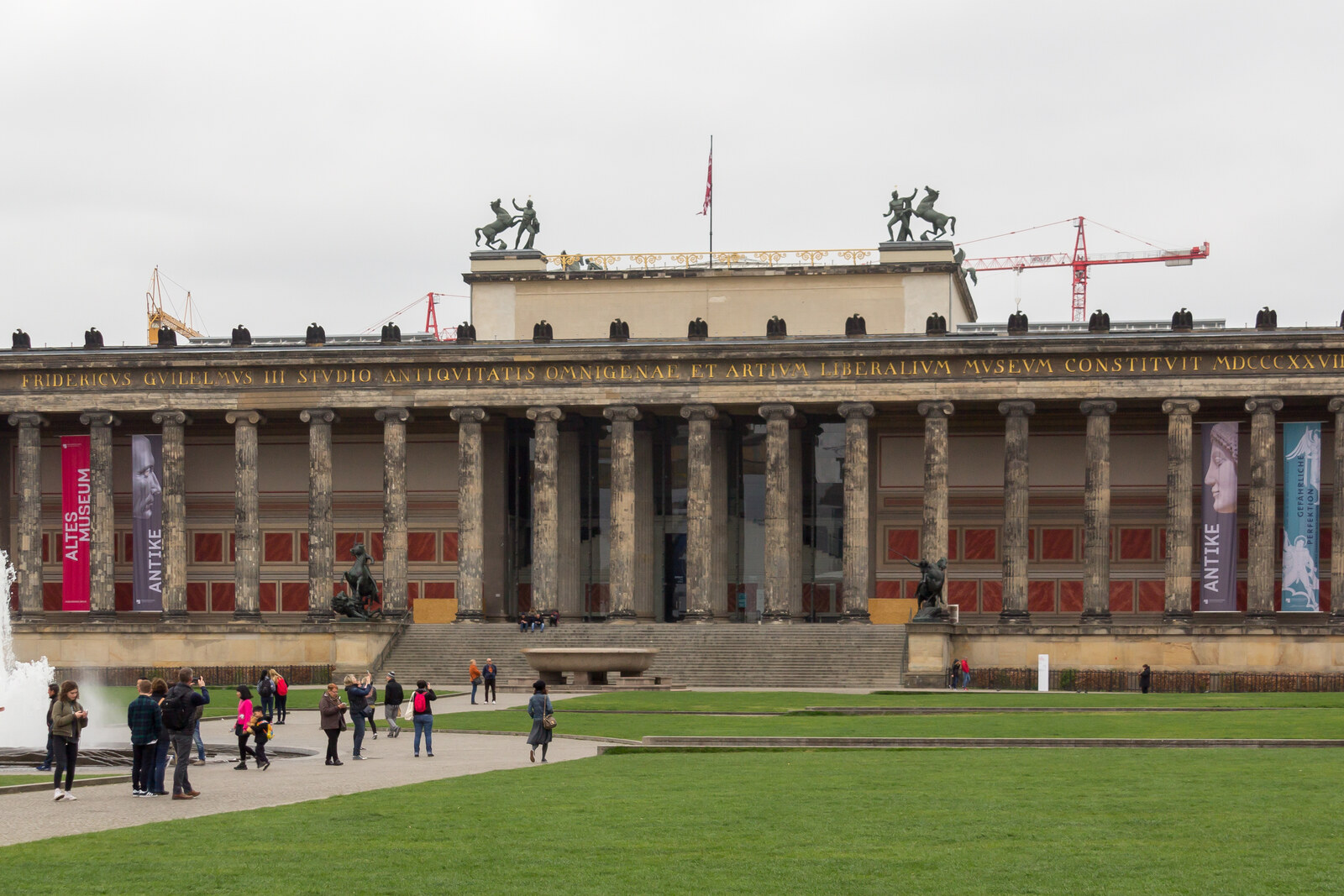
Look around first
What to notice
- The colonnade of the Altes Museum
- The broad staircase
- The rotunda beneath the dome
- The marble bust of Aloys Hirt
The story of the place
The northern half of the river island brought together five Berlin museums on land formerly occupied by the river customs service, with warehouses and offices. The Altes Museum faces the Lustgarten with its colonnade and broad staircase, continuing the ensemble of the palace, church, and arsenal around the square. At its center beneath the dome is a round hall, with ancient sculptures standing around its circumference.
In seventeen ninety-seven, the archaeologist Aloys Hirt proposed bringing together the finest works from the Prussian royal palaces in a single public museum. Hirt served at court as an art adviser, oversaw the royal antiquities, and taught the history of architecture. His position gave him access to the collections, while the project's fate depended on the king's favor.
Paintings, statues, and curiosities were then kept in different residences, which an ordinary Berliner could not enter. In eighteen ten, the Prussian king Frederick William III ordered the creation of a selected public collection. A site was chosen for it on the island opposite the royal palace, beside the cathedral and the arsenal. The architect Karl Friedrich Schinkel set the museum facing the Lustgarten: its broad staircase and colonnade faced the same square as the palace, the church, and the military building.
But Hirt and his former student Schinkel envisioned the museum differently. Hirt wanted a teaching collection, where the works would present the history of art as a coherent sequence. If the necessary example was not among the originals, he was willing to install a plaster copy. Schinkel and the art historian Gustav Friedrich Waagen, who was preparing the picture gallery, preferred to select originals and first give people the chance to look at art without a museum lecture.
The main dispute flared up around the rotunda—a round hall beneath a dome at the center of the building. Schinkel designed it after the Roman Pantheon and arranged ancient statues around its circumference. Hirt objected: such a hall would make visitors admire the museum itself, and the sculptures would become its decoration. The king supported Schinkel. In April eighteen twenty-nine, Hirt lost influence in the commission and left it—a year before the institution he had pursued for more than three decades opened. Waagen became the first director of the museum's picture gallery.
On August third, eighteen thirty, the building opened as the Royal Museum—the first public museum in Berlin and all of Prussia. Visitors were admitted free of charge two days a week. It was called the Altes Museum later, when the Neues Museum appeared beside it.
The collections quickly no longer fit in one building. In eighteen forty-one, the next king, Frederick William IV, ordered that the entire northern part of the island be given to the museums. Behind the Altes Museum then stood the Packhof—the warehouses and offices of the river customs service. They were gradually demolished, and another four museums were built on the cleared land. The last of them, the Pergamon Museum, opened in nineteen thirty. This is how the northern half of the river island acquired its literal name: the collections of five museums are kept, studied, and displayed to the public here.
A marble bust of Aloys Hirt now stands in the Colonnade Courtyard. The Altes Museum still contains Schinkel's rotunda, over which Hirt left the museum commission.
Useful on site
The island is freely accessible; museums have separate schedules and tickets, many Tue–Sun around 10:00–18:00. The Pergamon Museum is completely closed until its planned reopening on 04.06.2027.
Checked: June 28, 2026. Check the official source before visiting.The route ends outside and does not require entering the exhibitions. If you want to continue, choose one museum, check access and reservations separately, and allow it proper time.