 Guide On Map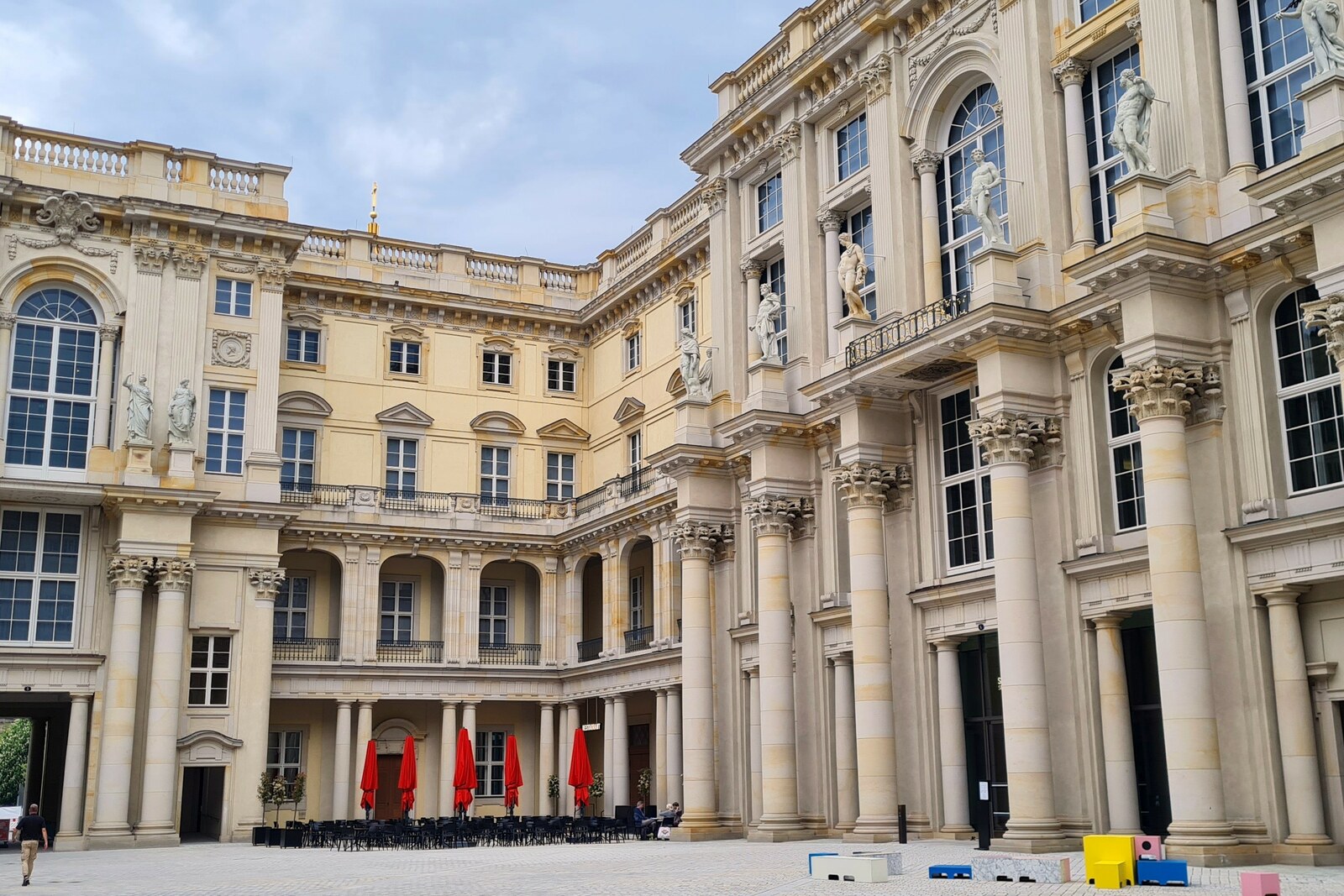
Look around first
What to notice
- Baroque façades of the Humboldt Forum
- Fourth portal of the northern façade
- Old sculptural parts of the portal in the façade across the square
The story of the place
The Baroque façades of today's Humboldt Forum repeat the appearance of the Berlin Palace, once the residence of the Prussian and German ruling dynasty. Behind them are now the exhibition halls and public spaces of the center of culture and science named after the Humboldt brothers. On the northern side, the fourth portal has been rebuilt, while the authentic sculptural parts of the old portal are incorporated into the long façade of the former State Council Building across Schlossplatz.
On November ninth, nineteen eighteen, a small truck with a red flag made its way to the Berlin Palace. Karl Liebknecht stood on its bed—a Berlin lawyer, former deputy, and leader of the revolutionary Spartacus League. He sought a republic governed by workers' and soldiers' councils. Only three weeks earlier, Liebknecht had been released under an amnesty: for anti-war agitation, he had been stripped of his parliamentary mandate and sentenced to four years and one month in prison.
Germany had already lost the First World War. A sailors' mutiny had grown into uprisings, strikes, and the formation of councils, while huge columns of demonstrators occupied central Berlin. The chancellor announced the emperor's abdication, although the emperor had not yet signed it. About two hours before Liebknecht appeared, the Social Democrat Philipp Scheidemann proclaimed the German Republic at the Reichstag. He wanted to get ahead of the supporters of a republic of councils and leave the decision on the country's future to an elected parliament.
Liebknecht was not satisfied with that outcome. His truck stopped before the Berlin Palace—the palace of the Hohenzollerns, the dynasty that had ruled Prussia and the German Empire. That is why he chose Schlossplatz: the name means the square of the palace. Liebknecht announced to those gathered that the palace was being placed under the protection of the workers' and soldiers' council, then proclaimed a free socialist republic. The palace guard opened the gates. A red flag appeared on the mast where the imperial standard had been raised.
This scene is usually placed on the balcony of the fourth portal. The exact location of the first speech remains disputed. A newspaper report printed the following day separates the two addresses: Liebknecht first proclaimed the republic from the truck, and after the gates were opened, he went up to the balcony, draped in red cloth, and repeated his demand. There is no photograph of the balcony speech.
The emperor left for exile the following morning, but Liebknecht's republic acquired no government. Berlin's councils approved a provisional Social Democratic cabinet and entrusted the country's further political arrangement to a national assembly. At the end of December, Liebknecht took part in founding the Communist Party of Germany. After the January fighting, soldiers from a volunteer unit captured him, interrogated him in a hotel, and shot him in the Tiergarten on January fifteenth, nineteen nineteen.
The old palace is not before us. The façades of the present building reproduce the Baroque palace, but behind them are the modern exhibition halls and public spaces of the Humboldt Forum, a center of culture and science. It was named after the brothers Wilhelm von Humboldt and Alexander von Humboldt, whom you already know from the university. The organizers linked Wilhelm's work on languages and education and Alexander's research on nature and cultures to a program in which museum collections are combined with research, lectures, and discussions.
On the northern side of the Humboldt Forum, the fourth portal has been rebuilt. The surviving sculptural parts of the old portal are elsewhere: they were incorporated into the long façade of the former State Council Building on the opposite side of Schlossplatz. The new palace retained a copy of the portal, while the old stone associated with Liebknecht's speech stands across the square.
Useful on site
Exhibitions: Wed–Mon 10:30–18:30, closed Tuesday; public areas are partly free, while exhibitions and the roof terrace require a ticket at the current rate.
Checked: June 28, 2026. Check the official source before visiting.First, walk around the building from outside: the main point here lies in the mismatch between its sides. Check and plan entry to the Humboldt Forum's exhibition spaces and individual programs separately from your walk.