 Guide On Map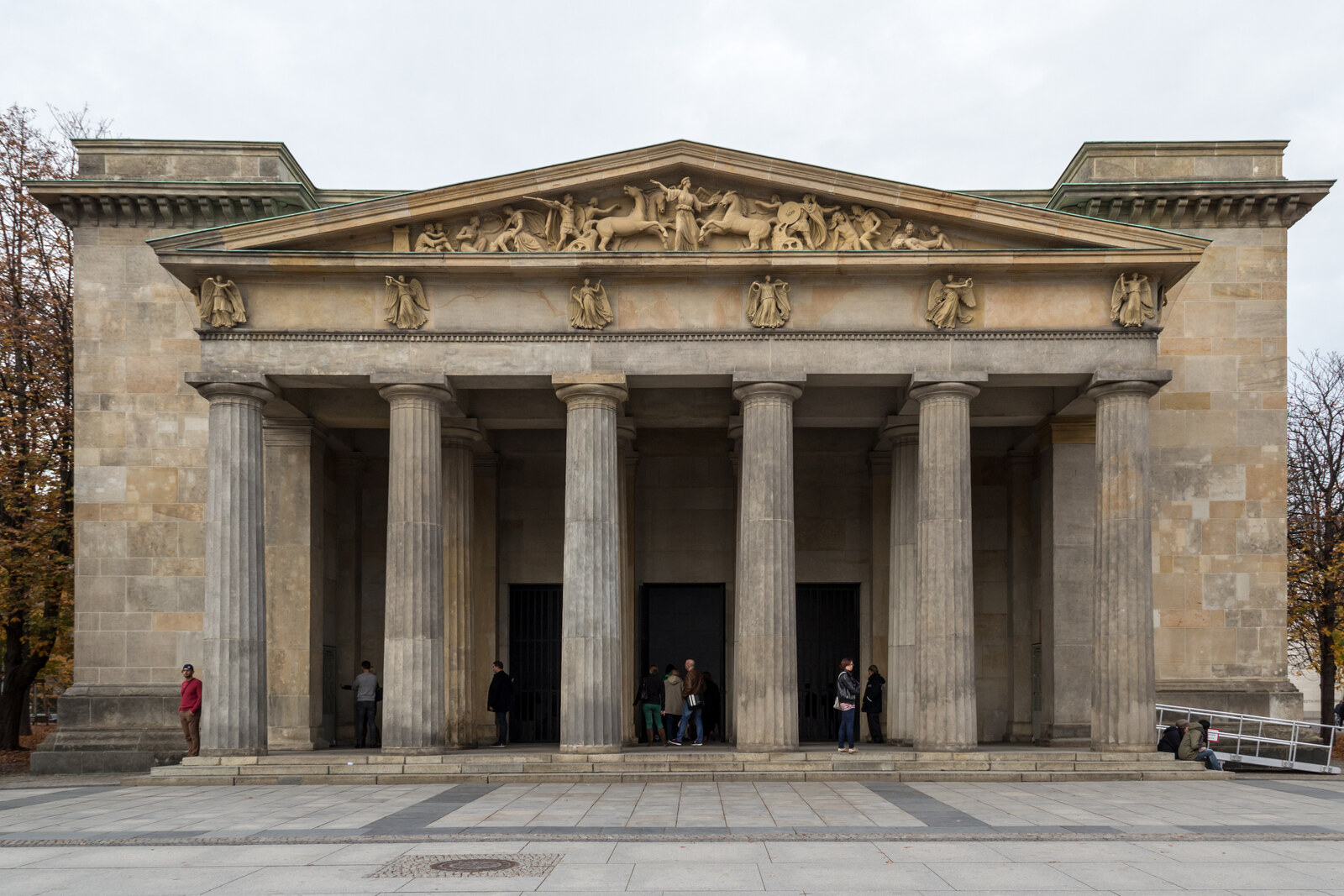
Look around first
What to notice
- Doric columns
- Circular opening in the ceiling
- Bronze figure of a mother with her son
- Floor slabs
The story of the place
Doric columns surround the entrance to the guardhouse, from which soldiers guarded the palace of the heir to the throne on the other side of the street. The word “New” in the name distinguished this post from the old artillery guardhouse among the chestnut trees. After the royal guard left, the premises became a memorial to the victims of war and tyranny. Beneath the circular opening in the ceiling, a bronze woman holds her son’s dead body on her knees.
On March sixteenth, eighteen forty-eight, a man wearing a white armband rushed beneath these columns. He served on the city guard commission—a group of unarmed officials and well-to-do townspeople tasked with keeping the crowd from clashing with the soldiers. People moved toward the portico behind him.
By then Berlin had spent several days awaiting a confrontation. Artisans and factory workers suffered from unemployment and expensive bread; the townspeople demanded freedom of the press, a constitution, and the right to bear arms themselves. News arrived from Vienna: the revolution had forced Chancellor Metternich, one of the main defenders of Europe’s old monarchies, to flee. On Unter den Linden, demands to remove the soldiers grew louder.
Prussian King Frederick William IV wanted to calm the city without arming its residents. At his order, about two thousand members of the guard commission were recruited. But workers and artisans—the very people who made up a substantial part of the crowd—were scarcely admitted. The white armband gave these people no authority, and they had no weapons.
One of them took refuge in Neue Wache. A contemporary left two versions of what happened next: either his pursuers tried to enter after him, or the officer merely thought that the guard post was about to be seized. The officer commanding the soldiers, who wanted the square cleared, ordered the drum to be beaten. This was the final warning before the shooting. The crowd did not disperse. A volley followed: two people were killed and several were wounded.
The soldiers were here precisely because the building really was a guardhouse. It was built between eighteen sixteen and eighteen eighteen for the main royal guard, which protected the palace of the heir to the throne on the opposite side of the street. It was called New in relation to the former artillery guardhouse that stood among the chestnut trees. Duty guards were stationed behind the Doric columns, and there was not yet a fence in front of the portico separating the post from passersby.
The deaths of the two people strengthened the demand to arm the townspeople. Two days later, gunshots at the royal palace triggered fighting at the barricades, in which more than two hundred fifty people were killed. The next day, the king withdrew the troops from the city and allowed an armed civic militia to be formed. The victory proved temporary: in November, soldiers returned to Berlin and disarmed the militia.
The royal guard left the building in nineteen eighteen, but the name remained. Neue Wache was restored after the destruction of the Second World War. It is now Germany’s central memorial to the victims of war and tyranny, and a bronze mother with her dead son stands in the former guardroom.
The Berlin artist Käthe Kollwitz created this figure after losing her younger son, Peter. Eighteen-year-old Peter sought permission to enlist as a volunteer in the First World War; his mother helped him change his father’s mind. In October nineteen fourteen, Peter was killed in Belgium. Kollwitz became an opponent of war and for decades afterward returned in her work to the mother who cannot protect her child.
In nineteen thirty-seven, on the anniversary of Peter’s death, she called the small sculpture a likeness of the Pietà: a mother sits holding her son’s body between her knees. The present bronze is enlarged fourfold and placed beneath a circular opening in the ceiling. Before it, beneath the floor slabs, lie the remains of an unknown soldier and an unknown prisoner of a Nazi concentration camp, surrounded by soil from the battlefields of the Second World War and from concentration camps.
Useful on site
Free admission; the memorial interior is open according to the current schedule and may close for ceremonies; please remain quiet inside.
Checked: June 28, 2026. Check the official source before visiting.If the entrance is open, enter quietly and allow your eyes to adjust to the dimness. Rain or snow may fall beneath the open opening, so watch your step and do not touch the sculpture.