 Guide On Map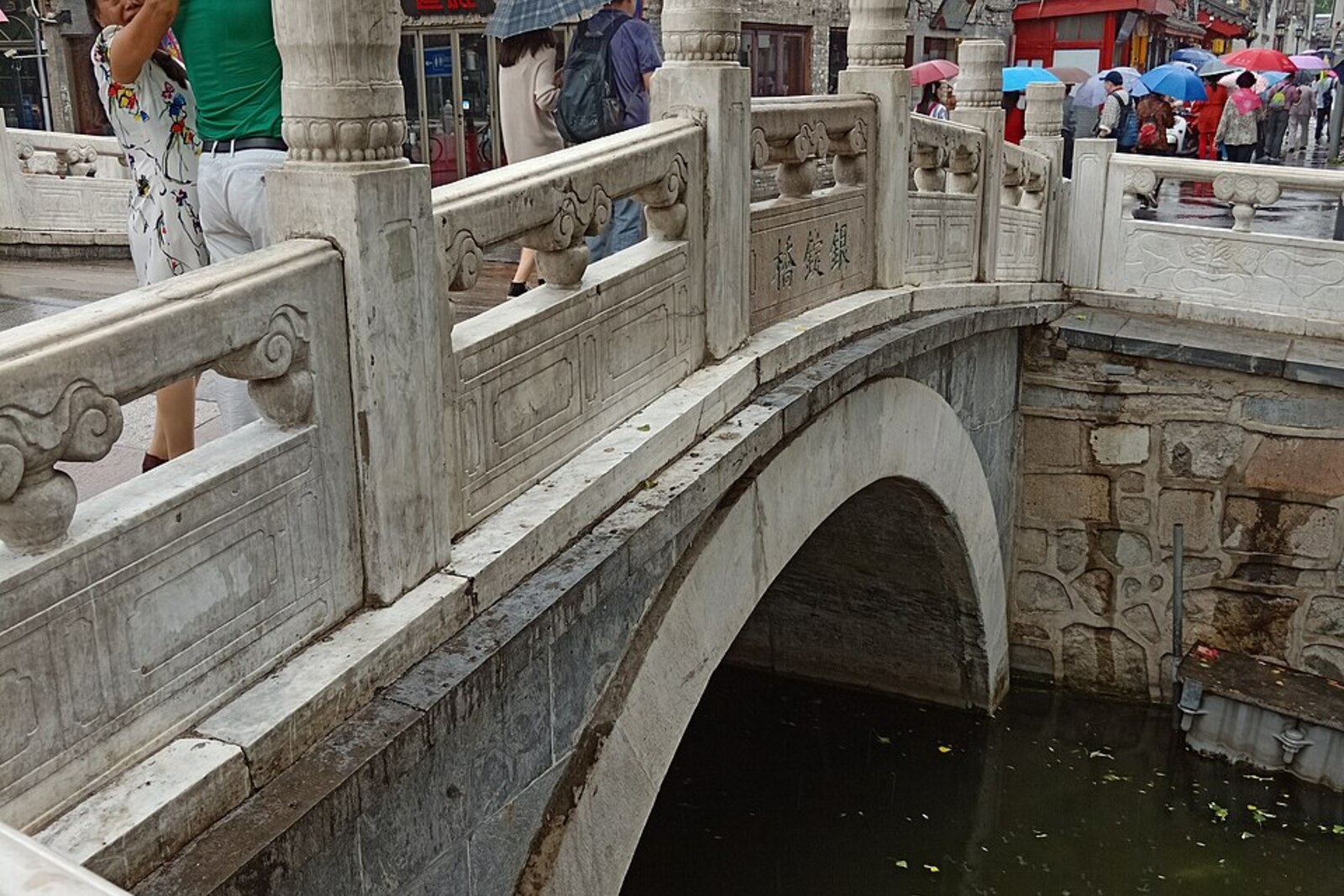
Look around first
What to notice
- The bridge’s stone cladding
- The inscribed plaque
- The narrow channel
- The sign of Kaorou Ji Restaurant
The story of the place
Yinding means “silver ingot.” The old bridge widened at the banks and narrowed above the water, resembling an inverted Chinese ingot with raised ends. It was built at the narrowest point of the channel between Qianhai and Houhai. Here, the road to the Drum Tower (Gulou), the streets by the water, and the only convenient crossing from one bank to the other converged.
In eighteen forty-eight, this flow was put to use by Ji Decai, a twenty-year-old peasant from a village near Tongzhou. He brought a one-wheeled cart to Beijing and set up a brazier with mutton at the eastern end of the bridge. He had no premises of his own: Ji earned money only during the months when the seasonal market opened at Shichahai and city dwellers came to stroll among the lotuses and look from here toward the Western Hills.
He chose the spot precisely. People had to pass across the narrow bridge, and after their walk they stopped at the cart. In addition to mutton, Ji sold cold noodles and other summer dishes. The vendor had no sign, so customers called his spot by its simplest feature: “Kaorou Ji Restaurant”—“Ji’s roasted meat.”
After Ji’s death, his son took over the cart, and then the business passed to his grandsons. The family returned to the bridge season after season, until in nineteen twenty-seven the merchant’s descendants replaced the street counter with a permanent establishment by the water. Now they could work year-round. Officially, they tried to call the restaurant “Luquanju Restaurant,” but visitors continued to say “Kaorou Ji Restaurant,” and the colloquial name became the sign.
The bridge from Ji Decai’s time no longer exists. It was dismantled and widened several times; beneath the present stone cladding is a modern structure, and after renovations in the early twenty tens, builders returned the old stones and the inscribed plaque to their place. But Kaorou Ji Restaurant still stands near the crossing. The surname of the peasant who traded here from a cart for several summer months each year has remained on the establishment at the Silver Ingot.
Useful on site
Open around the clock, passage is free.
Checked: June 28, 2026. Check the official source before visiting.The bridge serves as a passageway, so do not linger in the middle or obstruct traffic. For a distant view and to listen, it is better to step down to the shore.