 Guide On Map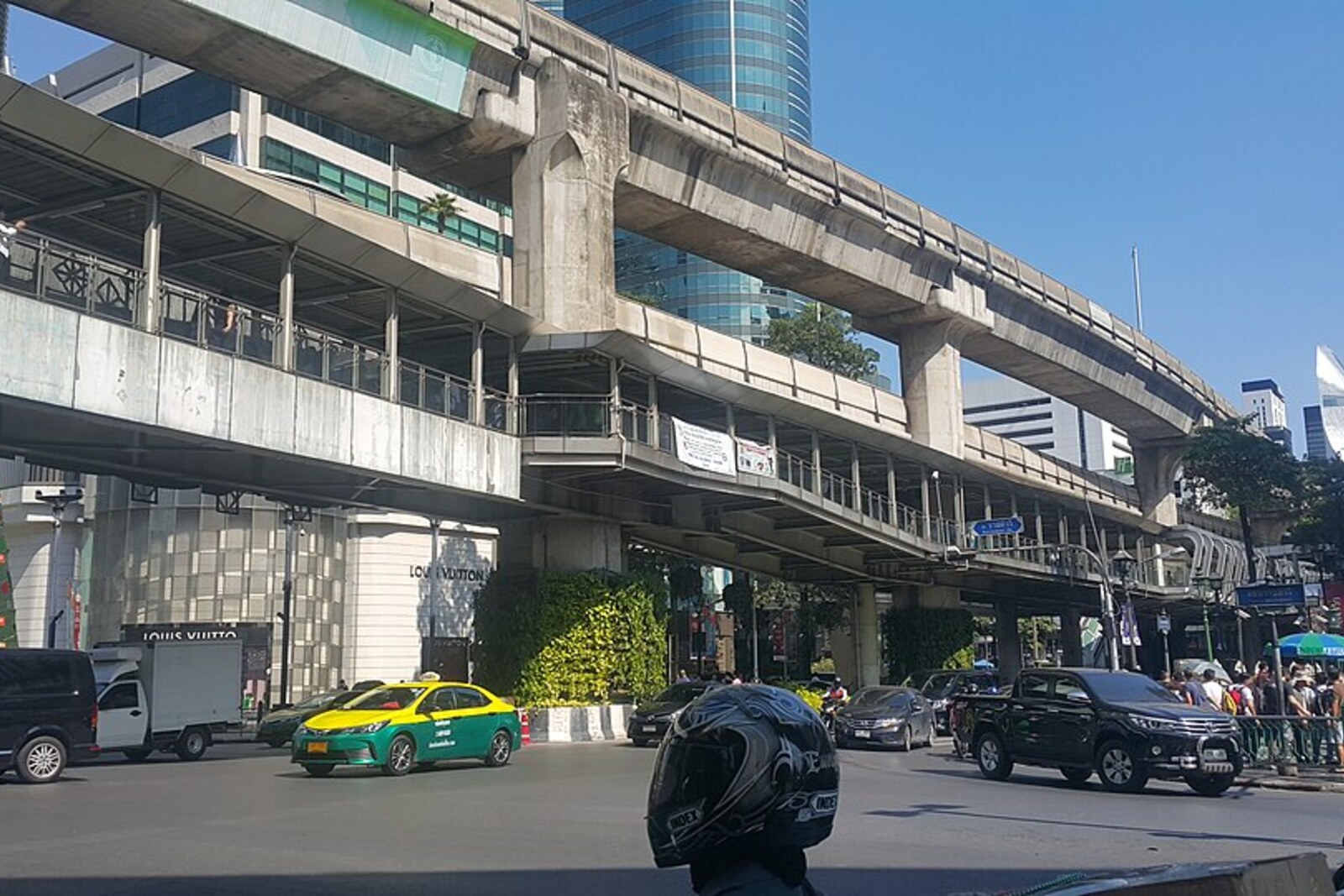
Look around first
What to notice
- Green surfacing
- Grates with narrow slots
- Leaf-shaped canopies
- Gentle approaches and lifts
The story of the place
A pedestrian platform measuring three thousand square meters unfolds above Pathumwan Intersection: routes from it lead to National Stadium BTS Station, the art center, and the district's shopping buildings. It replaced a narrow bridge with flights of stairs that could no longer handle the continuous flow between them. The green surface, metal canopies shaped like leaves, and narrow slots in the drainage grates refer to the lotus ponds that gave the district its name. Gentle approaches and lifts make it possible to pass through here without stairs.
The current broad skywalk appeared after one person could not manage its predecessor. About three years before the new platform opened, Krisana Lalai, a television host and president of the Accessible Environment Foundation, was checking how the crossing over Pathumwan was arranged. By then, he had already been using a wheelchair for twenty years. The old stairs proved too narrow.
Chadatip Chutrakul, the head of the company that managed the neighboring shopping centers, saw this attempt. By her own account, that was when she decided to replace the crossing with one that people in wheelchairs, older people, and passengers with heavy luggage could use.
What was needed here was a platform, not another staircase above the road. The old bridge linked National Stadium BTS Station with MBK Center, Siam Discovery, Siam Square, and the Bangkok Art and Culture Centre, but it could no longer accommodate the flow of people. A study by the city administration and the elevated-rail operator confirmed this in two thousand fifteen. Chadatip brought in Siam Synergy, an alliance of business owners in this district. They paid for the reconstruction, and in two thousand sixteen builders began widening the entire crossing.
It opened on August fourth, two thousand seventeen, after which the structure became city property. Gentle approaches and lifts replaced the cramped flights of stairs. Krisana specifically noted even the drainage grates: the slots were made narrow enough that the wheels of his wheelchair would not fall through them.
The platform's forms explain its address. “Pathum” means lotus, and the district's name goes back to the local lotus ponds and Wat Pathum Wanaram, the “forest of lotuses.” That is why the green surfacing, grates, and metal canopies were given leaf-like shapes. The crossing on whose stairs Krisana Lalai got stuck was replaced by a platform measuring three thousand square meters; above the intersection, only its directions remained—toward the same station, art center, and shopping buildings.
Useful on site
Public pedestrian passage; exact hours are not stated in the official release, and access may change because of maintenance, events, and connections to malls.
Checked: June 28, 2026. Check the official source before visiting.There is little protection from heat and downpours in the exposed sections; during large events, the passage may be especially crowded.