 Guide On Map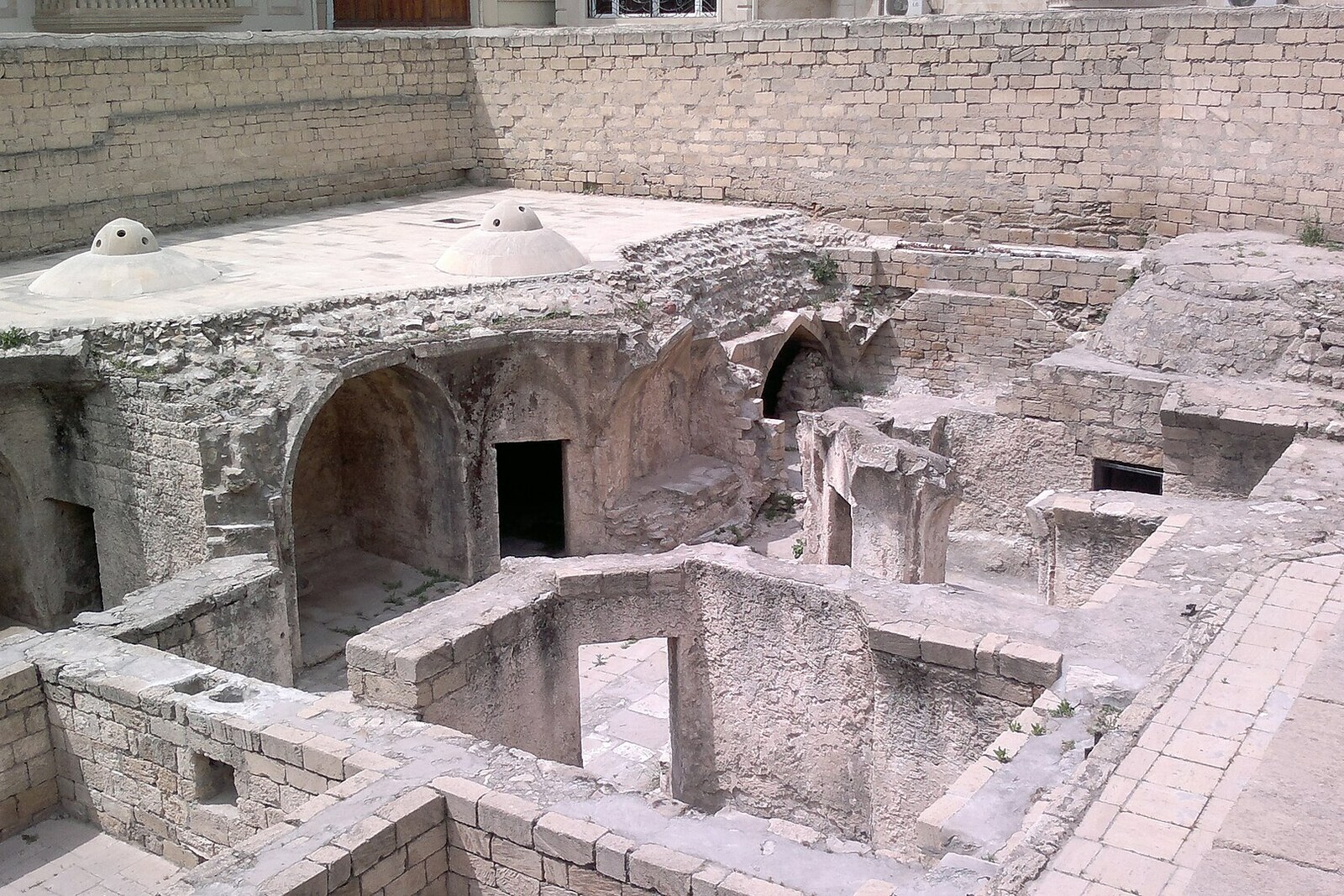
Look around first
What to notice
- Stone outlines of the bathhouse rooms
- Sunken lower walls
- Entrance to the ovdan
- Descent to the underground basin
The story of the place
Beneath the stone outlines of the lower palace terrace lay twenty-six rooms for washing and relaxation by the palace residents. The bathhouse was deliberately sunk into the ground so that the stone would not become as hot in summer and would retain heat longer in winter; the entrance and skylight domes once remained above the surface. Nearby, a staircase descends into the ovdan, while the low walls survived the collapse of the upper parts and the garden laid out above the buried ruins. The former layout vanished so completely from the surface that the bathhouse was only discovered by chance during archaeological work.
When the Shirvanshah Khalilullah I left to fight Iskandar, the ruler of the neighboring state of Kara Koyunlu, he left Baku in the care of his brother Gazanfar. Iskandar sacked Shamakhi, then the capital of Shirvan, twice. The Baku fortress was becoming the dynasty's alternative residence, and Gazanfar had to prepare the city for court life in case there would be nowhere to return to in Shamakhi.
He began with water. In fourteen twenty-eight, on his orders, a kahriz was brought to Baku—a subterranean gallery through which water came from afar without pumps. Almost ten years later, an ovdan, a deep water reservoir, was built beside the palace. Seventy steps carved into the rock led down to its basin.
The same Gazanfar commissioned the bathhouse around fourteen thirty-eight. This was reported by Badr Shirvani, a court poet who recorded the deeds of members of the ruling family. He called Gazanfar's building a “beautiful and pleasant bathhouse”; historians believe he meant these very ruins. The site was chosen on the lowest terrace of the palace, beside the ovdan, the deep water reservoir. From there, water entered the furnace room and then ran through ceramic pipes to the cold- and hot-water pools. The bathhouse was sunk into the ground so that its walls would heat up less in summer and cool more slowly in winter. Above the surface rose the entrance and domes with openings for light and ventilation.
In twenty-six rooms, the shah's family changed clothes, washed, and took steam baths. There were separate private rooms—the khalveti. Water was heated with hardened white petroleum: its pieces burned in the firebox, and hot air passed through channels beneath the floor. Long before industrial wells, Baku petroleum was already heating the palace bathhouse.
Gazanfar died in fourteen forty-three, at the age of forty-five. Khalilullah continued to rule for more than twenty years, and the system built by his brother served the palace after both of them. The traveler Lerche, who visited here in seventeen thirty-three, still found the bathhouse richly decorated inside and out.
Later, the domes and upper parts of the walls collapsed. People covered the remains with earth and laid out a garden above them, so that nothing of the twenty-six rooms remained above ground. In nineteen thirty-nine, archaeologists accidentally discovered the bathhouse, then cleared the lower courses of the walls and conserved them. The present stone outlines are the level along which water from the ovdan was distributed to the firebox, the pipes, and the shah's bathing rooms.
Useful on site
As part of the Palace of the Shirvanshahs, daily 10:00–19:00.
Checked: date not specified. Check the official source before visiting.Stone may be slippery in the lower sections, and the descent may be narrow and cool. If access to the ovdan is restricted, judge its scale by the entrance and the museum plan.