 Guide On Map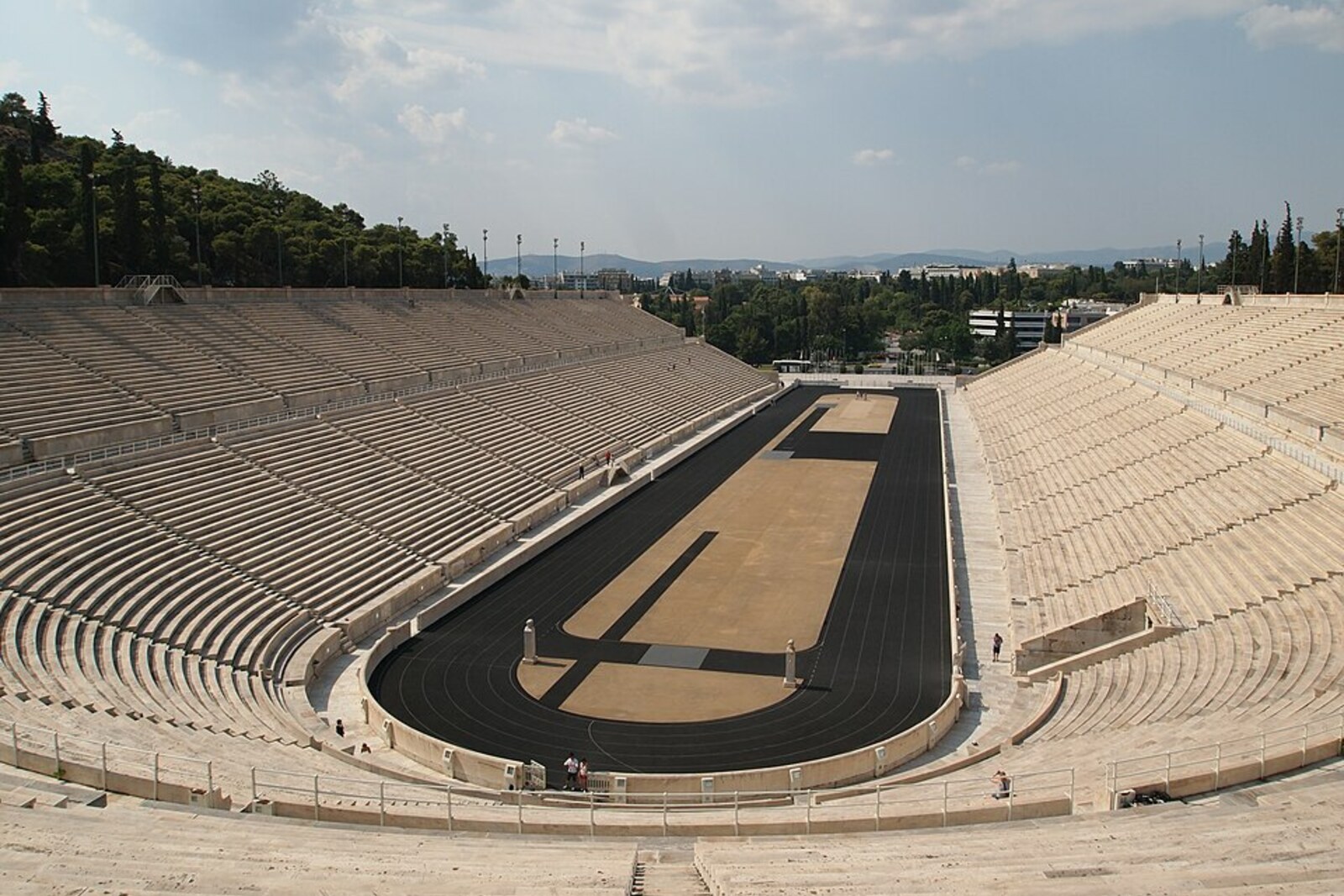
Look around first
What to notice
- White marble stands
- Horseshoe-shaped running track
- Statue of Georgios Averof
- Finish line
The story of the place
White marble rows surround the horseshoe-shaped track and rise along the slopes of the hollow between the hills. The present appearance was restored by consulting the ancient layout revealed by excavations; the restoration was paid for by the businessman Georgios Averof, whose statue stands at the entrance. The track still receives runners finishing the classic route from Marathon.
The white marble horseshoe bears the name of an ancient Athenian festival. The Panathenaea were held in honor of Athena for residents of the entire city; around three hundred thirty BCE, the Athenian politician Lycurgus established a stadium for competitions in the hollow between two hills. Four and a half centuries later, the wealthy Athenian Herodes Atticus paid for the marble stands. Then the competitions ceased, the structures were dismantled, and by the nineteenth century, all that remained here was a hollow with buried foundations.
The stadium was needed again when Athens was assigned the first modern international Olympic Games. The businessman Georgios Averof agreed to pay for its restoration, and the architect Anastasios Metaxas reproduced the ancient plan revealed by excavations. Averof's statue at the entrance shows to whom the white rows owe their appearance. Athenians also call the stadium Kalimarmaro—“beautiful marble.”
One of the new Olympic events had no ancient model. Ancient athletes did not hold marathon races. The French philologist Michel Bréal recalled the legend of a messenger who brought to Athens the news of victory over the Persians at Marathon, and proposed a race from there to the city. Bréal ordered a silver cup for the winner.
Among the Greek participants was Spyridon Louis from the village of Marousi. Together with his father, he delivered mineral water around Athens and earned his living with his legs long before he came to the starting line. His former army commander, Georgios Papadiamantopoulos, remembered how easily the soldier endured long marches and persuaded him to take part. Louis finished the qualifying race only fifth. He was not a professional athlete and was not considered a favorite.
In April eighteen ninety-six, seventeen men set off from Marathon. The Frenchman Albin Lermusiaux and the Australian Edwin Flack, who had already won two shorter distances in Athens, held the lead for a long time. Neither endured the course. Flack dropped out about three kilometers before the finish, and Papadiamantopoulos rode to the stadium to report that Louis was approaching in first place.
By then, the Greek participants had lost almost all the track-and-field events to foreigners. So the cry of “Hellene! Hellene!” meant very specific news to the spectators: a Greek was in the lead. When Louis appeared in the passage, Crown Prince Constantine and Prince George ran out to meet him and accompanied him to the finish. The water seller crossed the line in two hours, fifty-eight minutes, and fifty seconds. The second runner arrived here more than seven minutes later.
Louis received Bréal's cup, an Olympic prize, and many promised gifts. His portraits were sold in Athenian shops, merchants named goods after him, and the victory remained Greece's only first place in athletics at those Games. Louis himself, however, returned to Marousi, resumed his usual work, and never competed again.
Even today, the finish of the marathon along the classic route from Marathon to Athens is placed on the track of the Panathenaic Stadium. Runners enter the same marble horseshoe where the two princes once met the water carrier from Marousi at the passage.
Useful on site
March-October 08:00-19:00; November-February 08:00-17:00; check for weather/event-related changes.
Checked: June 28, 2026. Check the official source before visiting.The interior is visited separately; the marble heats up and reflects the sun, and climbing the rows requires caution and comfortable shoes.