 Guide On Map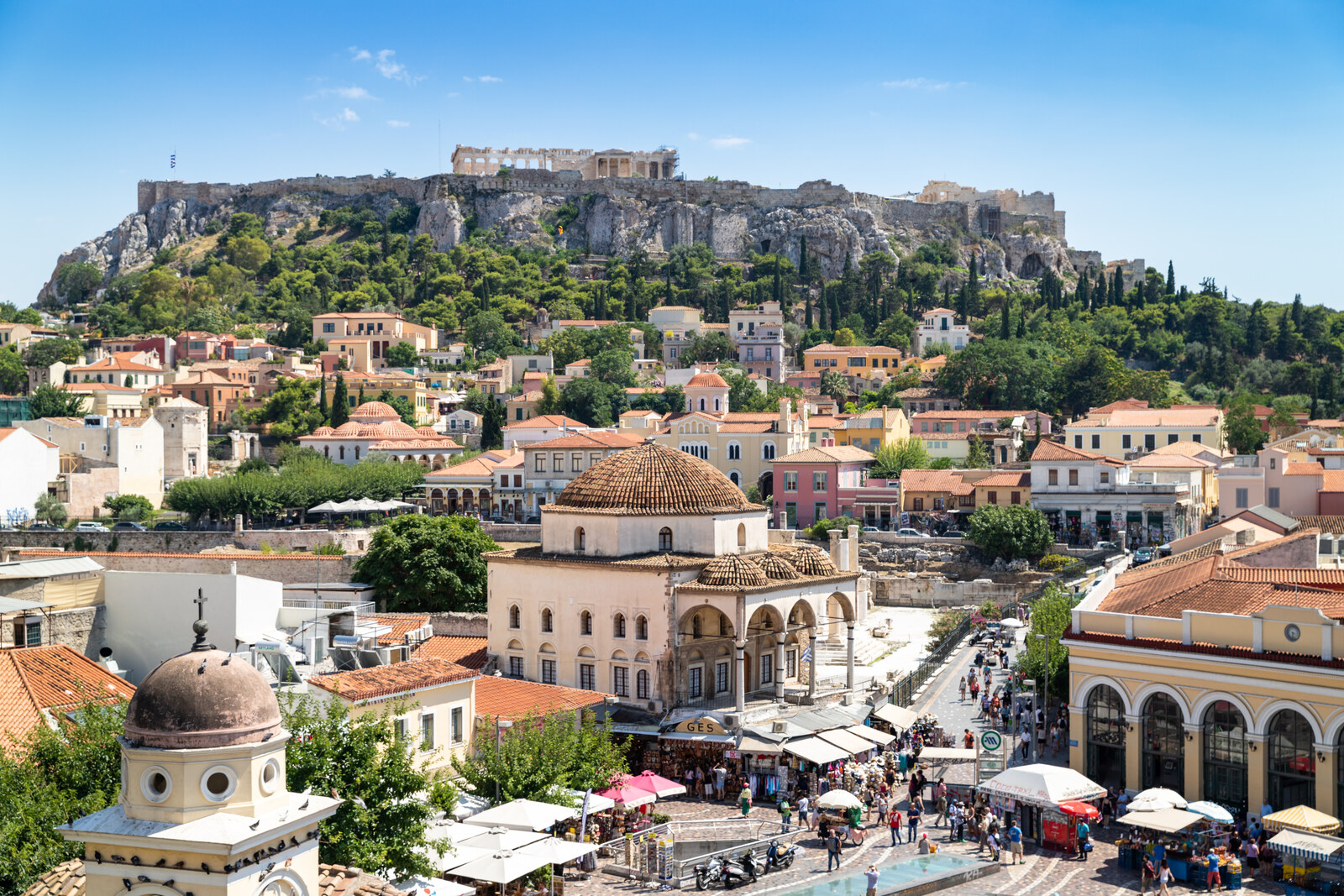
Look around first
What to notice
- The neoclassical facade of the station building
- The Church of the Pantanassa below square level
- Tzistarakis Mosque
- The open railway cutting
The story of the place
The square's name grew from the small Church of the Pantanassa, which stands slightly below street level. It was once the main church of a women's monastery known as the Great Monastery; gradually, only one church remained of the whole monastery. The diminutive name first attached itself to the neighborhood, then to the square and the station. Nearby, the neoclassical facade of the old station building survives, and first-line trains still run in the open cutting beneath the square.
On the square, people meet, change trains, and immediately head off in different directions: toward the Acropolis of Athens, the market, Ermou Street, or Psyrri. The railway station set this pattern. Before it appeared, trade already filled the blocks around Tzistarakis Mosque and Hadrian's Library, but the flow of people still had to be brought here.
From eighteen sixty-nine, the train from Piraeus carried passengers only as far as Thissio. Beyond it lay the center of Athens, but the locomotive struggled with the incline. The entrepreneur Stefanos Psychas headed a specially created company: he wanted to extend the railway through Monastiraki to Omonia Square. If the old Athens–Piraeus Railway Company did not accept the completed line, Psychas's company would be left with an expensive cutting, a tunnel, and two useless stations.
Engineers began work in eighteen eighty-nine. Beside the Ancient Agora of Athens, they dug a deep cutting, then drove a tunnel beneath the city. Private plots were bought up for Monastiraki Station; the owners, understanding that the builders had nowhere to retreat, demanded large compensation payments. The original cost of the whole undertaking reached three million drachmas.
By eighteen ninety-three, the tracks were ready, and Psychas's company demanded that service begin. Inspectors from the old railway company refused: the distance between the tracks in the tunnel proved insufficient for their carriages, and in their view, Monastiraki and Omonia stations did not comply with the contract. The builders went to court. The Athens Court of Appeal ordered the line to be accepted and imposed a fine for every day of delay. The railway company succeeded in having the decision overturned, and the dispute was sent to another court. To avoid leaving the invested money underground, the parties made a new agreement: the builders would correct the defects, and the operator would run the trains.
On May seventeenth, eighteen ninety-five, the first train passed through Monastiraki. One locomotive pulled the carriages, while a second pushed them from behind. Athenians standing above the cutting saw the passengers off with jokes about a journey to the next world: an underground railway was an entirely new experience for the city. The train safely reached Omonia, and the old bazaar gained a steady flow of passengers from the port and the center. In nineteen oh four, the line was electrified, and in two thousand three, an interchange with the third metro line was built here.
The first station was called “Monastirion.” Its name came from the Church of the Pantanassa, standing in the middle of the square below the present street level. In the seventeenth century, it was the main church of a women's monastery called the Great Monastery. The monastery gradually shrank to a single church, and Athenians began to say “Monastiraki”—“little monastery.” The diminutive name passed to the neighborhood, the square, and the station.
The neoclassical station building of eighteen ninety-five survives. Beneath its present signs, first-line trains still pass through the corridor that the two railway companies agreed to accept after a years-long dispute.
Useful on site
The square is open around the clock; shops follow their own schedules, and the true flea market is especially lively on Sundays. Tzistarakis Mosque/MNEP: daily except Tuesday 09:30–16:30, last entry 16:10.
Checked: June 28, 2026. Check the official source before visiting.The square is crowded and noisy: choose a spot at the edge of the flow, keep an eye on your belongings, and view religious buildings without disturbing visitors.