 Guide On Map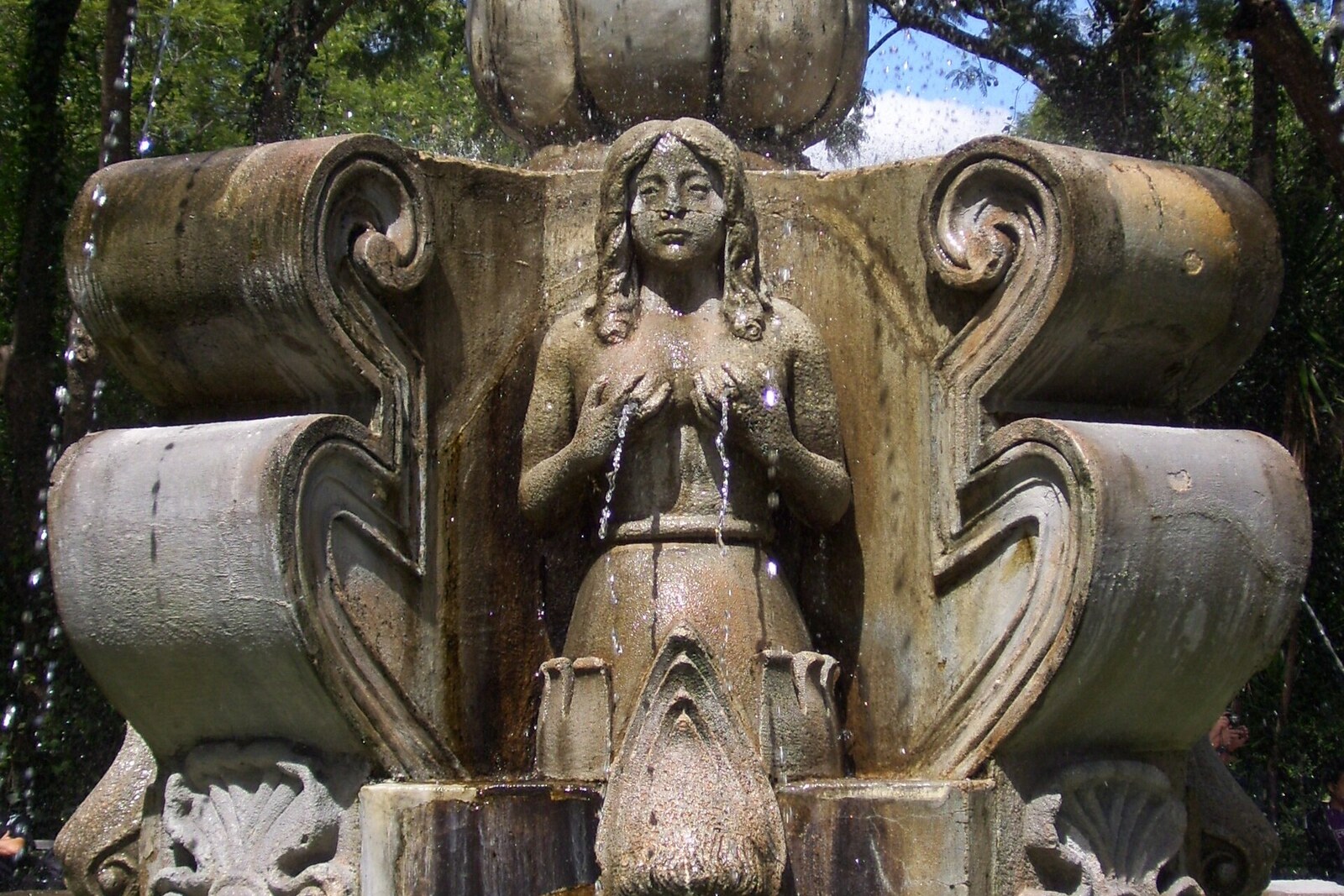
Look around first
What to notice
- Four siren figures
- Central column
- Stone basins
The story of the place
In nineteen oh two, General Enrique Heusler, the political chief of the department of Sacatepéquez, decided to turn the old Main Square—today's Central Park—into a place for strolling and concerts. To make room for a bandstand, he ordered the top of the fountain at the center of the square dismantled. The four stone sirens were knocked beheaded, the basins were removed, and a music pavilion was built on the surviving base. A military band played there on Thursdays and Sundays.
Heusler was altering a structure the townspeople had previously used in a very different way. After the former capital was destroyed by a mudflow in fifteen forty-one, the new city grid was laid out around this rectangle. Trade took place here on weekdays. The city council, the residence of the captain-general, the cathedral, and the merchants' arcades faced the square. Water was needed at the center: residents drew it, horses and pack animals were given water from it, and peasants used those animals to bring in goods.
In seventeen thirty-eight, the city council found the old basin at the southwest corner to be worn out. The councilmen ordered the water source moved to the exact center of the square and entrusted the work to Diego de Porres, the city's chief architect, who earned his living through municipal commissions. Porres used an engraving of the Neptune Fountain in Bologna and placed four sirens around the central column. They held their breasts with their hands, and water flowed from them. That is how the fountain got its name: the sirens represented water here and also served as drains.
On December nineteenth, seventeen thirty-nine, the council resolved to pay Porres one hundred pesos for “extraordinary work” and formally thanked him for carrying out the commission. After the capital was moved, the residents who remained in Antigua continued to hold a market around the fountain. Covered market stalls appeared nearby later. The open market square came to be called Central Park only in the twentieth century, when it was planted with trees and fitted with benches.
Heusler's pavilion stood for about three decades. In nineteen thirty-one, historians from the Society of Geography and History proposed restoring the fountain: the removed basins and damaged figures were still preserved. The official Carlos Cipriani ordered the restoration carried out, and the sculptor Óscar González Goyri remade the sirens in worked cement. The fountain was unveiled in November nineteen thirty-six; thirteen years later, Rodolfo Galeotti Torres restored the figures to their present appearance.
Today, residents and visitors meet by the fountain, while shoe shiners and street vendors work in the square. Water flows from the breasts of four sirens from the middle of the twentieth century. One of the figures carved for Diego de Porres no longer stands here: it was moved to the Museo de Santiago.
Useful on site
The public square is accessible at all times; events may temporarily occupy part of the space.
Checked: date not specified. Check the official source before visiting.Walk all the way around the fountain and compare the sides of the square; the details are easier to make out from the center, without lingering in the passageway.