 Guide On Map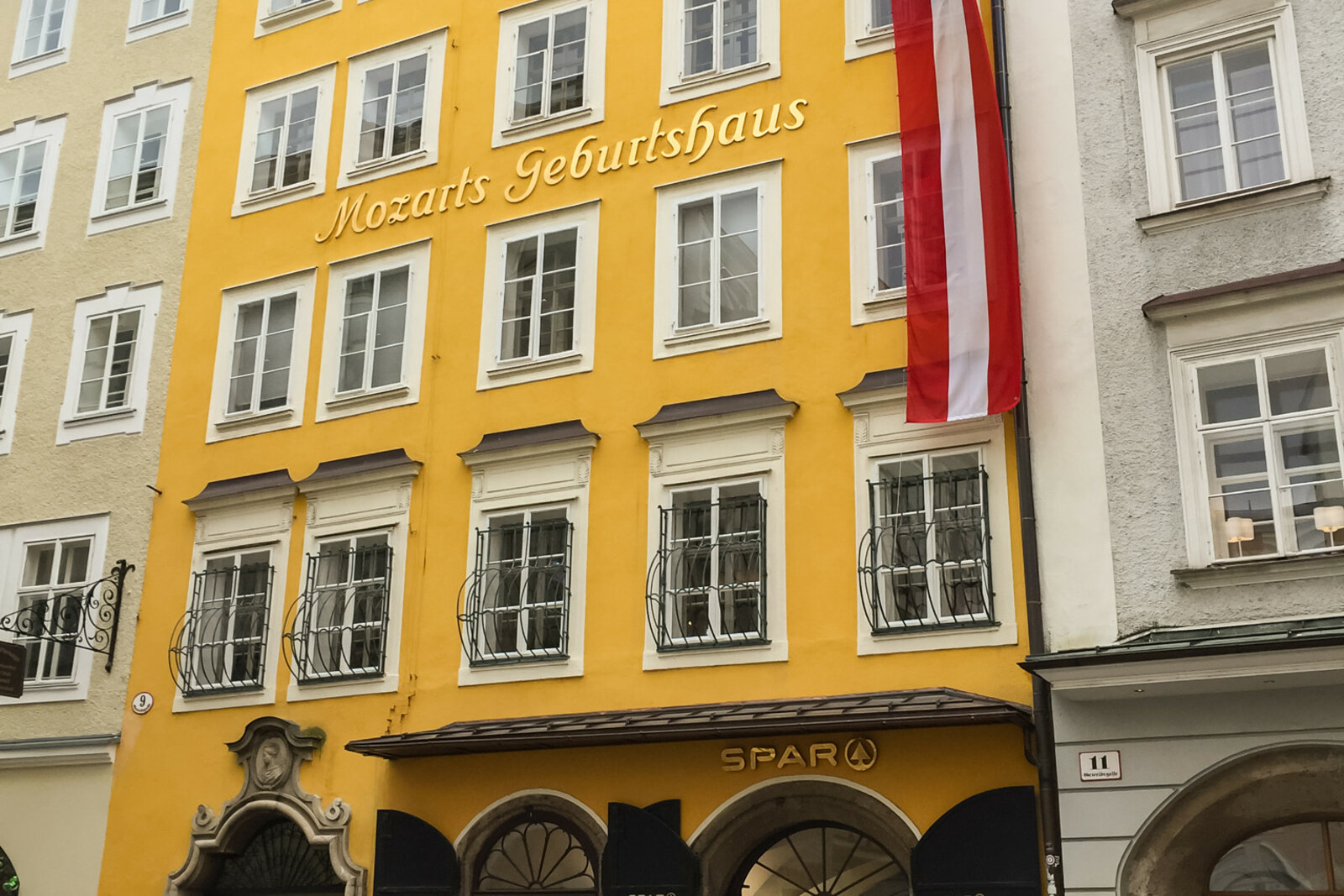
Look around first
What to notice
- The facade of Mozart's Birthplace
- The third-floor windows
- The museum sign
The story of the place
Behind the museum sign and the third-floor windows begins the former rented apartment of about one hundred thirty square meters. It had room for a living room, bedroom, workroom, small study, and kitchen; the landlord was a trading house. The large family lived here until moving to spacious eight-room accommodation on another square. Later rebuilding replaced the floors and stoves, but the apartment's outline survived, and since eighteen eighty these rooms have served as a museum.
In the apartment on the third floor, Leopold Mozart first taught not his son, but his eight-year-old daughter Maria Anna “Nannerl” Mozart, as she was called in the family. Leopold earned his living as a violinist and teacher in the court chapel of the prince-archbishop. In seventeen fifty-nine, he started a music notebook for his daughter: he wrote short pieces in it and based lessons on them.
Three-year-old Wolfgang Mozart watched his sister's lessons and soon began working through the same pieces. Leopold recorded his progress with almost bookkeeping precision. On the evening before his fifth birthday, the boy learned a minuet with a trio in half an hour. A few months later, he was already composing on his own. He did not yet know how to write down music, so his father put his son's first pieces onto paper.
All this took place in a rented apartment belonging to the trading house of Johann Lorenz Hagenauer. The floor contained a living room, a bedroom, a workroom, a small study, and a kitchen. Leopold and Anna Maria Mozart moved in here after their wedding in seventeen forty-seven. All seven of their children were born here; five died in infancy. Wolfgang was the seventh and last child. Anna Maria gave birth to him on January twenty-seventh, seventeen fifty-six—hence the house's present name.
By the end of seventeen sixty-one, Leopold decided that Nannerl and Wolfgang were ready to perform before the public. He first took them to Munich and Vienna. The children were so successful at court that their father received extended leave from his post and, in the summer of seventeen sixty-three, set off with the family on a grand European tour.
It was a bet on both children's careers. The income depended on invitations and concert takings, while the family of a court musician had to travel with a carriage, luggage, and suitable clothing. In the first ten weeks, expenses exceeded one thousand gulden and almost consumed what they had earned. Leopold continued the journey. He arranged performances, taught the children, published Wolfgang's first sonatas in Paris, and distributed an engraved family portrait. By the time they returned, Nannerl was known as an outstanding harpsichordist, and ten-year-old Wolfgang as a performer and composer of his own music.
Success unexpectedly revealed the apartment's shortcoming on Getreidegasse. In December seventeen sixty-five, Leopold wrote from The Hague to the house's owner, Hagenauer. He asked where his daughter would sleep after their return, where Wolfgang would live, and whether a separate place for his son's study and work could be found. He then proposed a solution: could another couple of rooms be added?
They could not be added. After three and a half years on the road, the Mozarts returned to the same apartment and for several more years divided the bedroom, lessons, and music composition among its rooms. In the autumn of seventeen seventy-three, the family moved to spacious eight-room accommodation on what was then Hannibalplatz, now Makartplatz.
Since eighteen eighty, a museum has operated in the Mozarts' former apartment. Its core is those same one hundred thirty square meters on the third floor. The floors and stoves are later additions: the rooms were rebuilt after the family left. What has survived is the volume of the apartment where Leopold wrote down the first compositions of his five-year-old son, and then asked the owner to enlarge the house for the work of a musician already known beyond Salzburg.
Useful on site
Usually daily 9:00–17:30; in July and August 8:30–19:00; last entry 30 minutes before closing; closed 13–14 October according to the current museum calendar.
Checked: June 29, 2026. Check the official source before visiting.The apartment can be seen only with a museum visit; from the street, focus on the house as a commercial and residential building.