 Guide On Map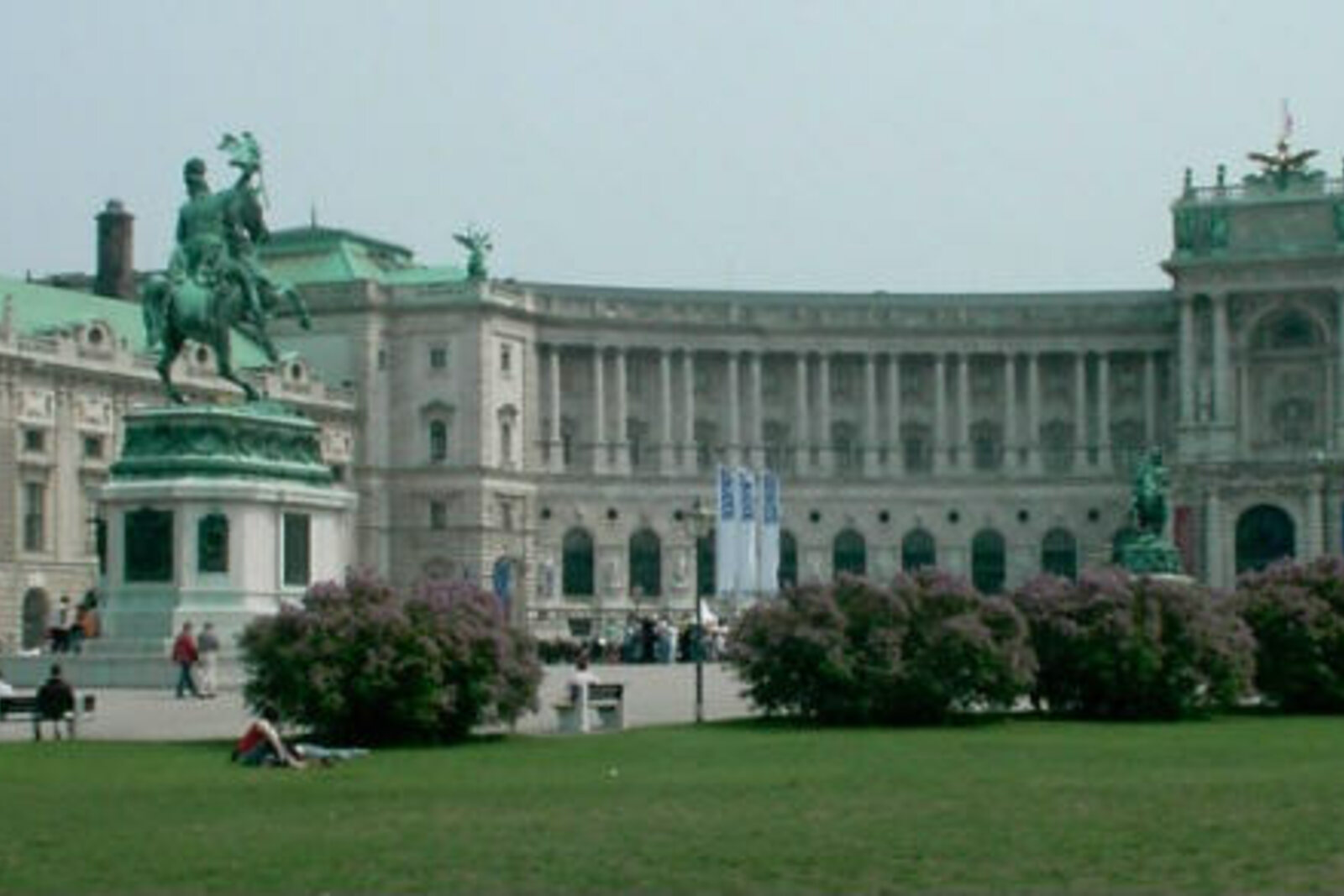
Look around first
What to notice
- Neue Burg terrace
- Equestrian statue of Archduke Charles
- Equestrian statue of Prince Eugene
- Open lawn
The story of the place
Heldenplatz literally means “Heroes’ Square.” The name came from two bronze equestrian statues. The first was installed in eighteen sixty: Archduke Charles, who commanded the Austrian army against Napoleon, is rearing his horse. He was honored for his victory at Aspern—the first major defeat Napoleon suffered on the battlefield. Five years later, Prince Eugene of Savoy, a commander in the service of the House of Habsburg who defeated Ottoman armies in several campaigns, was placed opposite him. In eighteen seventy-eight, the name Heldenplatz was officially established. The heroes here are precisely these two commanders.
The open field in front of the Hofburg was left by the French occupation forces: in eighteen oh nine, they blew up the bastion that stood here. Vienna authorities cleared the ruins, leveled the ground, and set it aside for parades and gatherings. Later, the court planned to surround the square with imperial wings, but only one curved wing was completed—Neue Burg, the new part of the palace. The broad terrace above its main entrance was intended for honored guests at mass ceremonies, and later became a platform for speakers.
It was there that Adolf Hitler, head of Nazi Germany and an advocate of Austria’s annexation, appeared on the morning of March fifteenth, nineteen thirty-eight. By that morning, everything essential had already happened. On March eleventh, a German ultimatum forced Austrian Chancellor Kurt Schuschnigg, who had been trying to hold a vote on the country’s independence, to cancel it and resign. Schuschnigg was placed under house arrest. On March twelfth, German troops crossed the border. On March thirteenth, the Austrian Nazi Arthur Seyss-Inquart, an advocate of annexation who had been appointed chancellor under pressure, signed the relevant law. On March fifteenth, the public at Heldenplatz were presented with an already completed takeover.
More than two hundred thousand jubilant supporters gathered in the square. Hitler announced the incorporation of his homeland into the German Reich and linked it to the tradition of the former empire, whose capital had been Vienna. The site offered a ready-made set of scenery for such a speech: the Habsburg palace, the parade field, victorious equestrian statues, and the terrace above the main entrance. Cameras filming the square placed the speaker above the crowd and turned those gathered into evidence that all of Austria had supposedly welcomed the annexation voluntarily.
These images spread through newsreels and newspapers. The next act was a vote scheduled for April tenth and held under Nazi control: Jews, Roma, and the regime’s political opponents were not allowed to take part, and hundreds of thousands of people were deprived of the right to vote altogether. By the time of the speech at Heldenplatz, pogroms, the humiliation of Jews, and the arrests of opponents had already begun. In the first six weeks, the Nazis arrested more than seventy thousand people; on April first, prisoners were sent from Vienna to Dachau concentration camp.
The stone terrace above the entrance to Neue Burg has survived. Structurally, it is a broad platform on the roof of the portico, but it acquired the name “Hitler Balcony.” The lawn still lies beneath it, and in front of the façade stand Charles and Eugene—the very bronze commanders from whom Heldenplatz received its official name.
Useful on site
An open square in front of Neue Burg; events, security, demonstrations, and museum hours around its perimeter may change access and the atmosphere.
Checked: June 28, 2026. Check the official source before visiting.For this stop, choose a place away from the main pedestrian flows and events. The square can be viewed freely from outside, but temporary events and security measures may change the usual routes.