 Guide On Map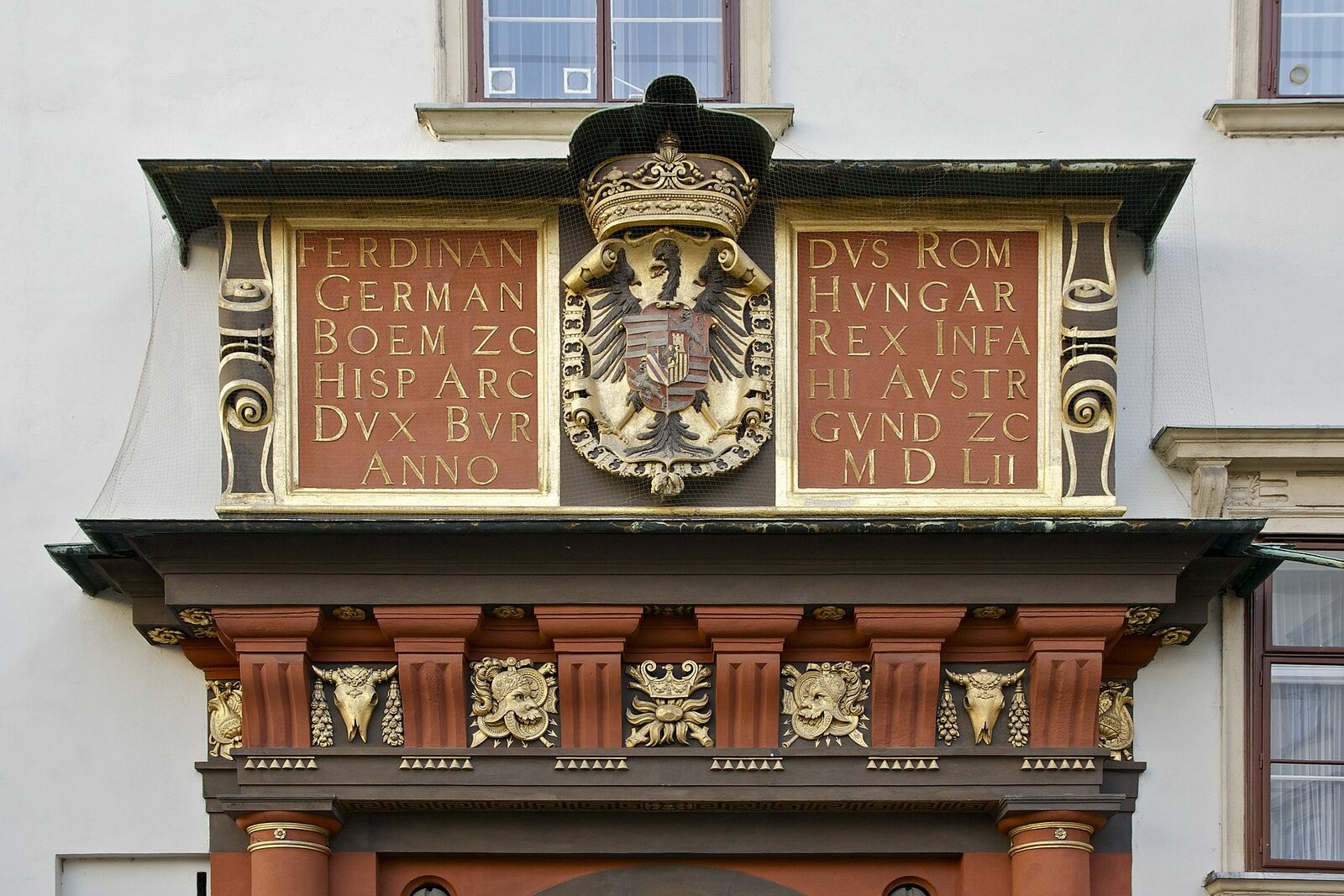
Look around first
What to notice
- Red-and-black gate
- Coats of arms above the passage
- Stone rollers on either side of the passage
- The rectangular courtyard of the Schweizerhof
The story of the place
The red-and-black passage with coats of arms leads into the Schweizerhof courtyard, which has preserved the rectangular plan of the old Hofburg fortress. The northwestern wall of the castle once stood on this side, and later the ceremonial entrance with a drawbridge was made in it. The stone rollers on either side of the passage still show where its chains worked. The gate's name recalls the Swiss company that stood guard at the Hofburg and took part in palace ceremonies.
In October fourteen sixty-two, Vienna's mayor Wolfgang Holzer led armed townspeople to the walls of what is now the Schweizerhof. Holzer had grown rich through the cattle trade and was now seeking to free Vienna from obedience to Emperor Frederick III. He supported the emperor's younger brother, Albert VI, who demanded control over all of Austria.
The brothers had already been at war with each other for a year. Their mercenaries ravaged the country, the debasement of silver coinage drove up prices, and Vienna lacked food. Holzer took advantage of the discontent, secured the office of mayor, began personally collecting the taxes owed to the sovereign, and ordered the arrest of two imperial advisers. Frederick was offered free passage out of the city. He intended to hold Vienna and refused.
At that time, the Hofburg fit almost entirely around this courtyard. Three residential wings and a defensive wall formed a quadrangular fortress with towers at the corners. The red-and-black gate did not yet exist: the wall of the old castle ran along this side. For several weeks, Holzer and his supporters held Frederick, his wife, his three-year-old son, and the courtiers inside. They fired cannons at the northern tower and dug a tunnel beneath its foundations; in November, cannonballs brought down one corner.
Frederick's ally, the Czech king George of Poděbrady, sent troops to lift the siege. Through his mediation, the brothers reached an agreement: Frederick ceded control of Lower Austria to Albert for eight years, and Albert promised to pay him four thousand ducats each year. The emperor left for Wiener Neustadt, Albert received Vienna, and Holzer achieved a change of ruler.
Along with the imperial court, its commissioners, buyers, and money left the city. The Viennese quickly felt the cost of their victory. As early as spring, Holzer secretly made contact with Frederick and tried to overthrow Albert. The plot was uncovered; the mayor was seized and quartered in Am Hof square. In December of the same year, Albert suddenly died without leaving an heir, and the estates of Lower Austria recognized Frederick once again. The emperor ordered the townspeople to pay for repairs to the damaged fortress. The broken corner of the tower was restored in fourteen sixty-four.
Later, the corner towers were dismantled. Of the fortress, only the rectangular outline of the Schweizerhof remained, and in the former northwestern wall, in fifteen fifty-two, the present ceremonial entrance with a drawbridge was made by order of Ferdinand I. The stone rollers over which its chains ran have survived on either side of the passage.
The gate was called Swiss only two centuries later. Maria Theresa's husband, Emperor Francis Stephen, could not command the royal and archducal guards that belonged to her, so he brought his own company of Swiss guards to Vienna. In seventeen forty-five, they accompanied him to his coronation, then stood guard at the entrances to the Hofburg and took part in palace ceremonies. After Francis's death, their son Joseph II decided to do without a separate company and disbanded it in seventeen sixty-seven. Some of the guards returned to Switzerland, while others were assigned to imperial residences. Their guard disappeared, but the courtyard and the gate have been called Swiss ever since.
Useful on site
The Gate and courtyard setting can be viewed from outside; Hofburg passageways, ceremonies, security, and museum entrances may affect the most convenient route.
Checked: June 28, 2026. Check the official source before visiting.The passage is narrow, so do not linger beneath the gate if you are obstructing traffic. The Imperial Treasury Vienna, the chapel, and choir performances have their own visiting conditions and are not part of the required outdoor section.