 Guide On Map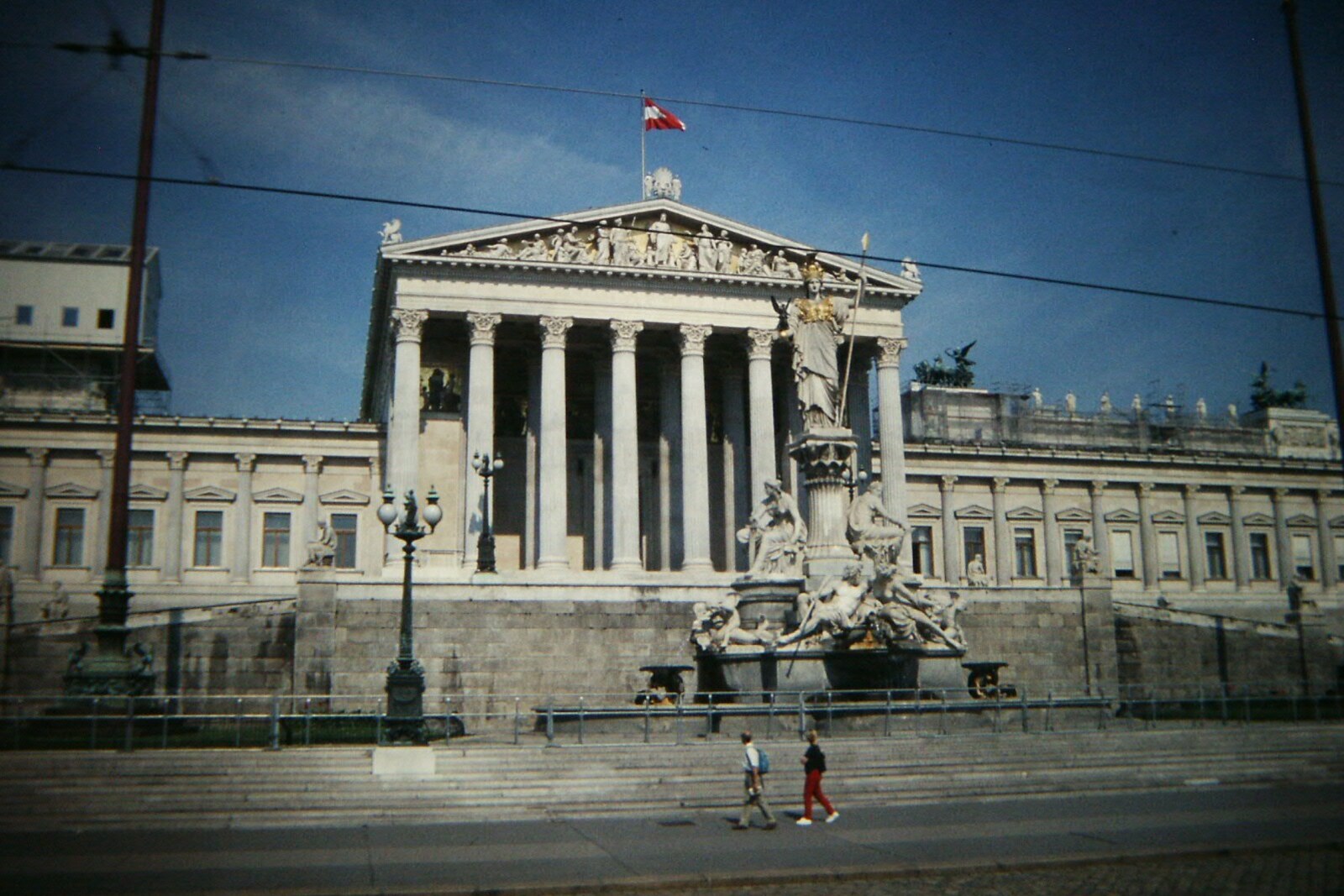
Look around first
What to notice
- Columns
- Greek facade
- Main portico
The story of the place
Behind the main portico with Greek columns, the National Council, the elected chamber of the Austrian Parliament, meets today. During the fighting for Vienna, the former chamber of the House of Lords burned out and was destroyed by artillery. The present chamber was rebuilt on the same site and opened in nineteen fifty-six. The Greek facade of the former building has survived outside.
Behind the columns, Theophil Hansen arranged two chambers for the houses of the Reichsrat—the parliament of the Austrian part of the Habsburg Monarchy. After its breakup, the elected National Council occupied the former chamber of the House of Lords. It was there, on March fourth, nineteen thirty-three, that one incorrectly signed ballot helped bring Parliament’s work to a halt for twelve years.
At the time, railway workers were paid their wages in installments. They responded with a two-hour strike, and the government with penalties, up to and including dismissals. The National Council met to decide whether people who depended on those wages and risked losing their jobs should be punished. A proposal to soften the penalties passed by eighty-one votes to eighty.
During the check, it emerged that one Social Democratic deputy had mistakenly used his neighbor’s personal voting card. The ballot box contained two cards bearing one surname and none bearing another. The president of the National Council, Karl Renner, a Social Democrat seeking to preserve the decision that had been passed, considered the vote valid: both deputies were present, and their intention was known. Government supporters objected. Without the disputed card, the result was a tie, and the proposal did not pass.
Renner resigned as president: in a repeat vote, he wanted to regain the right to vote that the president did not have under the rules at the time. He was replaced by the second president, Rudolf Ramek, a Christian Socialist who sought a new vote. Unable to hold one, Ramek resigned as well. The third president, Josef Straffner, a representative of the Greater German opposition, followed them. By ten o’clock in the evening, no one remained in the chamber who could preside over the session. The rules of procedure provided for the absence of one president, but not the resignation of all three at once: the session could neither continue nor be properly closed.
Federal Chancellor Engelbert Dollfuss exploited this gap in the rules. He declared that Parliament had itself ceased to function and began issuing decrees under an emergency law dating from nineteen seventeen. Nine days later, Straffner tried to reconvene the deputies and elect presidents. Dollfuss ordered the police to block the entrances to this building; some deputies were not allowed inside. The freely elected National Council never met here again. The following year, the Social Democrats were banned, and an assembly appointed by the government received the right only to discuss and approve laws prepared for it.
On April twenty-ninth, nineteen forty-five, Renner returned here as head of the provisional government. He insisted on the first session in the bombed-out Parliament. In December, a new elected National Council met here, and the following day the deputies elected Renner federal president.
The chamber Renner left in nineteen thirty-three no longer exists: during the fighting for Vienna, the former House of Lords burned out and was destroyed by artillery. The present chamber of the National Council was built on the same site and opened in nineteen fifty-six. Hansen’s Greek facade has survived outside; behind it sits a chamber for which it is now determined in advance who will take the president’s place if it becomes vacant.
Useful on site
Check the parliament’s website for the Visitor Center, tours, ID requirements, and sitting days
Checked: date not specified. Check the official source before visiting.The fountain and main facade are easy to view from outside. The chambers and exhibitions are visited under separate rules; do not plan on entering without checking.