 Guide On Map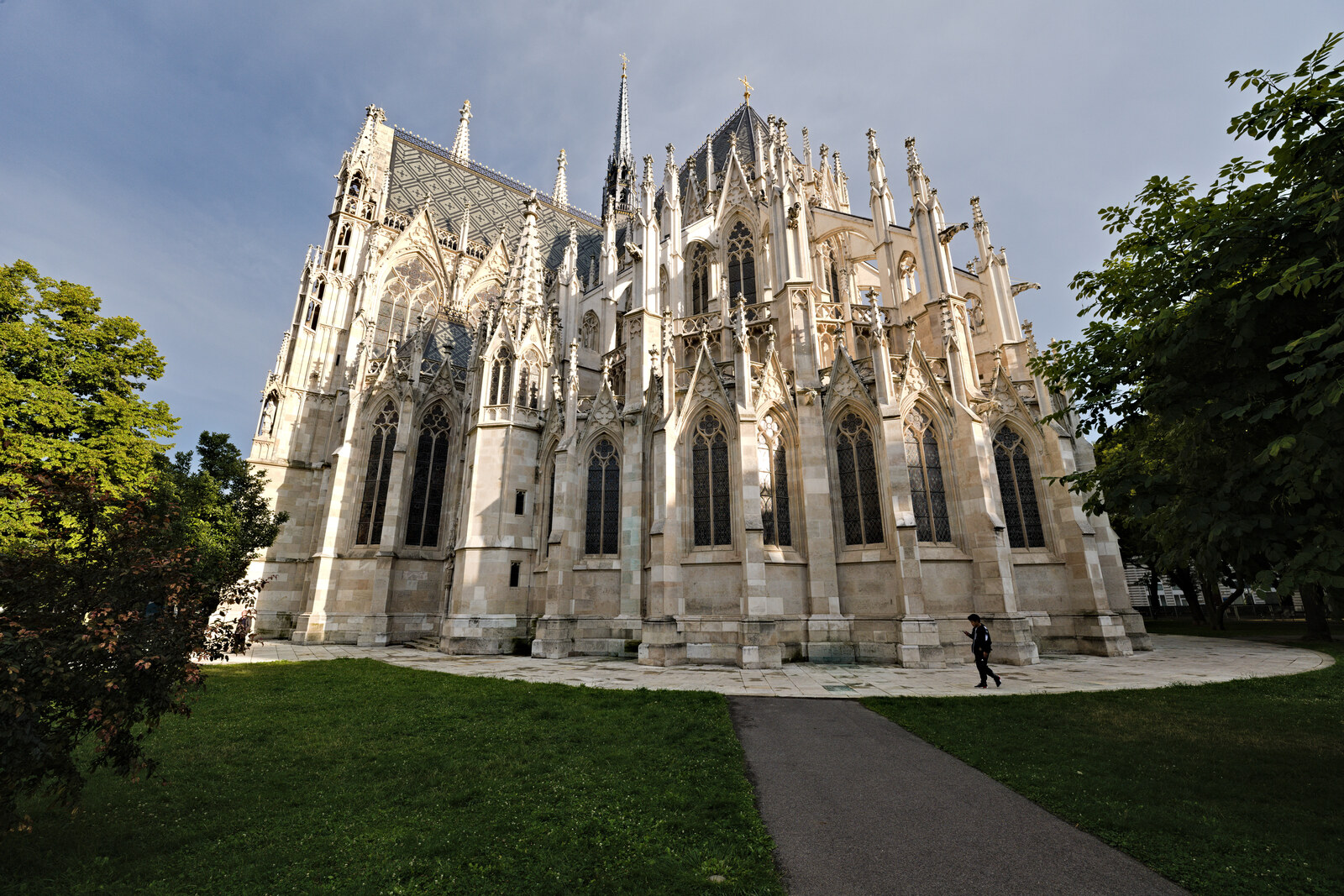
Look around first
What to notice
- Two towers
- Side aisle
- Copy of the image of Our Lady of Guadalupe
- Plaque bearing Maximilian's name
The story of the place
The two pointed towers of the Votive Church stand on the site of the former glacis, an undeveloped strip in front of Vienna's fortifications. While the church was being built, old Vienna was still encircled by walls, and this edge of the defenses soon became part of the new city. The church was intended to serve as a shared sanctuary for the subjects of the multinational monarchy, which is why it was given towers almost one hundred meters high. Inside, they wanted to assemble a pantheon of outstanding Austrians, but they never managed to choose shared heroes.
On February eighteenth, eighteen fifty-three, the twenty-two-year-old Emperor of Austria Franz Joseph stopped at the Carinthian Bastion and leaned over the parapet to watch soldiers' drills. János Libényi crept up behind him and stabbed him in the neck. The blade glanced off the high collar of his military uniform. The emperor was wounded but remained on his feet.
Libényi earned his living as a tailor. During the Hungarian Revolution of eighteen forty-eight to eighteen forty-nine, he made uniforms for insurgents defeated by Franz Joseph's army, then moved to Vienna. What exactly drove him to attempt murder has not been reliably established; revenge for Hungary's defeat is considered a likely explanation. He did not have time to strike a second blow. The imperial adjutant Maximilian O'Donnell struck him away with his saber, and Josef Ettenreich, a former butcher who happened to be nearby, helped restrain the attacker. Libényi was sentenced to death and hanged eight days later. Both rescuers were rewarded, and Ettenreich was raised to hereditary nobility.
This scene did not take place here. The Carinthian Bastion stood near today's Vienna State Opera; the Votive Church did not yet exist. The church came about thanks to Franz Joseph's younger brother, Archduke Ferdinand Maximilian. He proposed turning the emperor's rescue into a fulfilled vow and called on residents across the monarchy to pay for a church as a token of gratitude. This is the source of its name: Votive Church means a church built as a votive offering. The newspaper Wiener Zeitung printed the donors' names every day, and most of the money came from Vienna itself.
A site near Belvedere Palace was considered for the church at first, but the building committee found it too far away. The winner of the international competition, the twenty-six-year-old architect Heinrich von Ferstel, was allowed to choose another site. He pointed to the empty glacis before Schottentor—an open strip by the city's fortifications. That is why the church stands here, rather than where Libényi stabbed the emperor.
Franz Joseph laid the foundation stone in eighteen fifty-six. The city walls still surrounded old Vienna; the emperor did not sign the order to demolish them until the following year. Construction of the Votive Church began before Ringstrasse, and the future boulevard was laid out beside the church already rising here. Its two towers, almost one hundred meters high, were intended for a church called the “Cathedral of Nations”: it was meant to provide a shared sanctuary for the subjects of the multinational monarchy and to house a pantheon of outstanding Austrians. The pantheon was abandoned—they could not agree on whom exactly to consider shared heroes.
Ferdinand Maximilian did not live to see the construction completed either. He accepted the Mexican crown, and in eighteen sixty-seven opponents of his regime captured and shot him. The Votive Church was consecrated twelve years later, on the silver wedding anniversary of the rescued Franz Joseph and Empress Elisabeth.
In the side aisle stands a copy of the Mexican image of Our Lady of Guadalupe. Maximilian wanted a well-lit altar dedicated to her to be installed here, but his wish was fulfilled only in nineteen fifty-four. Beside the image hangs a plaque bearing the name of the man who began raising money for a church of gratitude for his brother and died before both towers above the glacis were completed.
Useful on site
Check the current opening hours of the church, museum, and services before entering
Checked: date not specified. Check the official source before visiting.The story can be read from the square in front of the church. To see the interior, check access separately, and do not enter during a service as though it were a sightseeing venue.