 Guide On Map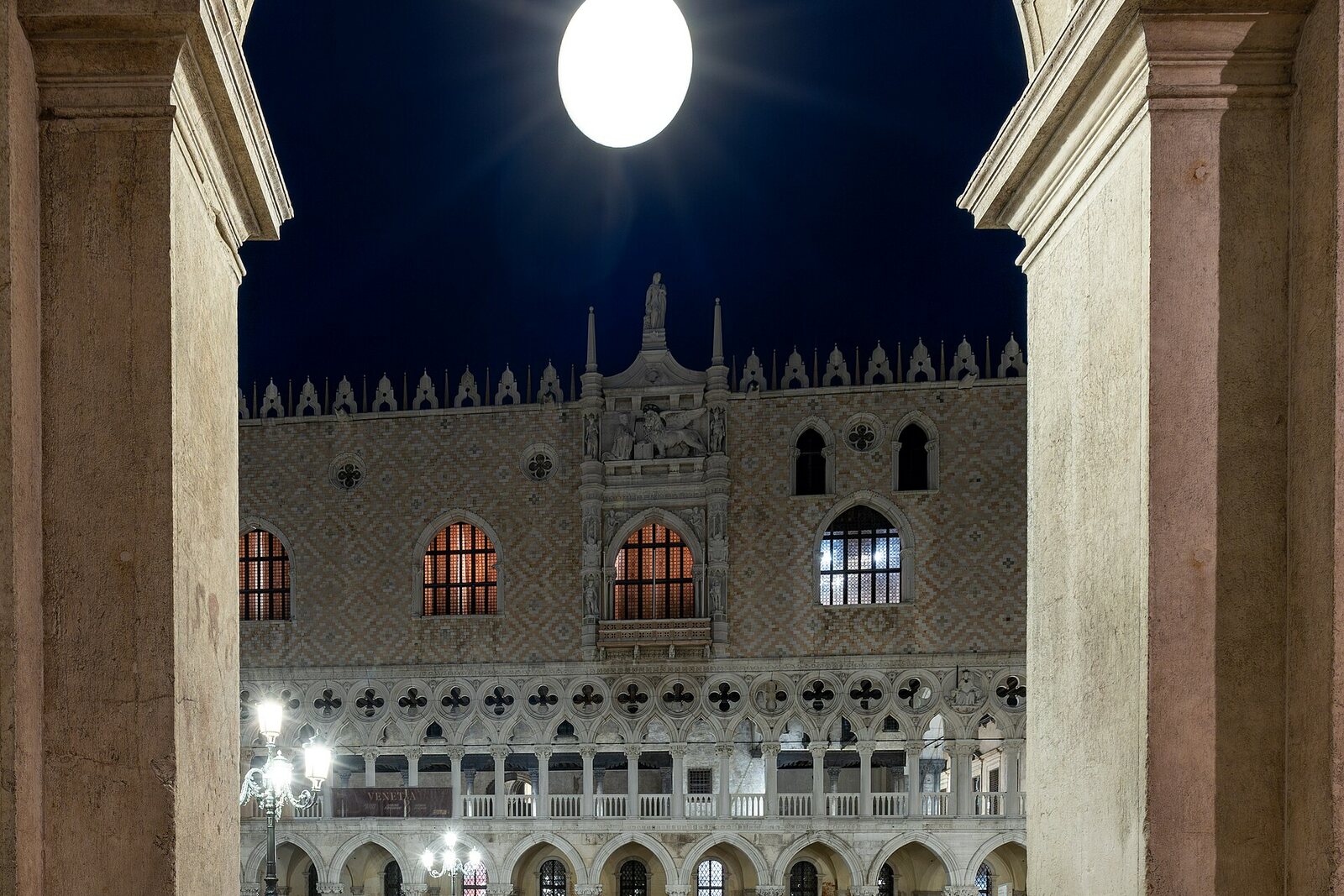
Look around first
What to notice
- Lower-level arcade
- Red columns of the loggia
- Balcony above Piazzetta San Marco
- Pink-and-white facing
The story of the place
On the night of April fifteenth to sixteenth, thirteen fifty-five, Doge's Palace filled with armed patricians. Doge Marin Faliero himself was under guard in the building where he lived as the lifetime-elected head of the Republic of Venice.
The palace's name can be misleading. Along with the doge's apartments, it housed the halls of the Great Council, courts, chancelleries, and the Council of Ten—a board that investigated conspiracies against the republic. The doge presided over ceremonies, arranged meetings, and received ambassadors, but the most important decisions went through the councils. When taking office, he swore an oath to observe the established rules.
Faliero had been elected only seven months earlier. Venice had already been at war with Genoa for four years, and soon after the doge's election, the Venetian fleet suffered a catastrophic defeat at Porto Longo: its ships fell to the enemy, while the admiral and most of his men were taken prisoner. Sailors and shipowners blamed the patricians who directed the war.
Then, in the naval office on the palace's ground floor, the patrician Giovanni Dandolo quarreled with Bertuccio Isarello, a shipowner and an influential man among the sailors. Dandolo struck Isarello in the face. Isarello gathered his companions and waited for his offender at the exit. Faliero summoned Isarello to the palace and rebuked him for the threats. At night, the doge summoned him again—this time without witnesses—and proposed that they act together against the patricians.
Later chroniclers explained Faliero's action as a response to personal humiliation: supposedly, young noblemen had insulted him and his wife, and the court had punished the culprit too mildly. The best-known version, involving an obscene inscription, appeared later and is considered unreliable. The trial records have not survived: in the relevant place in the Council of Ten's register, it is written twice that no entry should be made. One thing is known for certain: the doge met with the conspirators in the palace itself for several nights.
Isarello recruited sailors and shipowners. Among the leaders was his father-in-law, Filippo Calendario, a stonemason and boat owner. They planned to come to Piazza San Marco with armed detachments. On the doge's orders, the bells were to announce the approach of fifty Genoese galleys. The patricians would hurry to the palace to discuss the defense, and the conspirators would slaughter them there. After that, Faliero was to be proclaimed sole ruler, the existing membership of the Great Council was to be dissolved, and offices were to be handed over to the participants in the revolt.
The plan was ruined by one of those in the know, Vendrame, a furrier. Afraid of being exposed, he told everything to the patrician Nicolò Lion. Lion brought him to the doge. Faliero tried to dismiss the report as an empty rumor, but he was forced to summon the councillors. They began interrogations, alerted the patricians, and arrested the leaders of the conspiracy in a single night.
Isarello and Calendario were hanged at the red columns of the palace loggia; nine more participants were executed afterward. Faliero was tried on April seventeenth. The sentence was delivered by five of the doge's councillors and nine members of the Council of Ten. Before the execution, Faliero was stripped of the insignia of office and his property was confiscated, though his wife was allowed to keep two thousand ducats. At sunset, he was beheaded on the landing of the staircase where, upon taking office, he had sworn to observe the laws of the republic.
That staircase no longer exists. The present Staircase of the Giants in the courtyard was built between fourteen eighty-six and fourteen ninety-seven. Inside, however, beneath the ceiling of the Hall of the Great Council, a black curtain remains among the portraits of the doges. After the fire of fifteen seventy-seven, the artists restored the former inscription: “This is the place of Marin Faliero, beheaded for his crimes.” There is no portrait there. His place was left empty.
Useful on site
MUVE: in summer 09:00-19:00, last admission 18:00; on Fridays and Saturdays until 26 September 2026, extended until 23:00, last admission 22:00.
Opening hours by day
From outside, it is easy to examine the facade's structure. Faliero's portrait, Paradise, and the prison rooms are inside and accessible only on a separate visit.