 Guide On Map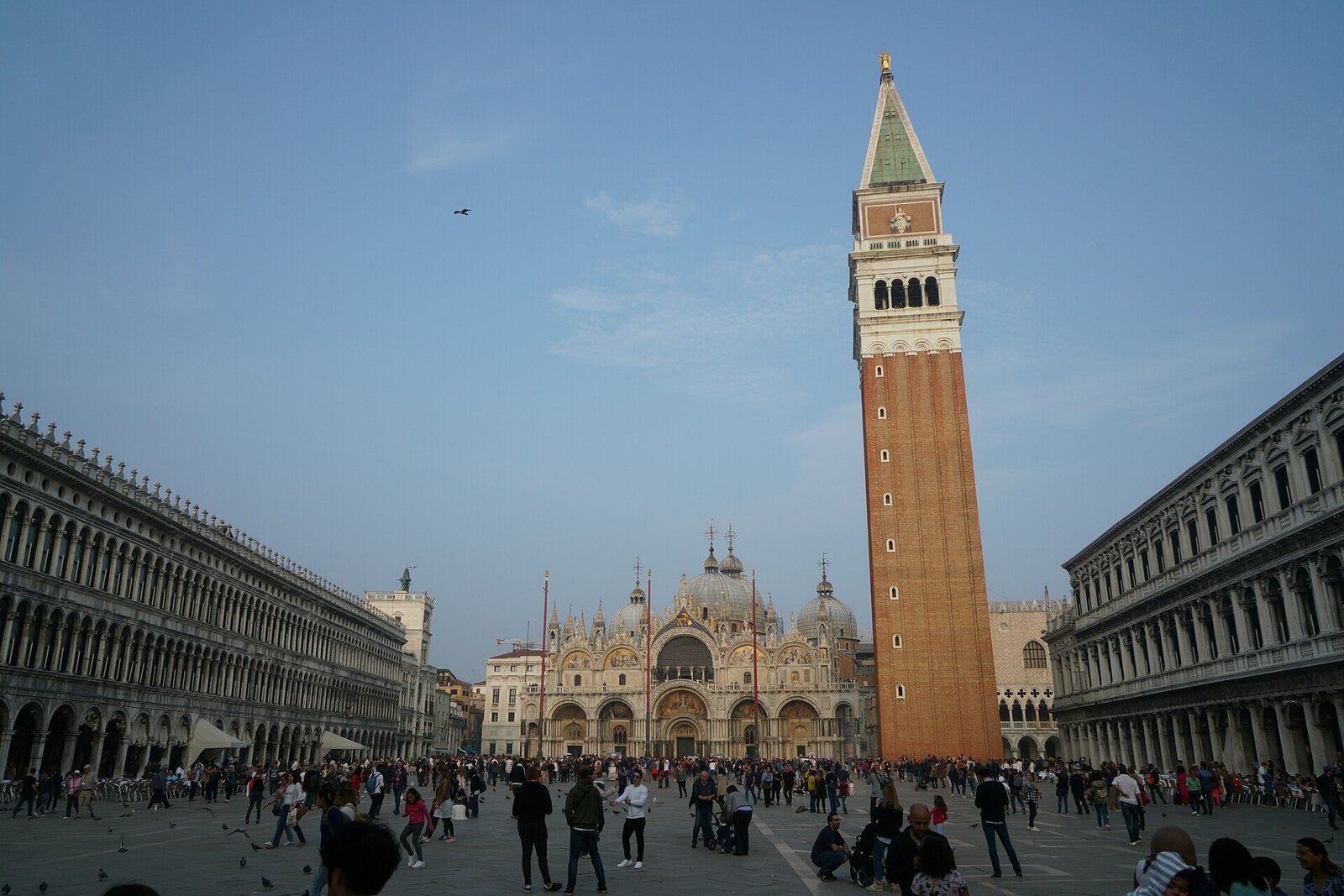
Look around first
What to notice
- Main façade of the basilica
- St Mark's Clocktower
- St Mark's Campanile
- Arcades of the Procuratie
The story of the place
On July twenty-fourth, eleven seventy-seven, a platform with a papal throne was set up before the main entrance to St Mark's Basilica. Pope Alexander III sat on it, seeking recognition as the only legitimate head of the Western Church. He was awaiting Frederick I Barbarossa, Emperor of the Holy Roman Empire, who had supported another pope for many years and was trying to maintain his positions in Italy.
The Mark in the square's name is Saint Mark the Evangelist, Venice's patron saint. The basilica dedicated to him closes off the eastern side. In front of it, the Republic of Venice held ceremonies meant to be seen by townspeople and foreign ambassadors. The emperor could arrive by water at the Molo, pass through Piazzetta San Marco, and find himself between the Doge's residence and Saint Mark the Evangelist's basilica. There was no better place in the city for a public reconciliation.
The conflict had begun eighteen years earlier. After the previous pope's death, a majority of cardinals elected Alexander, while a minority elected another candidate, whom Frederick recognized. Alexander excommunicated the emperor, and the cities of northern Italy, united in the Lombard League, opposed the emperor's claims. After his defeat at Legnano, Frederick needed an agreement. Alexander needed to end the schism and regain undisputed recognition.
The mediator was Sebastiano Ziani, the doge—the elected head of the Republic of Venice. Before his election, he financed trading ventures in the Levant, traveled to Constantinople himself, and traded expensive goods at Rialto. Successful investments brought him a reputation as the richest man in Venice. The previous doge had tried to resolve foreign disputes through a military expedition; the campaign ended in losses, the ruin of merchants, and the doge's own murder. Ziani placed his bet on agreements.
Venice was chosen as the venue for negotiations because both sides could arrive here without an immediate threat of attack. Ziani was personally responsible for that security. He swore not to admit Frederick into the city without the pope's consent. The emperor was to wait in Chioggia while the ambassadors agreed on the terms.
A few days before the reconciliation, everything nearly fell apart. Frederick's supporters decided to bring him into Venice without permission. On July twentieth, they gathered an assembly at San Marco and demanded that the emperor be admitted immediately. Ziani reminded them of his oath, but those assembled did not support him. Representatives of the Lombard League fled to Treviso. The Sicilian ambassadors prepared to take the pope away on their ships. Alexander himself feared that he would find himself in the city with his opponent and without allies.
The next day, Ziani prohibited public discussion of the emperor's arrival without papal consent. Frederick also understood that an unauthorized entry would turn the negotiations into a dangerous gamble. He abandoned the plan and sent two confidants to swear to the already prepared text of the agreement.
Only after that was the emperor allowed to enter Venice. The cardinals lifted his excommunication, Ziani seated him on his ceremonial galley, and brought him to San Marco. From the shore, the procession crossed the square. Before Alexander, Frederick removed his cloak, lay on the ground, and kissed the pope's feet. Alexander raised him up, gave him the kiss of peace, and blessed him. Then they entered the basilica together.
On August first, the sides took their final oaths. Frederick recognized Alexander as the legitimate pope, and Alexander recognized Frederick as emperor. A six-year truce was concluded with the Lombard League, and a fifteen-year peace with the Kingdom of Sicily. The emperor promised Venetian merchants complete exemption from taxes within the empire. Individual Italian cities continued to levy their own dues, but Ziani received an official document expanding the republic's trading privileges.
The same Ziani gave the square almost its present length. On his orders, the Rio Batario canal, which crossed this place, was filled in; a monastery garden was incorporated into the square; and the Church of San Geminiano was moved to the new western edge. The square became more than twice as large. The Church of San Geminiano is no longer here, but archaeologists found the bank of the filled-in canal in nineteen eleven beneath three layers of paving. In Venice, other open spaces are called campo; the word “piazza” without qualification means this square specifically.
Useful on site
Open urban space; choose a viewing spot that does not obstruct pedestrian flow.
Checked: June 27, 2026. Check the official source before visiting.Choose a place at the edge of the square or beneath the arcades so as not to obstruct the flow and to see the whole space.