 Guide On Map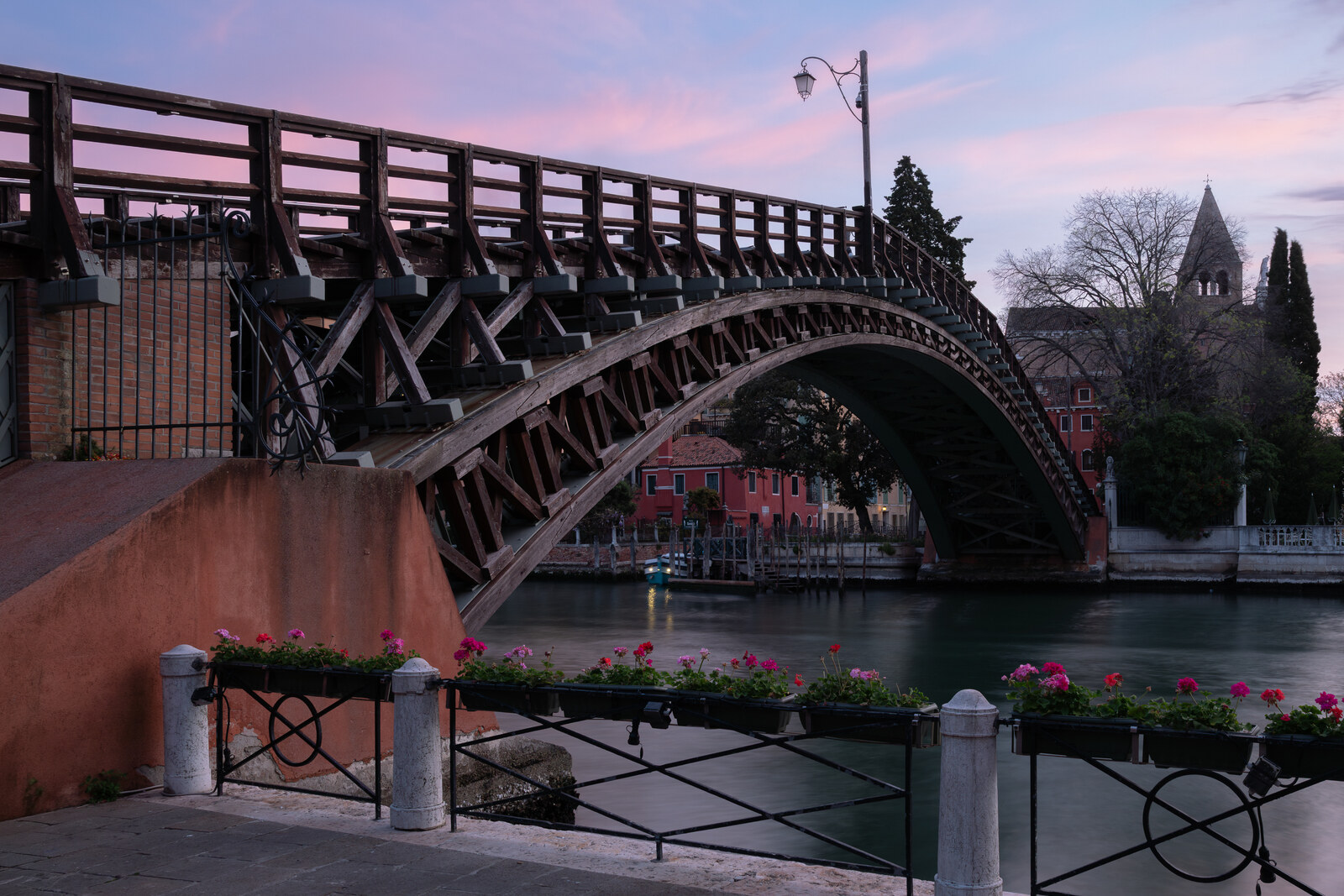
Look around first
What to notice
- Wooden cladding of the arch
- Steps and railings
- Facade of the Gallerie dell'Accademia
The story of the place
In nineteen thirty-two, Eugenio Miozzi, chief engineer of Venice's municipal public works, inspected the iron bridge by the Accademia. In his report, he wrote that a single blow of a sledgehammer to an iron strip would be enough to make the entire structure collapse like a house of cards. No one tested the calculation with a blow, but leaving the bridge open was dangerous.
Nor could they close the crossing for long. Until the middle of the nineteenth century, the Rialto Bridge was the only crossing over the Grand Canal. The owners of houses near San Vidal and on the opposite bank pressed for a second crossing: the new flow of pedestrians increased the profitability of their real estate. They were opposed by the owners of waterfront shops, who feared that a bridge would obstruct large vessels. After years of dispute, the supporters of the crossing got their way. The English engineer Alfred Henry Neville built a straight iron span here, and in eighteen fifty-four pedestrians began using it. At first, there was a charge for crossing.
Over nearly eighty years, this route between San Marco and Dorsoduro became familiar. Meanwhile, the iron rusted, and the bridge obstructed vaporettos at high water. The city announced a competition for a permanent stone crossing. While architects prepared their proposals, Eugenio Miozzi was assigned to provide a temporary crossing.
He served in the municipality and was responsible specifically for city construction: a safe crossing was his direct responsibility, not a commission sought for a famous name. Eugenio Miozzi designed a single larch arch almost as wide as the entire canal. Two wooden vaults rested on concrete abutments; the stairs and deck were suspended between them. Workers assembled the bridge in thirty-seven days. Its opening was then delayed for another month so that gas pipes could be laid along the arch. On February nineteenth, nineteen thirty-three, pedestrians were allowed onto the temporary bridge.
Two weeks later, the competition jury named the winners: architect Duilio Torres and engineer Ottorino Bisazza. They proposed the very permanent stone bridge for which Eugenio Miozzi had built the wooden replacement. But the cost of the project, and then the war, left it on paper. The winners did not receive the construction job; Eugenio Miozzi's temporary arch remained the city's crossing.
The wood exacted its price for that economy. As early as nineteen forty-eight, the rotted parts of the load-bearing arches were replaced with steel. In nineteen eighty-four, the bridge was declared dangerous and closed even to vaporettos passing beneath it. During reconstruction, engineers installed an entirely steel load-bearing frame, but repeated the outline of Eugenio Miozzi's arch and clad the metal in wood.
The name came from the Dorsoduro bank. The first iron crossing was called Ponte della Carità, after the former monastic complex of Santa Maria della Carità. As early as eighteen oh seven, the Royal Academy of Fine Arts of Venice was moved there. The teachers assembled paintings by old masters for their students, and in eighteen seventeen they opened the collection to visitors. The Gallerie dell'Accademia grew out of it, and over the course of the nineteenth century their name passed to the bridge.
Torres and Bisazza's stone bridge is not here. Beneath the wooden steps, railings, and cladding, the load is carried by a steel frame that repeats the temporary arch Eugenio Miozzi assembled in thirty-seven days.
Useful on site
Open city bridge; after rain, the wooden deck and steps require attention.
Checked: date not specified. Check the official source before visiting.The entire account can be read from outside. The steps can be crowded and slippery; do not stop in the middle of the passage or attach locks to the railings.