 Guide On Map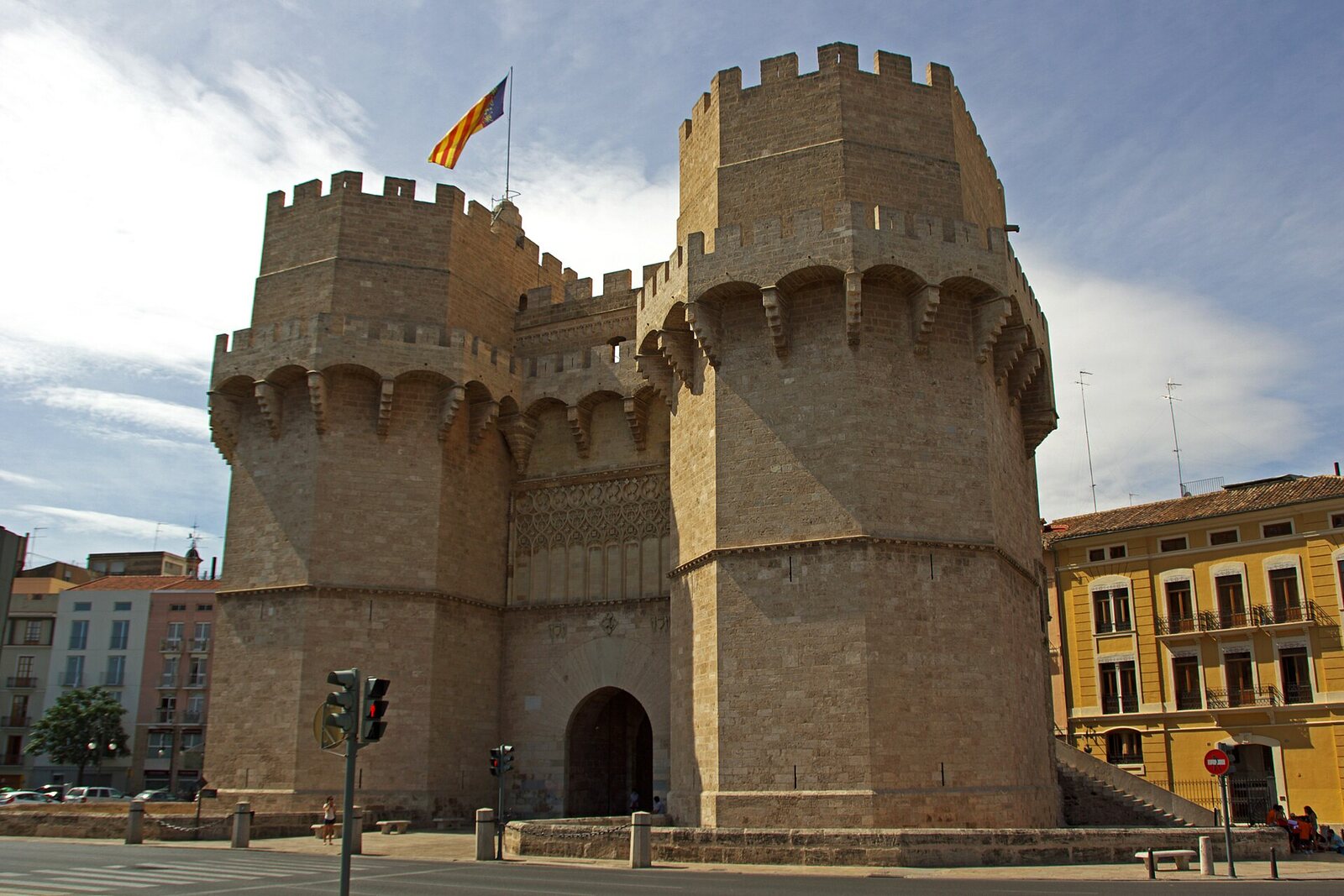
Look around first
What to notice
- Two pentagonal towers
- Arched passageway
- Open inner levels
- Crenellated parapets
The story of the place
When Valencia was encircled by a city wall, travelers arriving from the north entered the city through this arched passageway, and kings of the Crown of Aragon came through it on official visits. At the end of the fourteenth century, two pentagonal towers were built here, with thick masonry, open inner levels, and crenellated parapets at the top. The name preserves the direction of the old road that led from here toward the mountainous region of Los Serranos.
In December nineteen thirty-six, José Lino Vaamonde began building a reinforced-concrete shell inside these Gothic towers. Vaamonde served as architect-conservator of Museo del Prado and was responsible for the paintings evacuated from Madrid. The old walls could withstand a great deal, but a direct hit would have brought the upper levels down onto the crates containing the canvases. The new structure was meant to absorb that impact.
The towers were built at the end of the fourteenth century as the main northern gate of the city wall. Travelers entered through them, and kings of the Crown of Aragon arrived for official visits. The name is usually explained by the direction of the road: beyond the gate, it led toward the mountainous region of Los Serranos. The thick masonry of the two pentagonal towers made the former entrance the most secure storage facility that could be found in Valencia.
On November fifth, nineteen thirty-six, the ministry ordered the main works of Museo del Prado to be transferred here. The Republican government had already moved from besieged Madrid to Valencia. The following evening, nine incendiary bombs fell on the museum's roofs. The paintings faced a nighttime journey in guarded trucks, followed by storage in a city that had also begun to be bombed.
Vaamonde worked from the capabilities of new aerial weapons rather than medieval siege engines. Above the lower room set aside for the paintings, workers poured a vault of reinforced concrete ninety centimeters thick. On top, they laid a meter of rice husks, meant to cushion the impact of falling masonry, and then a meter of compacted earth. The terrace was covered with sandbags, and the openings were reinforced with concrete slabs. Electrical instruments monitored humidity and temperature: a canvas saved from shrapnel could still be ruined by ordinary dampness.
These rooms held Francisco Goya's The Second of May, Diego Velázquez's Christ Crucified, paintings by Titian, tapestries, and books. In the summer of nineteen thirty-seven, international specialists inspected the storage facility and found the works to be well preserved.
In March nineteen thirty-eight, the front approached the roads between Valencia and Catalonia. The custodians packed the collection again and sent it north, then through France to Geneva. On September ninth, nineteen thirty-nine, the works returned to Madrid with almost no losses.
After the war, Vaamonde's concrete shell was dismantled. The open levels of the towers no longer contain the protective vault, the rice husks, or the crates from Museo del Prado. What remains are drawings of the interior reinforcement and a photograph of a truck being unloaded at those same northern gates.
Useful on site
Exterior viewing is open as a public urban space; ascent/interior access to the Serranos Towers follows the current official schedule, with daytime hours and an early last entry.
Checked: June 27, 2026. Check the official source before visiting.The story can be read well from outside, on both sides of the gate. Plan the climb inside as a separate visit and check access in advance.