 Guide On Map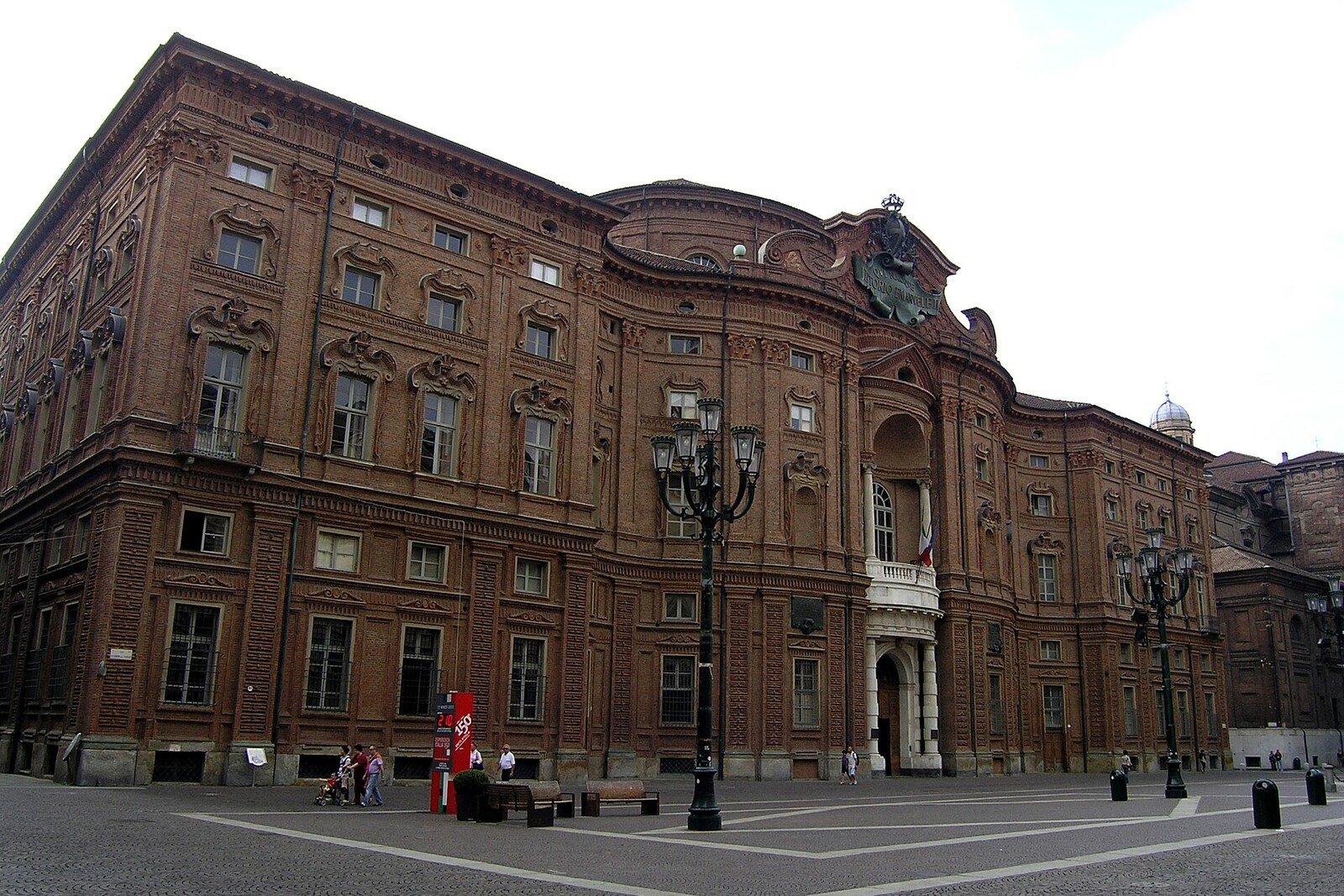
Look around first
What to notice
- Brick facade
- Inner courtyard
- Oval hall of the former chamber
- Clock and calendar of the earlier hall
The story of the place
On April eighteenth, eighteen sixty-one, Giuseppe Garibaldi entered the hall that then stood in the inner courtyard of Palazzo Carignano. The commander of the volunteers who had conquered Sicily and Naples now represented one of Naples’s electoral districts. Before the session began, he took the oath as a deputy, and a few hours later he nearly disrupted the work of the first parliament of united Italy.
The palace takes its name from the princes of Carignano—a junior branch of the House of Savoy, which received its title from the Piedmontese town of Carignano. In sixteen seventy-nine, Prince Emanuele Filiberto of Savoy-Carignano commissioned this city residence for his family. His descendants Carlo Alberto and Vittorio Emanuele II were born here. When Carlo Alberto established the elected parliament of the Kingdom of Sardinia, the former oval hall for palace festivities was converted into the Chamber of Deputies.
After the annexation of Lombardy and the central and southern regions of Italy, the deputies no longer had enough room. In one hundred thirteen days, builders erected a temporary hall of wood and iron in the courtyard—an amphitheater for one thousand people with a high glass roof. The nationwide parliament opened here on February eighteenth, eighteen sixty-one; the deputies then approved the law under which Vittorio Emanuele II assumed the title of King of Italy.
But by then Garibaldi’s men, who had delivered half the country to the king, had lost their own army. Camillo Cavour’s government disbanded the Southern volunteer army and decided to admit its officers one at a time, after checking their ranks and merits. An officer who left was entitled to six months’ pay. For many, this meant choosing between continuing military service and the last money before returning to their former trade.
Garibaldi came to Palazzo Carignano to secure the restoration of his units as a separate corps. Cavour, head of government, insisted on a single regular army with common rules. Garibaldi accused the ministers of humiliating his soldiers and spoke of a “fratricidal war” provoked by them. Cavour sprang from his seat and demanded that the insults stop.
The deputies left their benches and gathered at the bottom of the amphitheater. Some demanded that Garibaldi be denied the floor; others shouted that a deputy had the right to speak. The president of the Chamber covered his head—under the rules of the time, all discussion then had to cease. The session was suspended for a quarter of an hour.
After the break, Garibaldi repeated his demand to keep his officers in service. Two days later, the majority supported a formula that left the decision to the government. The Southern army was not restored as a separate corps: some officers were admitted after review, while the rest left. Vittorio Emanuele II arranged a meeting for Cavour and Garibaldi; they shook hands, but they no longer worked out a joint decision. Cavour died on June sixth.
The wood-and-iron hall where they clashed no longer exists. After parliament moved to Florence, it was dismantled in the spring of eighteen sixty-five. Inside Palazzo Carignano, the earlier, smaller chamber survives: its clock and calendar show half past two on December twenty-eighth, eighteen sixty—the moment of the last session before the move to the temporary hall. Both parts of the palace are now occupied by the National Museum of the Italian Risorgimento.
Useful on site
National Museum of the Italian Risorgimento open Tuesday–Sunday 10:00–18:00; Monday closed; last entry at 17:00.
Checked: June 24, 2026. Check the official source before visiting.The facade and commemorative inscription can be explored without visiting the museum. The historic halls and parliamentary spaces require separate admission; do not expect to pass through them casually.