 Guide On Map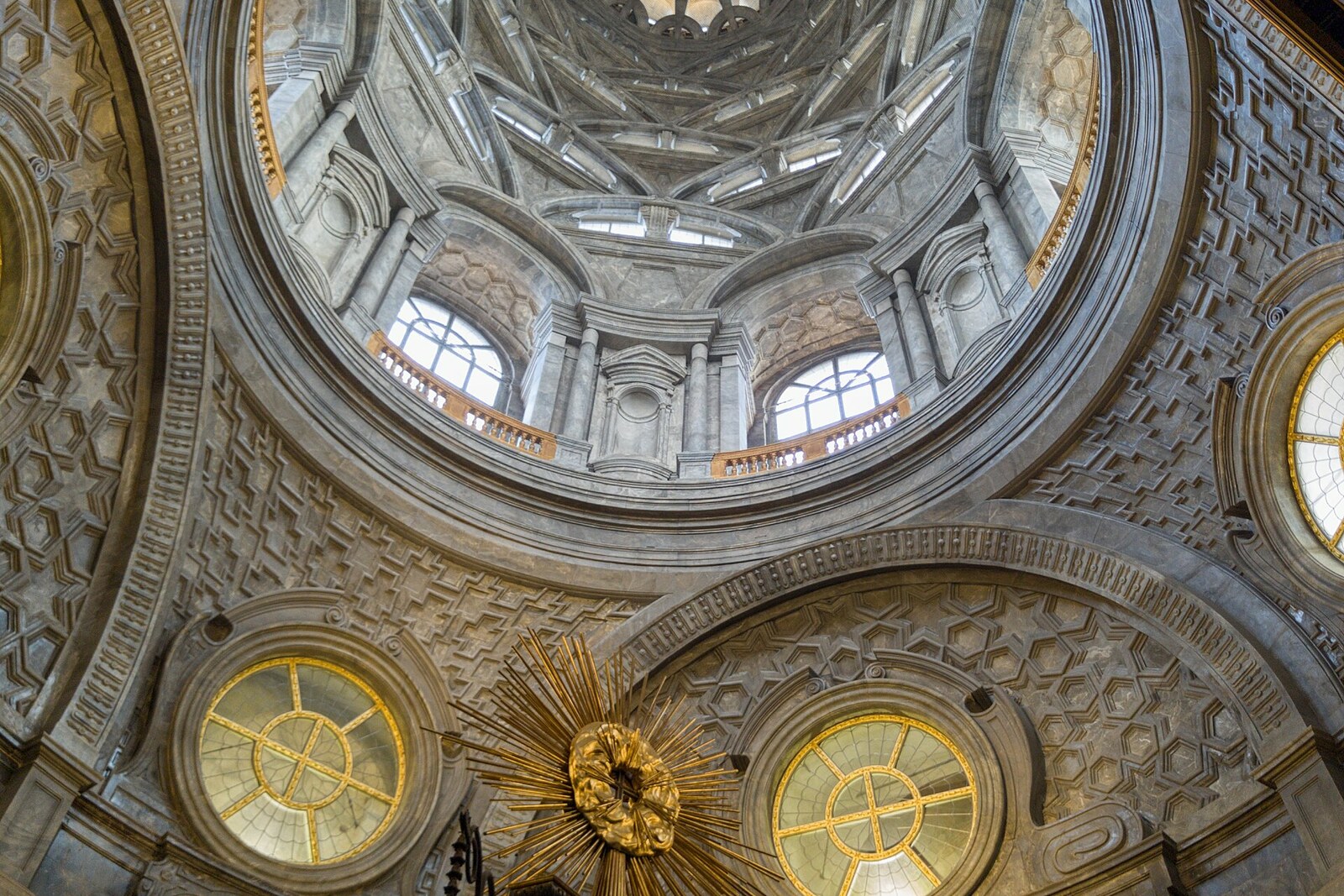
Look around first
What to notice
- The metal casing of the display case
- The Royal Tribune
- The chapel staircases
- The dome of the Chapel of the Shroud
The story of the place
The tall dome of the Chapel of the Shroud rises above the cathedral apse, between the church and the Royal Palace. The Savoy dukes created a palace chapel here for their relic: a separate passage led to it from the palace, and two staircases rise from the side aisles. The cathedral is dedicated to Saint John the Baptist and serves as the seat of the Archbishop of Turin; regular services are held here, and the cloth is displayed rarely. It is now kept unfolded in an airtight display case, enclosed by a large metal casing, in the far chapel of the left aisle beneath the Royal Tribune.
On the night of April eleventh to twelfth, nineteen ninety-seven, forty-four-year-old firefighter Mario Trematore was at home with his wife. He was not on duty, but he saw smoke over central Turin, called his station, and learned that the complex between the Royal Palace and the cathedral was on fire. Trematore put on an old jacket bearing the fire service insignia and went to help his colleagues.
Flames engulfed the scaffolding around the Chapel of the Shroud, a tall space above the cathedral apse. The heat bent the metal pipes, and pieces of stone fell from above. The firefighters feared that the dome would collapse into the chancel.
The Shroud of Turin itself was no longer in the burning chapel. Four years before the fire, it had been removed for restoration and placed behind the cathedral's main altar. Christians venerate the long linen cloth, on which the front and back imprints of the body of a crucified man are visible, as the burial cloth of Jesus. The reliable history of this relic can be traced only to the middle of the fourteenth century. In nineteen ninety-seven, it was kept rolled around a wooden roller in a silver casket, and the casket was enclosed by thick sheets of bulletproof glass.
The glass protected the relic from attack, but now prevented it from being carried out from beneath the collapsing dome. Trematore took a heavy iron sledgehammer. His colleagues sprayed the display case with water while he struck one point until the glass cracked. The firefighters pulled the shards apart with their hands, removed the silver casket, and carried it out through the cathedral. Small pieces of glass remained in Trematore's palms. He later said that he had feared dying and had thought of his wife and children; he did not like the nickname “savior of the Shroud”—he believed that he and his comrades had simply done a firefighter's job.
Two days later, specialists opened the casket: the fire had not damaged the cloth. The public display planned for the following year went ahead, while the restoration of the burned chapel took twenty-one years. It reopened in two thousand eighteen.
The Shroud of Turin came to Turin thanks to another man who was preparing to travel to it on foot. Carlo Borromeo, Archbishop of Milan, cared for the sick during the plague and vowed to come venerate the relic if the epidemic receded. At that time, the cloth was beyond the Alps, in Chambéry, the former capital of the Duchy of Savoy.
Duke Emanuele Filiberto of Savoy had already moved his capital from Chambéry to Turin and wanted to keep the principal relic of the House of Savoy near the court. Borromeo's intention gave him a convenient pretext. In fifteen seventy-eight, the duke ordered the Shroud of Turin brought to Turin to spare the archbishop a crossing of the Alps. Borromeo nevertheless walked from Milan for four days, fasting and praying. Here he fulfilled his vow, and the cloth never returned to Chambéry.
Later, the Savoy dukes built a chapel for it between the palace and the cathedral. A separate entrance led there from the palace, and two staircases rose from the side aisles. In sixteen ninety-four, the Shroud of Turin was placed on the chapel's central altar; it remained there until restoration work began in nineteen ninety-three.
The church itself is dedicated to Saint John the Baptist—the preacher who baptized Jesus—and serves as the cathedral church of the Archbishop of Turin. Regular services are held here, while the Shroud of Turin is shown only during rare public displays. It is now in the last chapel of the left aisle, beneath the Royal Tribune. The cloth lies unfolded in an airtight display case, concealed inside a large metal casing. The rolled linen cloth and the silver casket that Mario Trematore carried out on his shoulder are no longer behind this wall.
Useful on site
The cathedral is open daily 9:00–12:30 and 15:00–19:00; during Masses and ceremonies, access to the Chapel of the Shroud is suspended.
Checked: June 24, 2026. Check the official source before visiting.Do not expect to see the unfolded cloth during an ordinary visit. The cathedral and chapel have different access arrangements; inside, observe the rules of the active church.