 Guide On Map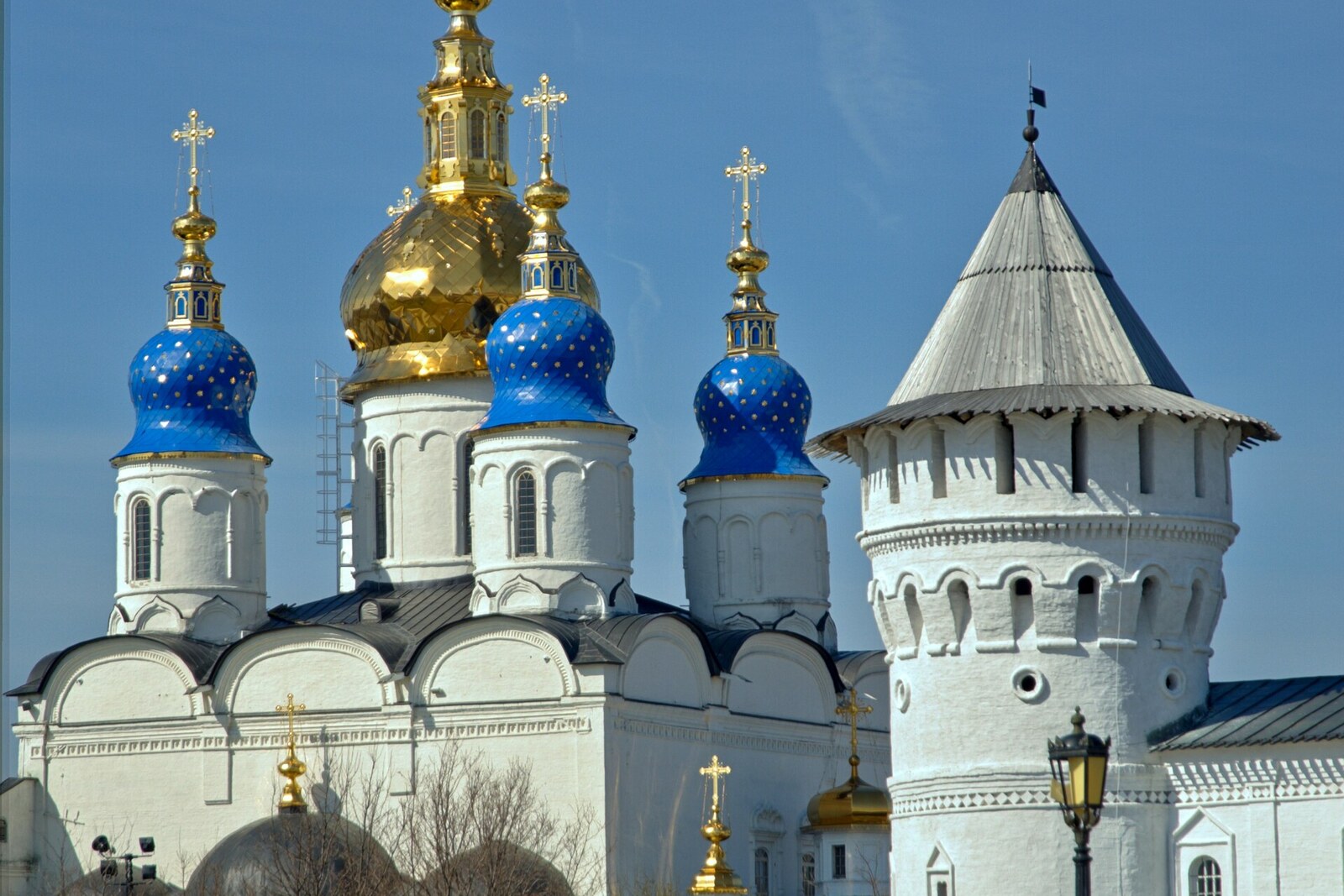
Look around first
What to notice
- Four massive piers
- Brick vaults
- Large bricks with makers’ stamps
- Five domes
The story of the place
Five domes rise above brick vaults supported by four particularly massive interior supports. The cathedral’s double name preserves the memory of two dedications: to Sofiya, Wisdom of God, in the former wooden church and to the Dormition of the Mother of God in the stone one. In the vault masonry, conservators found large bricks with makers’ stamps; the church still serves as a cathedral.
In sixteen seventy-nine, Metropolitan Pavel, head of the vast Siberian Eparchy, arrived in Tobolsk and demanded that the burned wooden cathedral church be replaced with a stone one. A cathedral was so called because it contained the bishop’s seat: Pavel served here and from here administered church affairs throughout Siberia.
The city knew how to fire bricks for stoves, but no large stone church had yet been built there. Pavel did not dare entrust such work to local craftsmen. He had formerly been the confessor of Tsarevna Sofya and had retained connections at court, so he appealed directly to Tsar Fyodor Alekseyevich. The tsar ordered seven hundred rubles from Tobolsk customs revenues to be allocated, plans of the Ascension Church of the Moscow Kremlin to be sent, and stonemasons to be dispatched beyond the Urals.
Pavel asked for five stonemasons and twenty brickmakers. Five sheds with kilns were put up for them by the Irtysh River: the future cathedral required bricks of a size and quality that had scarcely been made in Tobolsk before. The work was directed by Gerasim Sharypin and Gavrila Tyutin, apprentices in stonework. They were to transfer the Moscow model to a city where no established school of stone construction existed.
By the summer of sixteen eighty-four, the craftsmen had almost raised the building to the central dome. Then the interior piers could not bear the weight. The chronicler recorded the reason without excuses: the piers proved too thin. They fell, the vaults broke away, and the entire upper part collapsed into the cathedral.
It happened at night, so none of the builders died. In the morning, Pavel faced walls piled with bricks and Siberia’s first major stone construction project, where the dispatched specialists had made an error in the very calculation of the supports.
Pavel did not return to the wooden church. The craftsmen resumed the masonry and rebuilt the piers and vaults. In sixteen eighty-six, the metropolitan consecrated the completed cathedral in honor of the Dormition of the Mother of God—an event that, in church tradition, marks the end of her earthly life. That is how the word “Assumption” appeared.
The cathedral had been called “Sophia” even before Pavel: the former wooden church on this site was the Church of Sofiya, Wisdom of God. Here, Sofiya does not mean a woman or Tsarevna Sofya, Pavel’s former spiritual daughter. The old dedication became attached to the episcopal see and remained in documents even after the new consecration. The present double name unites the wooden predecessor and the stone church that Pavel did finish.
Today it is an active cathedral. Its vaults are supported by four massive piers—the craftsmen’s second calculation after the nighttime collapse. During surveys, conservators found large bricks in the vault masonry with makers’ stamps and marks: traces of those very people who had to raise the upper part of Siberia’s first stone church twice.
Useful on site
Daily 07:00–19:00; a service may limit tourist viewing of individual sections.
Checked: June 24, 2026. Check the official source before visiting.This is not only a monument but also a church: speak quietly inside, do not play audio during a service, and keep in mind that viewing may be restricted.