 Guide On Map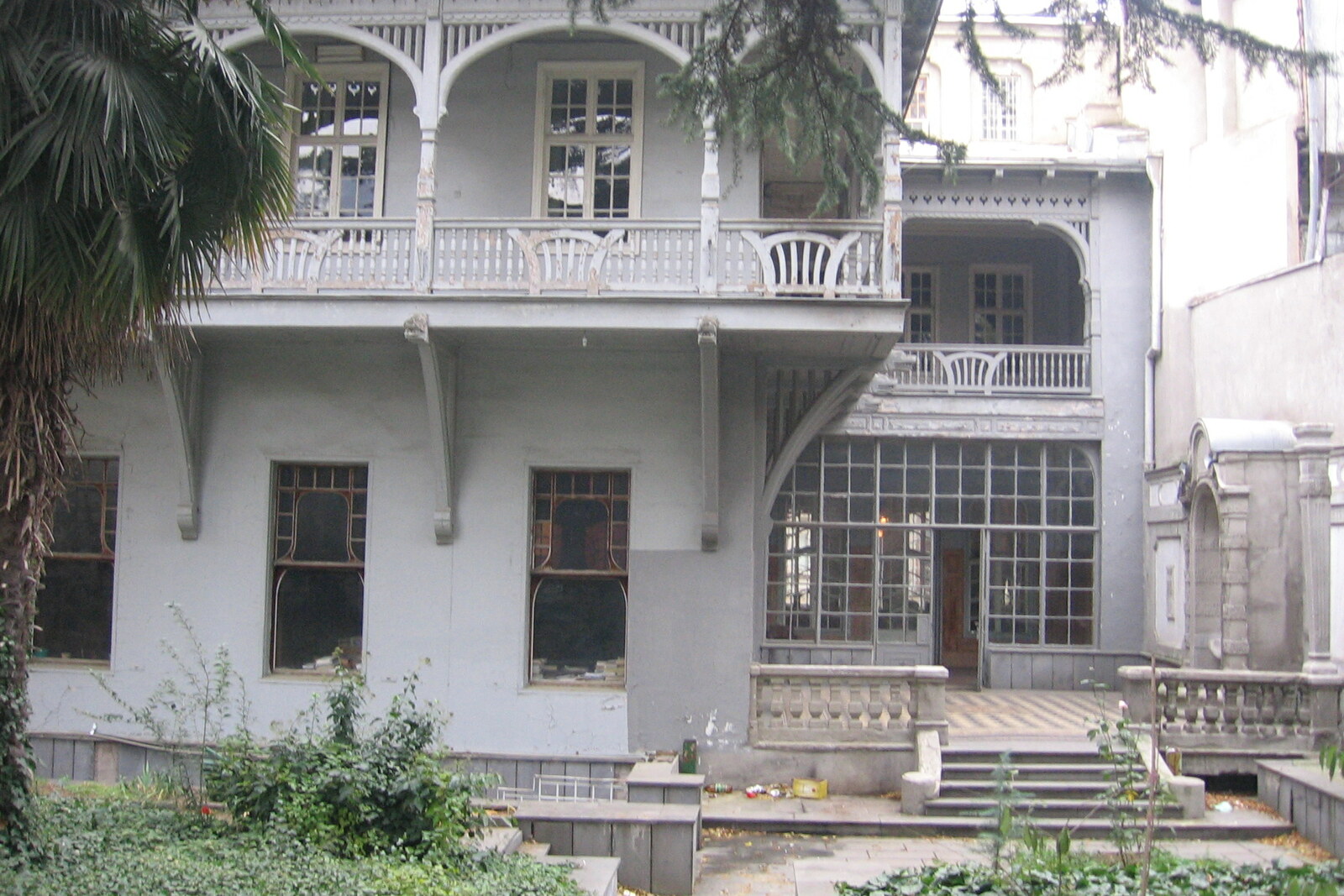
Look around first
What to notice
- The mansion facade
- The main entrance
- Second-floor windows
The story of the place
The facade with the main entrance belongs to the mansion that David Sarajishvili commissioned for the twenty-fifth anniversary of his marriage to Ekaterine Porakishvili. It was built between nineteen oh three and nineteen oh five for the family, but the rooms soon began to draw writers, artists, and guests: new texts were read here and discussed around a shared table. After the owner's death, the house passed to Ekaterine, and relatives later put it up for sale because of financial difficulties. The second-floor windows still belong to the house where, alongside literary life, the memorial museum and the Museum of Repressed Writers operate.
On February twenty-eighth, nineteen twenty-one, three days after the Red Army entered Tbilisi, the poet and organizer of literary life Paolo Iashvili secured the transfer of this mansion to Georgian writers and artists. The decision was made by the Revolutionary Committee, a temporary Soviet governing body. The previous owner, the industrialist Akaki Khoshtaria, had been forced to leave the country, and any new institutions could have occupied his house.
Writers had been welcomed here long before Iashvili. The mansion was built between nineteen oh three and nineteen oh five by David Sarajishvili, the founder of Georgian brandy production. He commissioned the house for the twenty-fifth anniversary of his marriage to Ekaterine Porakishvili. The couple held literary evenings and exhibitions here; writers read new works, and guests discussed them around a shared table. David's name remained attached to the mansion precisely because he built it for his family and was the first to turn private rooms into a venue for public cultural life.
After Sarajishvili's death, Ekaterine inherited the house. Later, relatives put the mansion up for auction because of financial difficulties. In nineteen eighteen, Khoshtaria bought it at the request of the Georgian public. Three years later, Iashvili helped preserve the address's former purpose, although both the owner and the political system had changed. The house was named the Palace of Arts, and from nineteen twenty-three it housed the Writers' Union of Georgia, a professional organization on which publications and the very right to remain in official literature depended.
In the summer of nineteen thirty-seven, officials gathered writers in these rooms and required them to accuse colleagues of espionage and counterrevolution. Anyone who defended a friend risked being arrested as well. Iashvili lived for literature: he wrote poetry, translated, and published journals. Only a year earlier, he had been received at the Kremlin and awarded an order, but now he was reproached for his friendship with people who had already been arrested, and pressure was put on him to testify against other writers.
On July twenty-second, Iashvili came here with his own hunting rifle. While the Writers' Union leadership was meeting downstairs, he went up to the second floor and shot himself. His act did not stop the accusations. Six days later, members of the Writers' Union gathered again in this house, declared the suicide a provocation, and called the deceased a traitor. Of his writer friends, only the poet Kolau Nadiradze dared to attend the funeral. Iashvili's close friend, the poet Titsian Tabidze, was soon arrested and executed by shooting.
Literary gatherings and exhibitions are held here again today. The house contains the David Sarajishvili Memorial Museum and the Museum of Repressed Writers. One of the museum displays is devoted to Paolo Iashvili, the man who helped transfer this mansion to writers and, sixteen years later, died inside the institution they had created.
Useful on site
A city route stop; access to private entrance halls, museums, and courtyards changes, so check the rules on site and do not enter residential spaces without an invitation.
Checked: date not specified. Check the official source before visiting.You can view the house freely from outside, but plan visits to the interior separately and follow the institution's rules. Do not count on access being possible during your walk.