 Guide On Map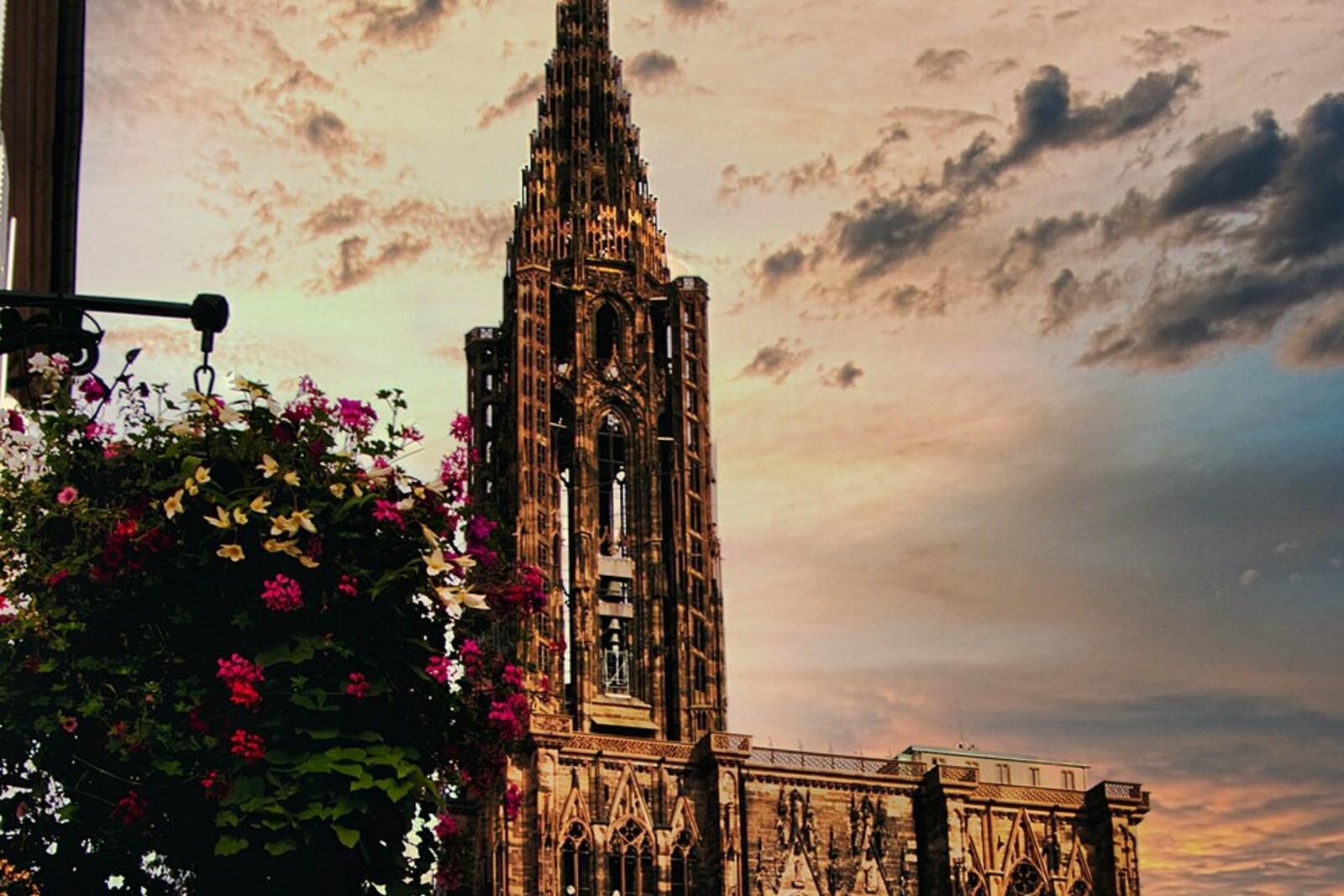
Look around first
What to notice
- Spire with a cross
- Portal sculptures
- Bronze bust of Sultzer
- Sign showing the cathedral in a red cap
The story of the place
Notre-Dame means “Our Lady”: this is what Catholics call the Virgin Mary, the mother of Jesus. The church is dedicated to her. It is called a cathedral because inside is the cathedra—the seat of the Archbishop of Strasbourg. Masses are held here; people are baptized, married, and given funeral services. Construction of the present building began on the foundations of an earlier cathedral after a fire in eleven seventy-six.
In the autumn of seventeen ninety-three, revolutionary commissioners stopped Catholic services here and turned the cathedral into a Temple of Reason, a place for the new civic cult. The municipality was ordered to destroy religious images. Over several days in December, people smashed and hacked apart two hundred thirty-five statues. Some of the figures now standing in the portals appeared later to replace those that had been lost.
The next target was the spire. It was completed in fourteen thirty-nine; at one hundred forty-two meters tall, it was the tallest monument in the Christian world. One radical municipal official demanded that the tower be dismantled: its height was regarded as an insult to republican equality. At the same time, the district representative demanded three times that the cross be removed from the top.
The city council stalled, then decided to cover the cross with an enormous Phrygian cap—a red head covering that served as a symbol of revolutionary freedom. The cap was made of sheet iron. It stood more than ten meters tall. In May of seventeen ninety-four, it was raised onto the spire, and the demand to remove the religious symbol was fulfilled without dismantling the tower.
City tradition attributes this ruse to Jean-Michel Sultzer. He was a hereditary locksmith, made his living by his trade, and at the same time served as a municipal official. According to a later account, Sultzer persuaded his colleagues to preserve the tower as an observation point and turn the cap into a symbol of freedom visible from the other bank of the Rhine.
Sultzer's authorship remains a legend. The records confirm the council's decision and the appearance of the cap, but do not name him as the originator of the idea; the proposal to cover the cross with such a symbol already appeared in a letter from the district representative. Sultzer's later fate, however, is known. In January of seventeen ninety-five, he was removed from office; in the summer he was arrested and accused of involvement in the destruction at the cathedral. The court archives later disappeared, so it is unknown whether he was convicted. Sultzer died in seventeen ninety-nine.
The red cap remained at the top until eighteen oh two. Catholic services had already been restored by then, and the spire was not dismantled. The removed cap was kept in the city library and burned there during a fire in eighteen seventy. A bronze bust of Sultzer and a sign showing the cathedral in a red cap have survived on house number twenty-four opposite the north façade. Above the sign rises that very spire.
Useful on site
Usually Monday–Saturday 08:30–11:15 and 12:45–17:45; Sundays and holidays 14:00–17:15. Closures during services are possible.
Checked: June 24, 2026. Check the official source before visiting.This is an active church: speak quietly and do not disturb services. Viewing hours depend on access inside, but the main story can also be read from the square.