 Guide On Map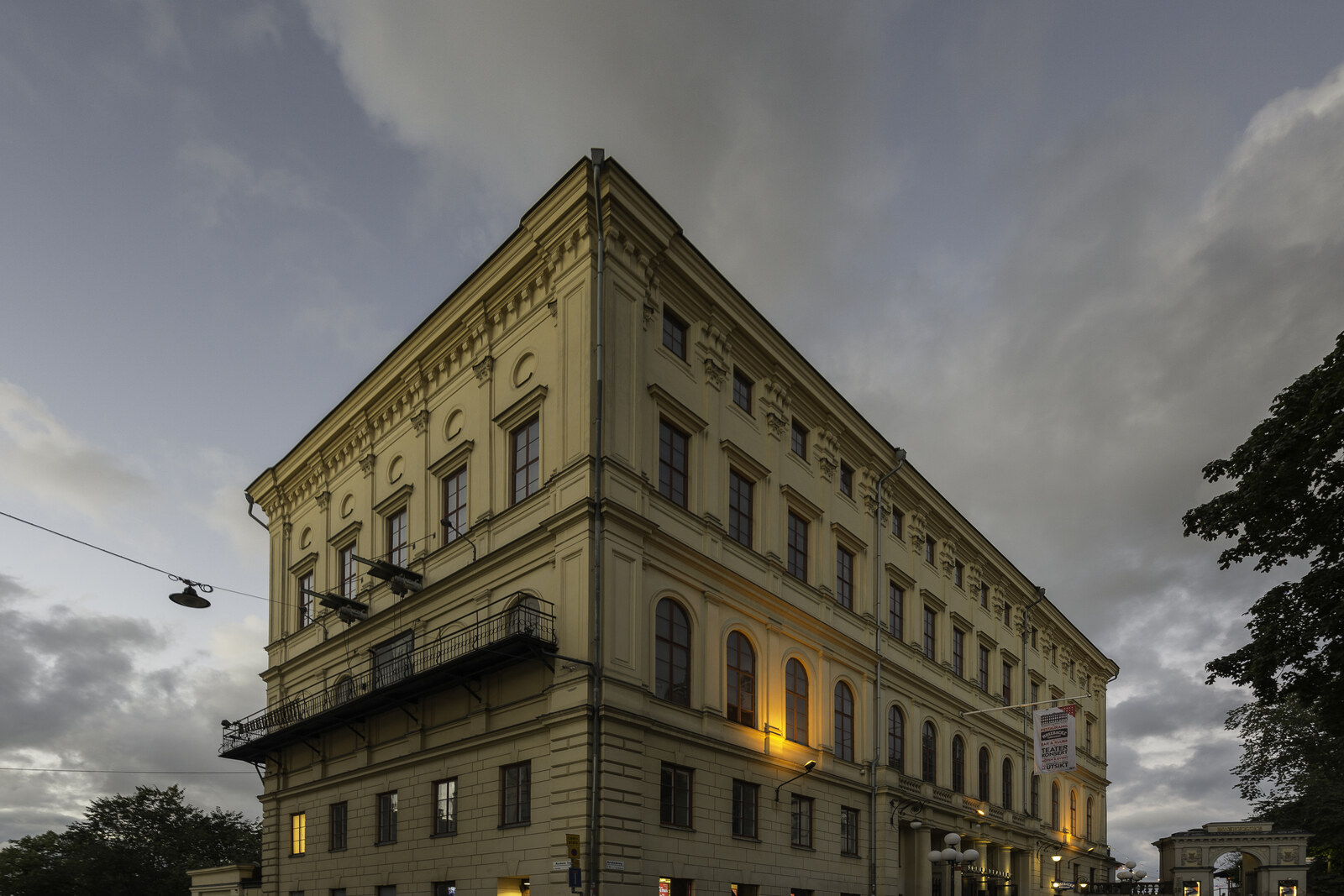
Look around first
What to notice
- The façade of Södra Teatern
- The lower terrace
- Mosebacke Square
The story of the place
Beside the façade of Södra Teatern lies the lower terrace, with Mosebacke Square around them; there was once an inn garden here. In the century before last, the garden was filled with a dance pavilion, attractions, stages, and a covered stage. The first theater building perished in a fire; the present one took its place and still hosts concerts, performances, club evenings, and private events.
The name Mosebacke is older than the present theater. In the late seventeenth century, two mills belonging to Moses Israelsson operated on this height. As early as sixteen ninety-eight, they were called Moses's Mills, and then his name passed to the slope: Mosis-Bakke, “Moses's slope,” became Mosebacke. The mills have long been gone.
In the middle of the nineteenth century, Wallman, a Stockholm organizer of paid entertainment, bought a local inn with a garden. He installed a dance pavilion, a carousel, swings, music stages, and a covered stage. At first it was called the New Theater at Mosebacke, but the name Södra Teatern—“Southern Theater”—soon remained. The first building burned down, and the present one opened in its place in eighteen fifty-nine. Concerts, performances, club evenings, and private events are held here today.
In the spring of eighteen ninety, Quintus Möllgren, manager of the entertainment venue, needed an act capable of drawing a paying audience to the terrace between concerts. He hired nineteen-year-old aerial gymnast Viktor Rolla from Vitebsk. Rolla called himself a captain and earned money by ascending in a gas balloon. He told his landlord that he wanted to make a fortune, give up dangerous performances, and find a quieter occupation.
The danger was known in advance. Rolla's teacher, Charles Leroux, died with the same balloon, and in Helsinki officials forbade the young man from performing this act. At Mosebacke, they agreed. Rolla was to ascend while hanging from a trapeze, move into the ring of a parachute attached to the balloon, and detach himself. The tension in the parachute system simultaneously opened a valve: the balloon released gas and fell separately.
The first Stockholm ascent ended in a municipal planting. The crowd that rushed over trampled the flowers, and a bill for three hundred thirty kronor was sent to Rolla himself. During the second, the parachute took a long time to open. The gymnast became tangled in the lines and fell into the water between Skeppsholmen and Kastellholmen. He was pulled out by a ferry. That same evening, Rolla returned to Mosebacke and received an ovation from the paying audience. The performances were not canceled.
On May twenty-ninth, Möllgren announced the final ascent. When the balloon was being released, one of the men holding the rope held on to his end too long. The balloon swung. Möllgren tried to hold it, but in the confusion the parachute ring was jerked, the parachute came loose, and the valve did not open. Rolla remained on the trapeze beneath the filled balloon. He took off his cap and waved to the audience, after which the balloon disappeared into the clouds. Rolla was found dead in the Ljusterö area. Performers organized a benefit concert for his mother, and Stockholms Panoptikon displayed a wax figure of the gymnast in his costume and with that very parachute.
Rolla was released from the lower terrace of Mosebacke, by Södra Teatern. The terrace and theater continue to serve paid performances; the balloon, parachute, and launch equipment are no longer here.
Useful on site
A city route point; access to the elevator, church, museum, and theater varies, so check current rules on the official pages or on site.
Checked: date not specified. Check the official source before visiting.The square and the theater's exterior are accessible without attending a performance. Check the program, access to the halls, and the operation of the venues independently of the walk.