 Guide On Map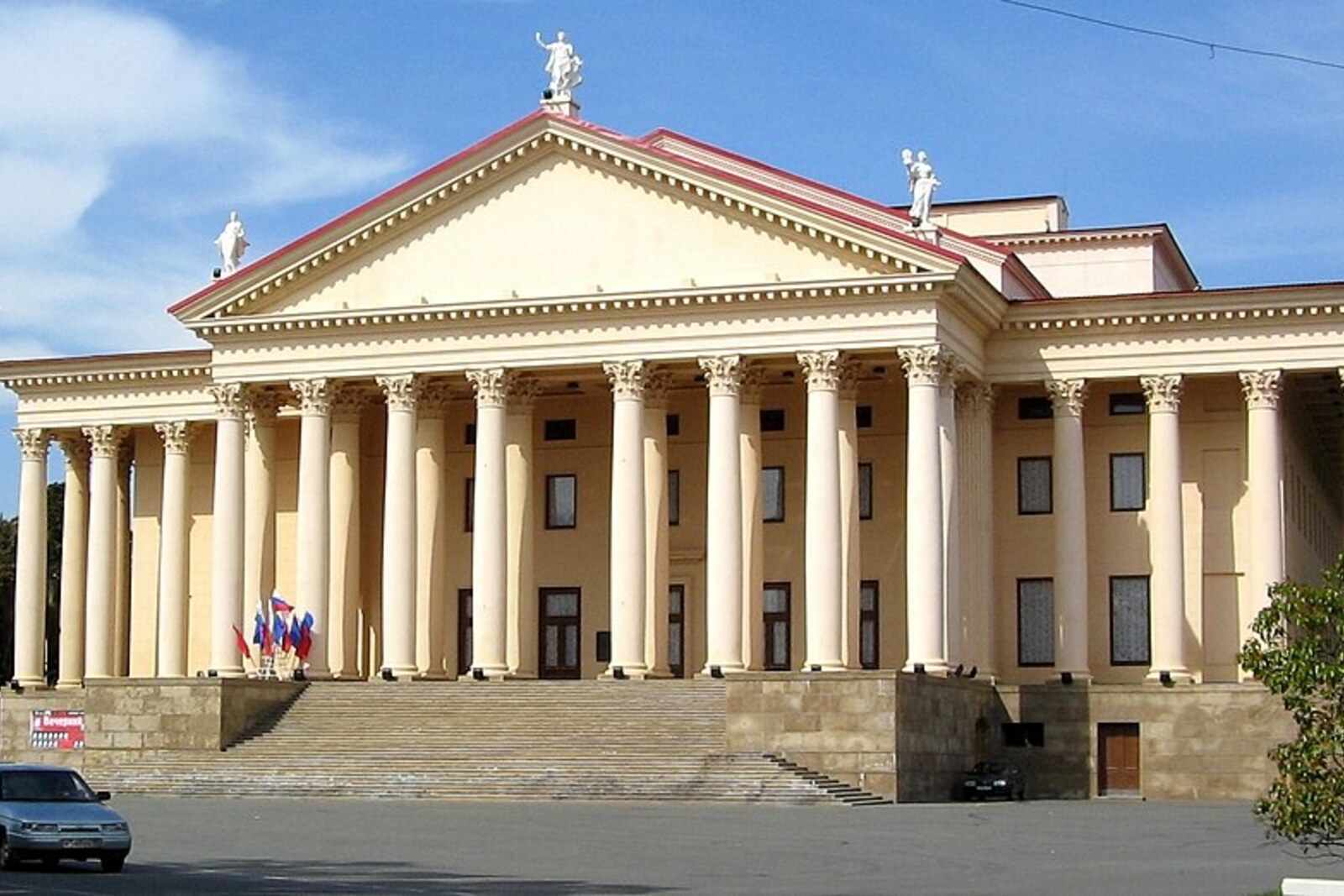
Look around first
What to notice
- Ceremonial staircase
- Broad portico on the sea side
- Small portico on the avenue side
- Ring of Corinthian columns
The story of the place
The word “Winter” preserved the old distinction between Sochi’s two theatrical venues: a covered auditorium operated here, while the Summer Theatre remained open to the air. A ring of Corinthian columns runs around the stage, auditorium, and performers’ rooms, giving the building a ceremonial appearance from every side. From Kurortny Prospekt, a small service portico is visible, while the broad staircase and main entrance open toward the sea. This arrangement had to be found between the city road and the descent to the shore.
The Winter Theatre never had its own acting company. This was planned from the start: Sochi needed a stage where companies from the capital and the provinces could arrive one after another. Sanatorium holidaymakers changed every week, and the program had to change with them.
In nineteen thirty-four, six designs were prepared for the future theatre. Konstantin Chernopyatov was thirty-four years old. Until then, he had earned a living by designing and restoring individual buildings, and now he was competing for the leading commission in the young resort. His proposal won first prize. A separate design workshop was created under Chernopyatov’s direction, and the architect himself was appointed first deputy chief construction engineer. The experienced Vladimir Shchuko and Vladimir Gelfreikh became consultants, who were to help turn the competition sketch into working drawings.
The site required a choice. On the city side ran what is now Kurortny Prospekt, while on the other side there was a descent to the sea. If the main entrance faced the avenue, audiences would find themselves with their backs to the coast during intermission. If the entrance faced the sea, the service façade would be visible from the main road. Chernopyatov chose the sea. He turned the ceremonial staircase and broad portico toward the shore and extended the colonnade along every wall. The service entrance on the avenue side also received a portico, only a smaller one. This is the reason for the ring of Corinthian columns: the architect used them to conceal the difference between the building’s front and back sides.
On May fifteenth, nineteen thirty-eight, artists from the Moscow State Theatre named after Konstantin Stanislavsky performed Rimsky-Korsakov’s opera The Tsar's Bride here. The Moscow company arrived with its own production and left; no permanent company was established in Sochi. The building had a stage, scenery storage rooms, performers’ rooms, and a director’s office, but the designers did not provide the full set of rooms needed for the daily work of an in-house company. Ready-made productions were received here.
The word “Winter” referred to a permanent covered auditorium. In the same resort city of Sochi, the open-air Summer Theatre was built: the names distinguished the two touring stages by their design.
Later, a legend grew up around the colonnade. It claims that Joseph Stalin, the country’s leader, expressed dissatisfaction with the number of columns, and that Chernopyatov then took his own life. It is only a legend. The architect lived until nineteen seventy-eight. For his seventieth birthday, colleagues gave him a wooden model of the Sochi theatre; decades later, Chernopyatov’s great-grandson donated this model and a cast of the architect’s hand to the city museum.
From Kurortny Prospekt, the smaller service portico is still the first thing visible. The ceremonial staircase remains on the sea side, and the Winter Theatre’s program once again lists the name of a company that arrived in Sochi with its own production.
Useful on site
The façades can be viewed from outside; the auditorium opens according to the event schedule and with tickets.
Checked: June 24, 2026. Check the official source before visiting.Walk around the building along the publicly accessible perimeter to see for yourself that it has no back façade. The auditorium can be viewed only through current access arrangements or as part of a separate event.