 Guide On Map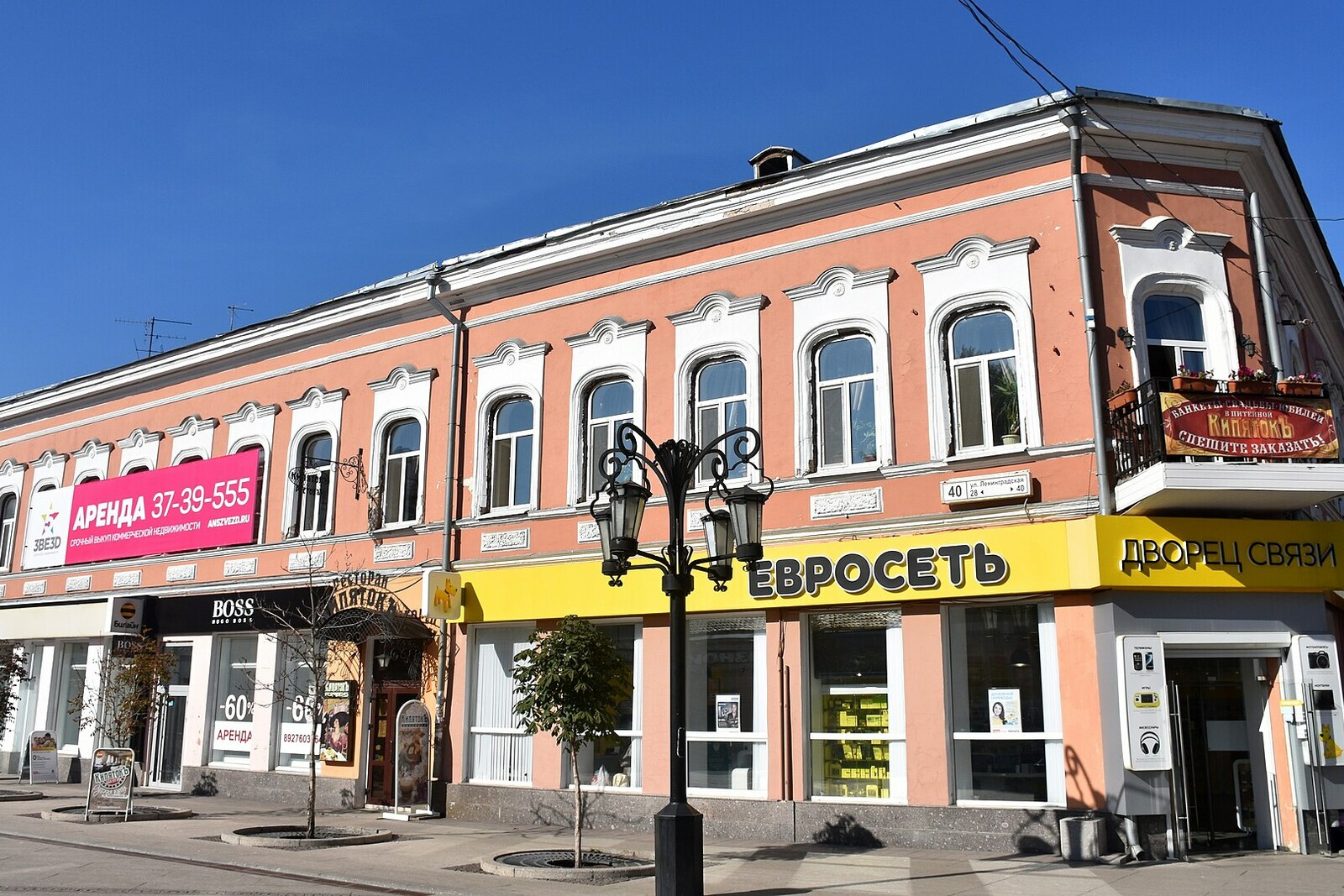
Look around first
What to notice
- Facade of house No. 34
- Windows of the former shop
- Old views of Samara on the café walls
- Photograph of Konstantin Golovkin
The story of the place
Behind the facade of house number thirty-four, the lower floor was occupied by retail premises, while the apartment and studio of its owner were upstairs. Two large windows of the former shop face the street; there is now a café behind them, with old views of Samara and a portrait of the former owner hanging on the walls. After the owner changed, the paintings, display cases, tapestries, glass, and porcelain that remained here entered the city museum's collection.
The street received its most enduring pre-revolutionary name—Panskaya—from a commodity. Samara merchants called a factory-made product “pansky,” as distinct from an item made by an artisan. Its earlier names referred to shop counters even more directly: Sennaya, Moskatelnaya—after the trade in paints, oils, and other household compounds—and then Khlebnaya. By the end of the nineteenth century, expensive ready-made goods were already being sold here, while hotels and specialized shops were opening.
In house number thirty-four, Konstantin Golovkin traded. He was the son of a merchant and wanted to become an artist and gather Samara painters around him. His father prepared him for the family business: after six years of school, he made him a delivery boy in a shop selling dishes and wallpaper. Konstantin continued to draw, but made his living through trade. In the house on Panskaya Street, he set up an apartment upstairs, while on the ground floor he sold paper, pencils, brushes, paints, and photographic materials. From morning until lunch, he worked behind the counter, then went upstairs to the studio. Other artists came here: they bought materials, drank tea, and discussed exhibitions. Panskaya Street gave them a place where an artistic circle could exist every day, rather than only during the next exhibition.
Golovkin learned photography and, during his European travels, saw how postcards with city views were sold. Between nineteen hundred and nineteen oh six, he ordered nine editions of postcards from a Moscow phototype printing house, mostly based on his own photographs. The Volga River, the Zhiguli Hills, city streets, bridges, fishermen, and barge haulers appeared in the two large windows of his shop. Customers took the cards away from here and sent them across Russia and abroad. Outside Samara, people saw the city for the first time as a local merchant and photographer had chosen to show it.
For Golovkin, this activity remained part of his business: he paid for the publication, displayed the cards alongside ordinary goods, and expected every print run to sell. After the shop passed to another owner, Golovkin's paintings that remained here, display cases, tapestries, glass, and porcelain articles were transferred to the city museum. His photographs were also preserved in museum collections; they can now be used to reconstruct buildings and Volga River views that have long since disappeared.
The name Panskaya disappeared in nineteen eighteen. The street was renamed Petrogradskaya, after Petrograd, as present-day St Petersburg was then called. After the death of Vladimir Lenin, the leader of the Bolsheviks who sought Russia's socialist transformation, Petrograd was renamed Leningrad. In nineteen twenty-six, Samara's Petrogradskaya Street became Leningradskaya Street in turn. Trade remained, however: department stores, bookshops, and shoe shops operated here later, and in nineteen eighty-six traffic was closed on the first section and the roadway was given over to pedestrians.
House number thirty-four has survived. A café now occupies the former retail space; old views of Samara and a photograph of Konstantin Golovkin hang on its walls. His face ended up in the very place where the postcards he made were once sold.
Useful on site
Pedestrian street, accessible around the clock; shops and cafés keep their own schedules.
Checked: June 24, 2026. Check the official source before visiting.Do not try to take in the street in one broad view: its past is better read in individual houses and in the boundary between the shopfront below and the living quarters above.