 Guide On Map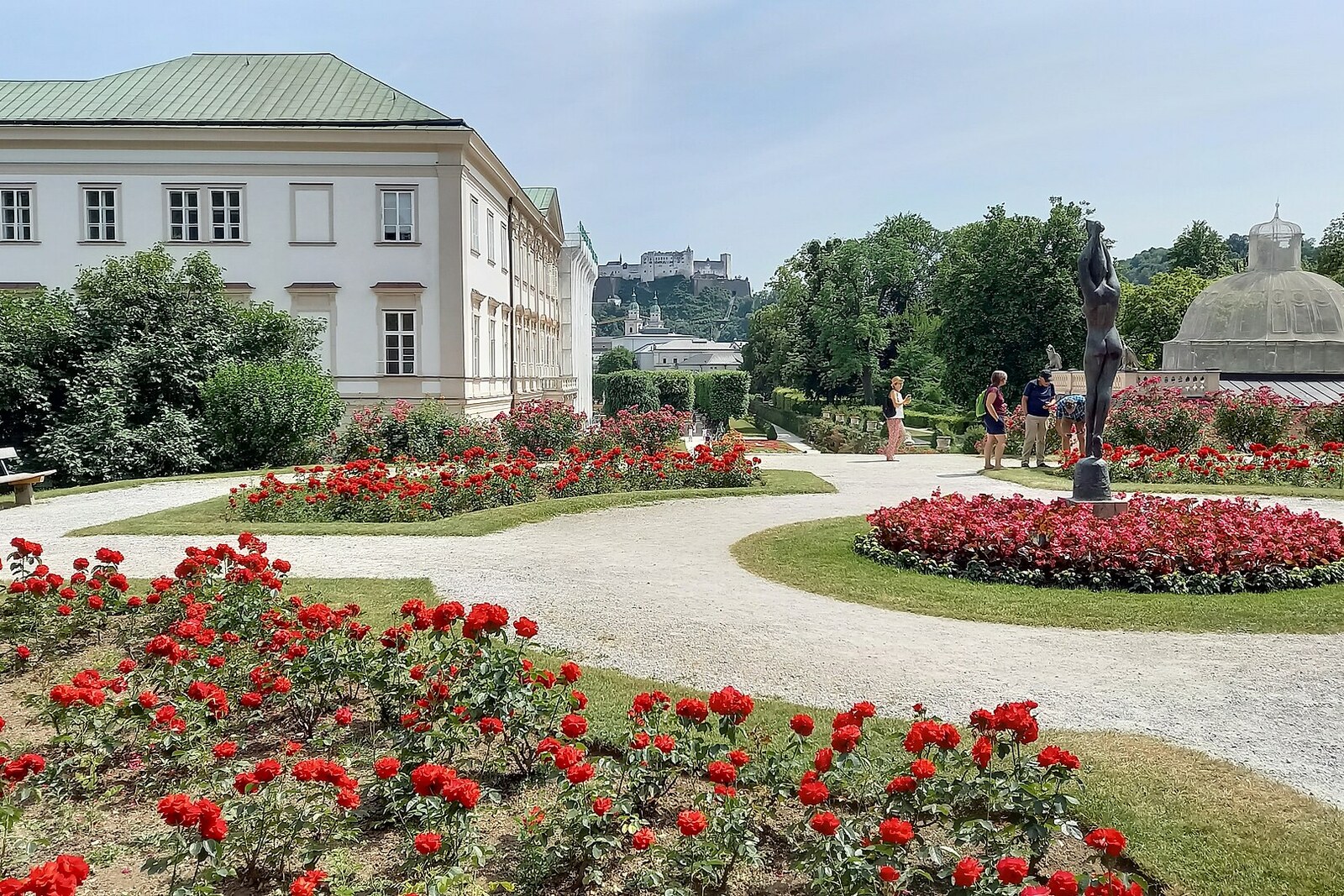
Look around first
What to notice
- The steps of Rosenhügel
- The bronze dancer
- Mirabell Gardens
- The silhouette of the Old Town and the fortress
The story of the place
Rosenhügel is the surviving earthen core of St. Vitalis Bastion. In the seventeenth century, cannons stood on this rampart, protecting Salzburg’s right bank. When the fortifications were abolished, the stone was removed, the moats were filled in, and the embankment was preserved and planted with roses. Thus the military rampart acquired its current name, Rosenhügel, and became a viewing platform above Mirabell Gardens.
In nineteen fifty, the hill nearly disappeared. Clemens Holzmeister, an architect who had spent many years designing theaters and working for the Salzburg Festival, was preparing a building here for an international music Olympiad. The organizers even held a ceremonial laying of the first stone.
Holzmeister planned a structure about one hundred thirty meters long, from Auerspergstraße to Mirabell Palace. Its eastern wall would have come within about ten meters of the palace, and Rosenhügel would have had to be leveled. The site was chosen for the view that opens up from the steps. In the back wall of the stage, the architect provided for three large portals. They could be opened during a performance: behind the actors, the garden, the towers of the Old Town, and Hohensalzburg Fortress would have appeared. The scenery would not have been painted in a workshop—the real panorama of Salzburg would have become it.
After the laying of the first stone, new calculations were commissioned, but construction did not begin. In nineteen fifty-three, machinery did come here—for a congress center and an indoor swimming pool. Holzmeister had to move the work to another part of the city. There, by the former court stables, fifty-five thousand cubic meters of Mönchsberg rock were blasted away for his next project. In nineteen sixty, the Great Festival Hall opened, while the first stone on Rosenhügel remained the beginning of a building that does not exist.
Fourteen years later, filmmakers made use of the preserved hill. Screenwriter Ernest Lehman turned the stationary stage number “Do-Re-Mi” from the musical The Sound of Music into a journey through Salzburg. Director Robert Wise filmed it in several locations and staged the finale on these steps. Julie Andrews, in the role of Maria, and the children who played the von Trapp family lined up here before the camera; behind them lay the very garden and city skyline that Holzmeister had planned to reveal through theatrical portals. After the premiere in nineteen sixty-five, this shot spread around the world, and tours for fans of the film began coming to the steps.
The bronze dancer above has nothing to do with the filming. It portrays Inge Schabel, a former prima ballerina of the Salzburg State Theatre. The Italian sculptor Giacomo Manzù met her in Salzburg in nineteen fifty-four, married her, and made her the model for a whole series of works. He created this figure in nineteen fifty-five: Inge stands en pointe and lifts her hair with both hands. Publisher Franz Burda gave the bronze to the city in nineteen seventy-six.
At the site of the theater’s unrealized back wall remain the steps from the film shot, the figure of a real ballerina, and the open scenery for which Holzmeister once chose Rosenhügel.
Useful on site
Open section of Mirabell Gardens; access depends on the garden's schedule and partial winter closures.
Checked: June 26, 2026. Check the official source before visiting.Take your time going up: wet steps are slippery, and the best view opens up from the platform, not from the edge of the stairs.