 Guide On Map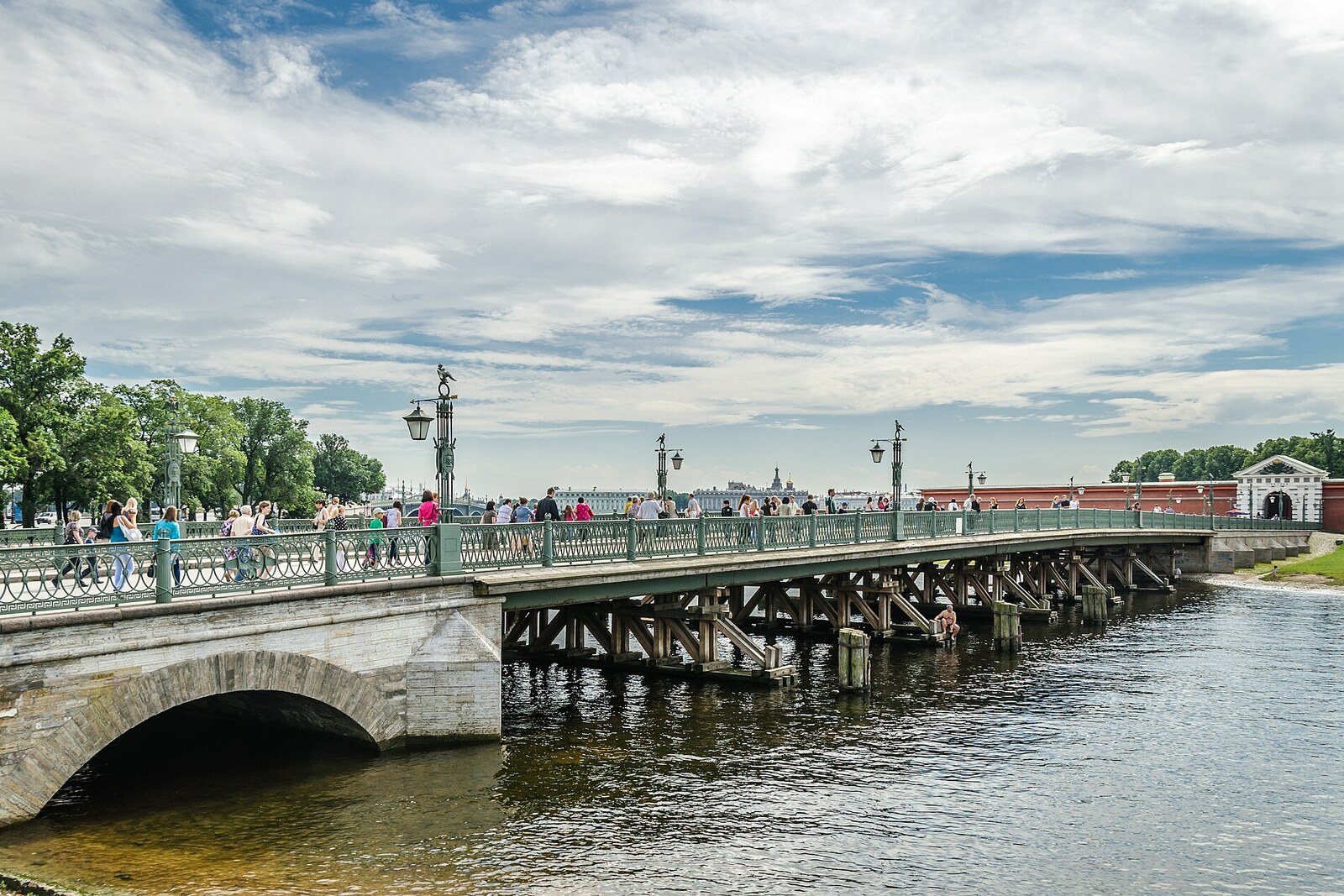
Look around first
What to notice
- Ioannovsky Gate
- The facade of Ioannovsky Ravelin
- The bridge span
The story of the place
Ioannovsky Gate stands above this bridge span, and beyond it you can see the facade of the ravelin, an advanced fortification that protected the entrance to the fortress from artillery fire. A moat once lay before the main wall, and another, short inner bridge crossed it; its name was later given to the present crossing. The moat was filled in and the wooden decking was replaced more than once, but the route still leads directly to the gate of the ravelin named in memory of the elder brother of Pyotr I. The trace of two bridges survives here.
In January seventeen forty-two, people sentenced to death were led out of Peter and Paul Fortress across this crossing. The bridge was then called Petrovsky Bridge. It led from Zayachy Island to Gorodovoy Island—today's Petrograd Side—and the condemned were then taken across all of St Petersburg to the scaffold on Vasilievsky Island.
Among them was Burkhard von Münnich, a military engineer and former first minister of the overthrown government. Only recently, he had commanded the army and the empire's fortifications; now he could only hope that the sentence of death by quartering would not be carried out. His own work connected him to the fortress. In the seventeen thirties, Münnich oversaw its reconstruction and designed the stone ravelin toward whose gate the bridge leads.
A ravelin is an advanced fortification that protected an entrance from artillery fire. It was named Ioannovsky in honor of Tsar Ivan V Alexeyevich, the elder brother and co-ruler of Pyotr I. Ivan died several years before St Petersburg was founded, but his daughter Anna Ioannovna became empress and gave the new fortification her father's name.
After Anna's death, the throne passed to the infant Ivan Antonovich. Münnich arrested the regent appointed for the child and helped make the emperor's mother, Anna Leopoldovna, the ruler. A year later, Elizaveta Petrovna, the daughter of Pyotr I, overthrew her as well. Münnich was arrested as one of the leaders of the previous government, imprisoned in the fortress, and then led across the bridge past the ravelin that he himself had built.
At the scaffold, Münnich heard that his execution had been replaced with exile. Instead of being quartered, he was sent to Pelym in Siberia. There the former field marshal lived with his wife for twenty years, without rank or command, under constant guard. He returned as a seventy-eight-year-old man: Pyotr III freed Münnich and restored his ranks.
The bridge planks along which the condemned were led have not survived; the crossing was rebuilt many times. The short inner bridge across the moat between the ravelin and the main wall also disappeared. It was this bridge that was once called Ioannovsky. When the moat was filled in, its name was transferred to the former Petrovsky Bridge. Now Ioannovsky Bridge leads directly to the gate of the fortification created by the engineer who was once led out of here to his execution.
Useful on site
Summer season 2026: Zayachy Island 06:00–21:30, the area inside the walls 09:50–20:30.
Checked: June 24, 2026. Check the official source before visiting.On the narrow bridge, step aside from the main flow before stopping by the water or examining the sculpture.