 Guide On Map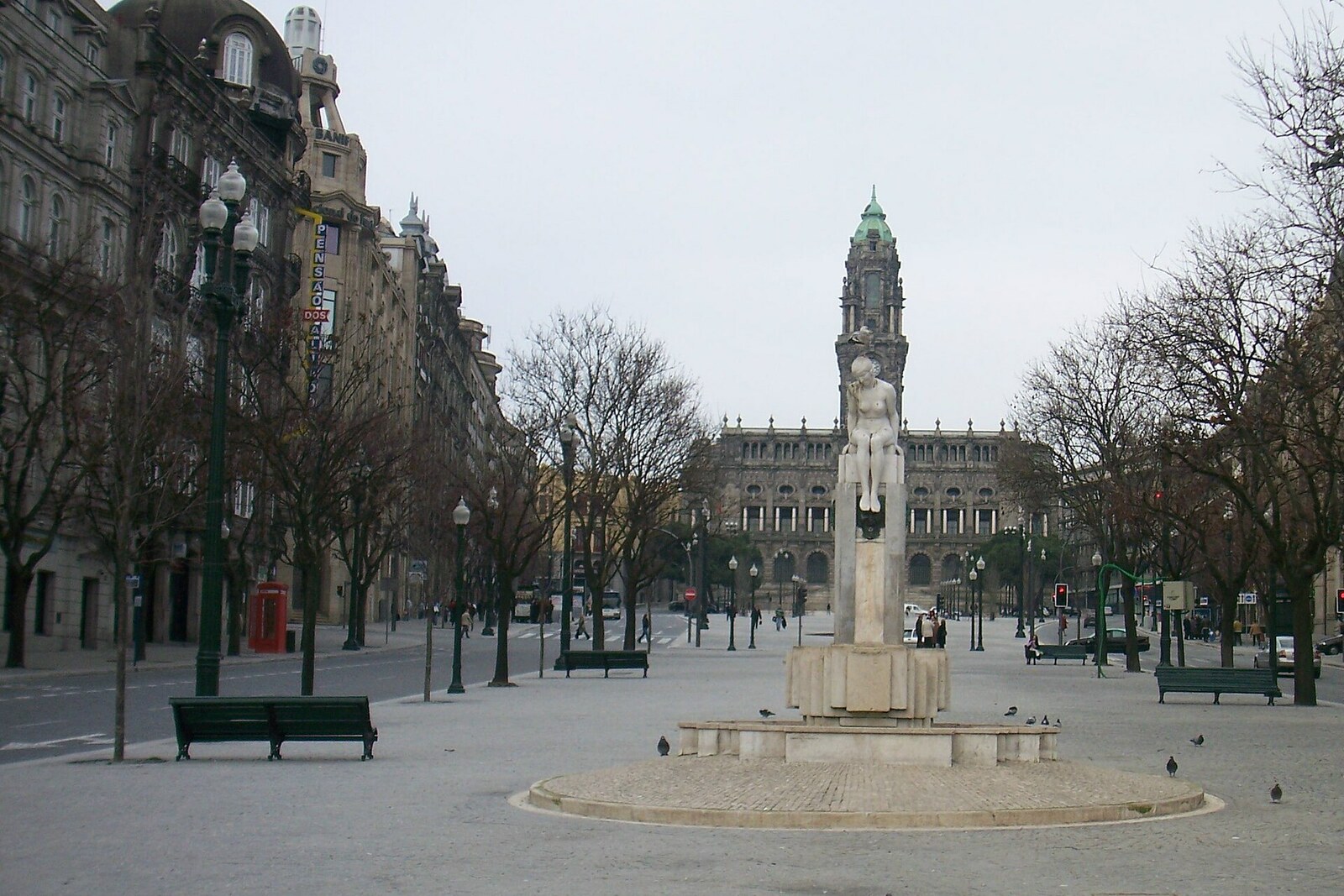
Look around first
What to notice
- The present-day city hall tower
- Praça da Liberdade
- The avenue’s long vista
The story of the place
When Porto needs a large open-air civic space, traffic on Avenida dos Aliados is blocked off. This is where people welcome the New Year, hold citywide ceremonies, and celebrate football club victories. Between Praça da Liberdade and city hall, it becomes a long grandstand without walls. Yet on January thirty-first, eighteen ninety-one, there was no avenue here at all. The north side of Praça de D. Pedro—as today’s Praça da Liberdade was then called—was occupied by the old city hall.
That morning, Augusto Alves da Veiga stepped onto its balcony. He was a lawyer, journalist, and teacher, and the civilian leader of an uprising against the Portuguese monarchy. The previous year, the British government had demanded that Portugal give up its claims to the lands between Angola and Mozambique. The king and his ministers gave way. To the republicans, this proved that the monarchy was no longer capable of defending the country’s interests.
Alves da Veiga sought the proclamation of a republic. Soldiers and sergeants from two regiments came to city hall; there were only a few officers among them. Military bands played A Portuguesa, a song written after the British Ultimatum. It would become the national anthem later. The rebels occupied the building, raised the red-and-green flag of the republican club over it, and Alves da Veiga declared the monarchy overthrown. The actor Miguel Verdial read out the membership of the provisional government in a loud voice. The list even included people who had not been asked in advance whether they were willing to join it.
Proclaiming a new regime from the balcony proved easier than establishing it in the city. The rebels needed the telegraph office and the military headquarters by Praça da Batalha. The column went up Rua de Santo António, today’s Rua de 31 de Janeiro, but the municipal guard blocked the way. After its volley, the formation broke apart. Some of the soldiers returned to city hall, which was soon fired on by two artillery pieces. By around half past ten, it was all over. The official count recorded twelve people killed and forty wounded; researchers consider these figures understated.
Hundreds of military personnel appeared before courts convening directly on ships in the Port of Leixões. The two regiments that took part were dissolved. Alves da Veiga managed to escape to France and decided not to return while the monarchy remained in Portugal. In Paris, he earned money by teaching Portuguese and doing legal work at consulates. Alves da Veiga returned home only after the proclamation of the republic in nineteen ten, and then received a diplomatic post in Belgium.
The balcony from which he proclaimed the republic for several hours disappeared. On February first, nineteen sixteen, President Bernardino Machado began the demolition of the old city hall. It was demolished together with Bairro do Laranjal to make way for a broad city avenue. The new city hall was planned for the other, upper end.
The Allies entered the name later. On November fourteenth, nineteen eighteen, three days after the armistice in the First World War, the city council unanimously renamed the still-unfinished Avenida da Cidade Avenida das Nações Aliadas. The name referred to the countries of the Entente—above all France and Britain, and the states that joined them; Portugal fought on their side. Over time, the long official name was shortened to Avenida dos Aliados.
One precise spatial link remains from the earlier scene: at the lower end of the avenue, where it opens onto Praça da Liberdade, stood Alves da Veiga’s city hall. The present-day city hall stands at the opposite end, and between them lies the street that received its name three days after the war ended.
Useful on site
The public space is open around the clock.
Checked: June 17, 2026. Check the official source before visiting.Stop where the entire axis of the avenue is clearly visible, but do not linger in the roadway or at crossings. The story concerns the whole space: you do not need to enter city hall for this stop.