 Guide On Map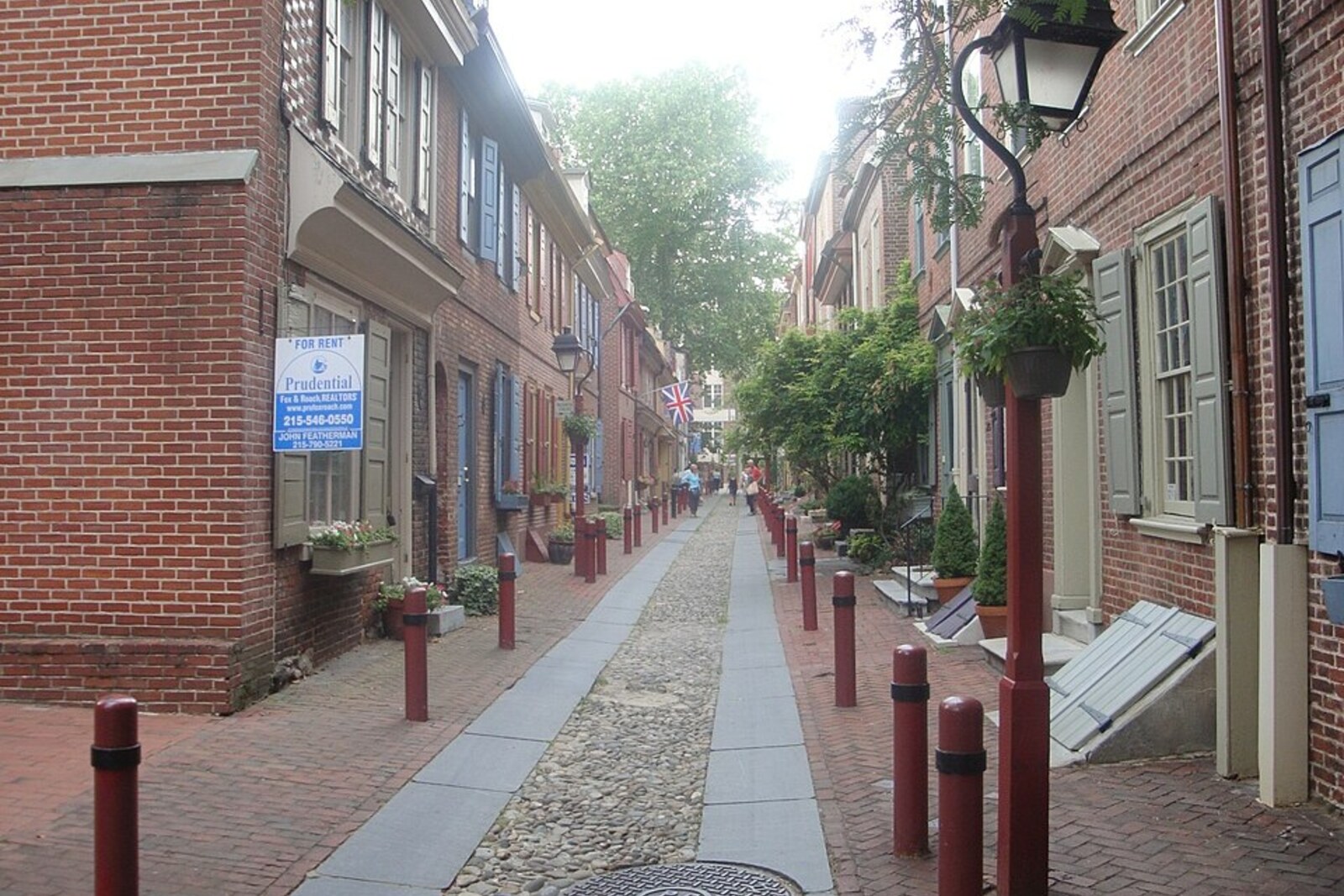
Look around first
What to notice
- 115 Elfreth's Alley
- 124 and 126 Elfreth's Alley
- Hearthstone Café sign
- Row of narrow houses
The story of the place
The present row of narrow houses grew up along a passage that was set aside between private plots in the early eighteenth century for wagons traveling to the river. There was not enough room at the port, so the street-facing room here often served as a workshop, while the family of a craftsman lived behind it. Blacksmiths, carpenters, tailors, and shoemakers worked in such houses. The alley was named for the blacksmith Jeremiah Elfreth, who built rental housing nearby, although the passage itself existed before his houses.
In August nineteen thirty-three, Dollie Otte, owner of the Hearthstone Café at 115 Elfreth's Alley, learned that George Wetherill's paint and varnish factory had already bought three old houses here—one hundred six, one hundred fourteen, and one hundred twenty-four. Its production buildings pressed right up against the backyards, and the new acquisitions could disappear behind a factory wall.
Otte made her living from inexpensive lunches. Sandwiches at the Hearthstone Café cost ten or fifteen cents, and customers were served in the rooms of a cramped old house. She did not have the money to buy the neighboring buildings. She wrote to the Sunday newspaper Evening Bulletin and asked how to stop the demolition.
Frances Anne Wister, head of the recently founded Philadelphia Society for the Preservation of Landmarks, read the letter. She knew how to win the support of wealthy city residents and negotiate with municipal officials. On March twenty-eighth, nineteen thirty-four, residents founded the Elfreth's Alley Association: Florence Greer became its chair, and Dollie Otte her deputy.
To make city residents want to defend the alley, its residents let them into places where they were not usually allowed: their homes. Hundreds of people came to the first open day. Eight years later, the number of visitors had reached nearly two thousand. Elfreth's Alley Day became an annual fundraiser. At the same time, association members filed petitions against the factory and sometimes stopped demolitions simply by being present at the houses. Wister's society persuaded the mayor to suspend several orders to dismantle buildings.
Otte's own café did not bring her success. As early as nineteen thirty-six, she asked Wister to help her negotiate with the gas company over an unpaid bill, and in nineteen forty-two she closed the Hearthstone Café. The association continued its work, and the following year 115 Elfreth's Alley became its headquarters.
124 Elfreth's Alley, for which Otte began the fight, also explains the alley's name. In seventeen oh three, the landowners Arthur Wells and John Gilbert set aside narrow strips of their properties for a wagon passage to the river. There was not enough room near the port for housing and workshops, so blacksmiths, carpenters, tailors, and shoemakers settled along the passage; the front room often served as a workshop, while the others were the family home.
From about seventeen fifty, people began calling the passage after Jeremiah Elfreth—a blacksmith and the owner of land on both sides of the exit onto Second Street. He built houses here to rent out, including 124 Elfreth's Alley and the original 126 Elfreth's Alley, and later sold them. Elfreth did not found the alley: his surname became attached through the transactions involving plots at its entrance.
A museum now operates in 124 and 126 Elfreth's Alley, while the other buildings remain primarily private homes. The museum collection holds the Hearthstone Café sign—the café whose owner could not pay for gas but did manage to stop the factory from swallowing up the house built by the man whose name Elfreth's Alley bears.
Useful on site
This is a residential street: stay in the public passage, do not look into windows, and do not occupy doorsteps for photographs.