 Guide On Map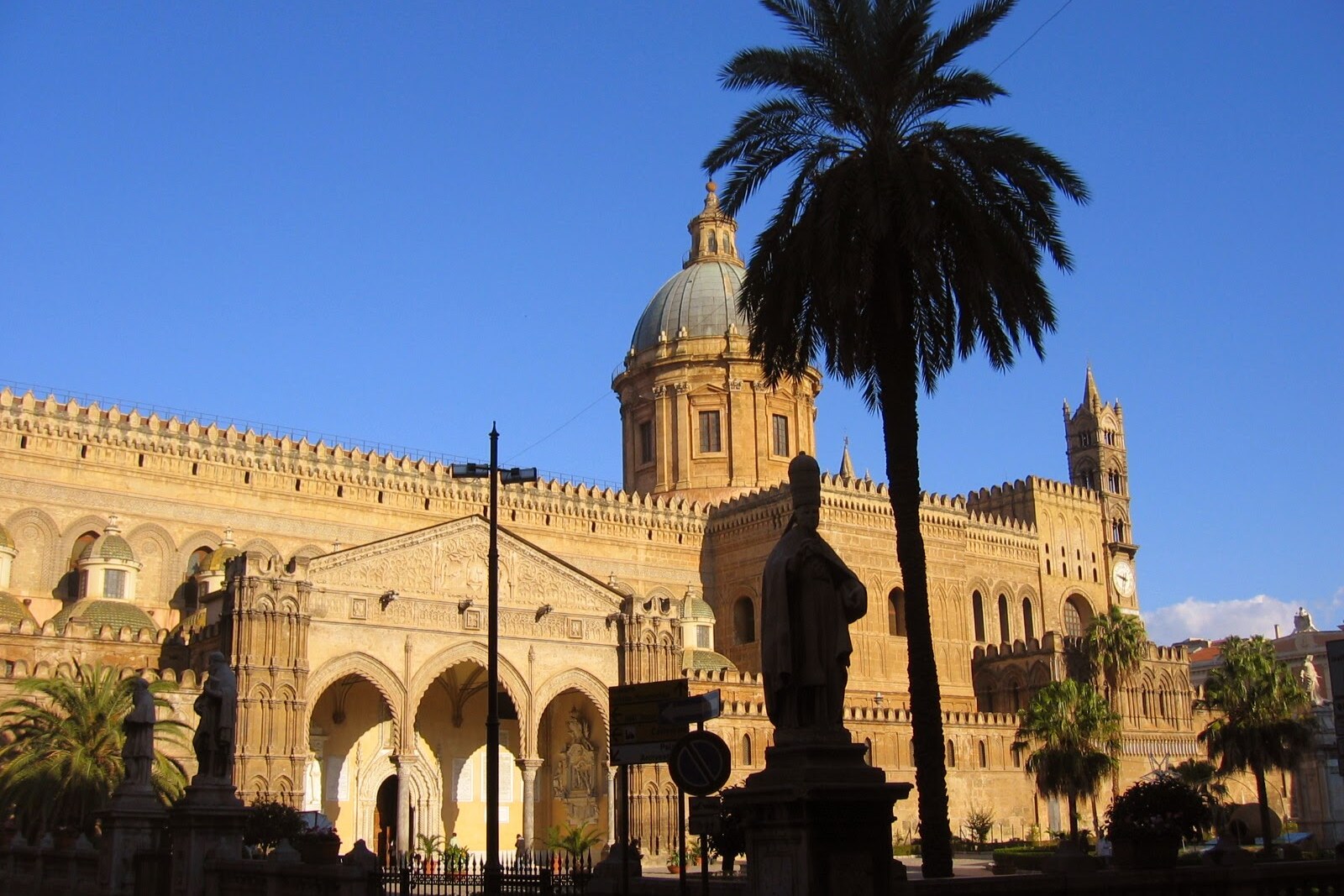
Look around first
What to notice
- South portico
- Royal tombs
- Red-porphyry sarcophagi
- The archbishop's chair
The story of the place
The cathedral serves as the main church of the Catholic Archdiocese of Palermo: it contains the archbishop's chair, from which the word “cathedral” derives, and its principal services are held here. The church's full dedication is to the Virgin Mary Assumed into Heaven. For Sicily's rulers, the cathedral had one more direct function: in the capital of the kingdom, this was where they were anointed and crowned.
In the spring of eleven ninety-eight, Queen Constance of Hauteville was preparing such a ceremony for her three-year-old son Frederick II. She was seeking to have the boy recognized as Sicily's heir while that was still possible.
His right to the throne came from his mother. After the death of the childless King William II, the Sicilian nobility preferred another ruler to Constance—Tancred, already familiar from the rebellion at the Norman Palace. Constance's husband, the German emperor Henry VI, conquered the kingdom and crowned himself in this cathedral at Christmas in eleven ninety-four. He wanted to pass both Sicily and the imperial inheritance to his son. When Frederick II turned two, the German princes even elected him King of the Romans—the title given to a future claimant to the imperial crown.
In September eleven ninety-seven, Henry died unexpectedly. The German princes began choosing another king, while in Sicily a rebellion rose against the late emperor's men. Constance sent the German commanders away, brought her son back from Central Italy, and reached an agreement with Pope Innocent III, who considered himself the supreme lord of the Kingdom of Sicily. In return for recognition of the heir, she ceded to the pope some rights over the local church.
On May seventeenth, eleven ninety-eight, the day of Pentecost, Frederick II was crowned King of Sicily here. Under the accepted Sicilian rite, after Mass the nobles were to swear allegiance to him, while acclamations of praise were heard in Latin and Greek. Constance's decision immediately appeared in the documents: the former title of King of the Romans disappeared. The mother was giving up her son's German claims in order to keep one crown for him—the Sicilian one.
In November of the same year, Constance died. In her will, she appointed Pope Innocent III Frederick II's guardian. The crown remained with the child, but papal representatives and rival courtiers controlled his inheritance. Only at fourteen did Frederick II begin to rule on his own; later, he did return to his German claims and became emperor.
In twelve fifteen, Frederick II ordered two red-porphyry sarcophagi, commissioned by his grandfather Roger II, to be brought from Cefalù to this cathedral. He placed the remains of Henry VI in one and reserved the other for himself. Now, at the beginning of the right nave, stand the tombs of father, mother, and son: Constance, who crowned the three-year-old Frederick II here for the sake of the Sicilian inheritance, is buried beside him.
Useful on site
Nave: Mon–Sat 07:00–19:00, Sun 08:00–19:00. Monumental area: Mon–Sat 09:30–18:00, Sun 10:00–18:00; last entry 17:30.
Checked: June 24, 2026. Check the official source before visiting.The interior is crowded with periods; follow the details of the story rather than trying to take everything in on one circuit.