 Guide On Map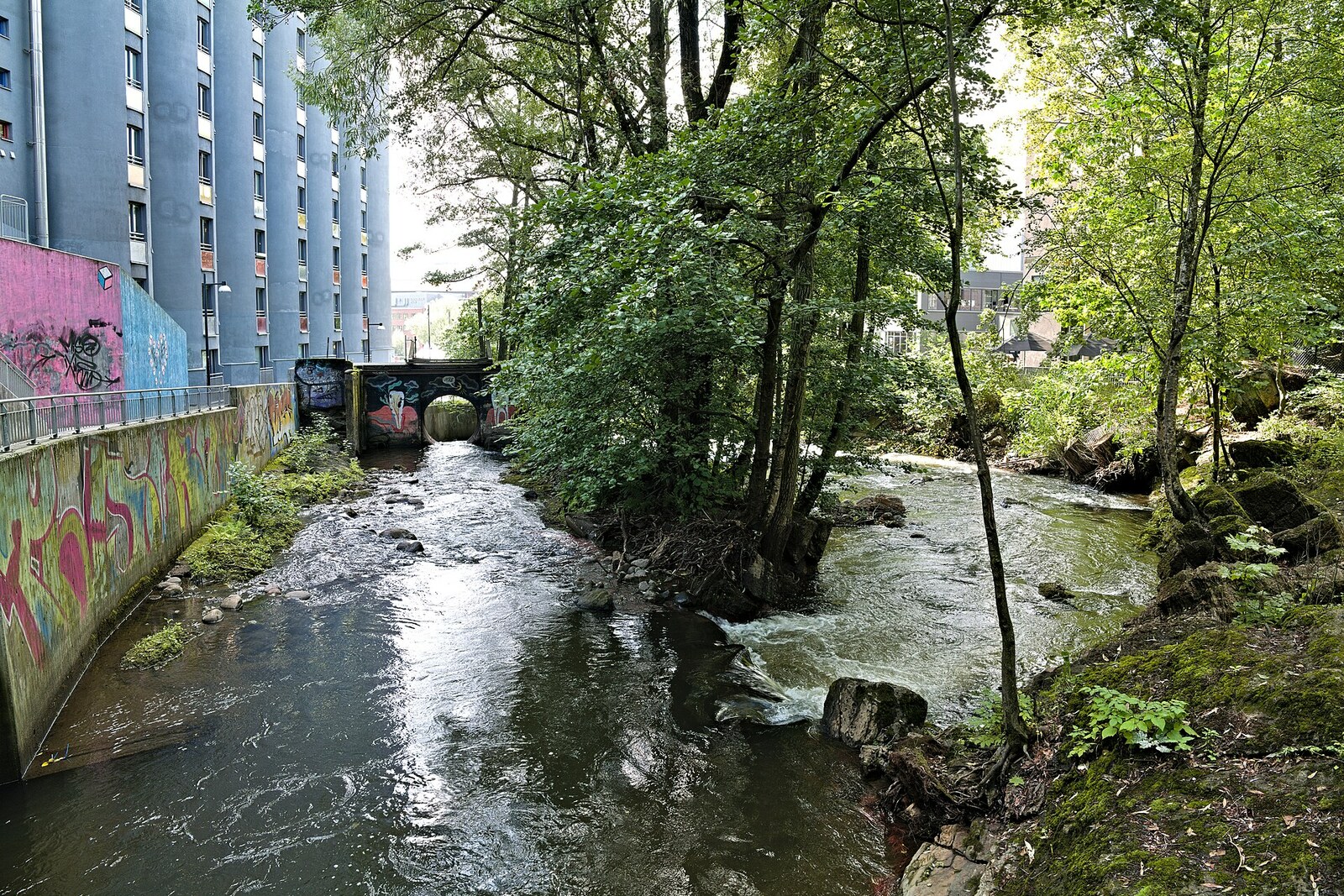
Look around first
What to notice
- Nedre Foss waterfall
- Main manor house
- Tall grain silo
The story of the place
Here, Akerselva drops almost six meters before reaching the fjord. In the Middle Ages, monks from the island of Hovedøya set up a grain mill by this drop and milled, among other things, the church tithe there. After the Reformation, the waterfall and mill came under the Crown's control, and the owner's house, warehouses, and service buildings grew up beside the production. The mill itself was dismantled long ago, but the main manor house and tall grain silo remain, and students now live in the silo.
At Nedre Foss, the last significant fall of Akerselva before the fjord, on September twenty-seventh, sixteen fifty-one, Fredrik Boyesen, the tenant of the local mill, obtained a special charter from the king. He asked that after his death, any of his children could take over the business, including a daughter if no sons remained. In the charter, the king agreed: the mill, sawmill, and manor could be passed to a daughter on the existing terms.
The request concerned a valuable family business. Fredrik's father, Boje Fredriksen, received Nedre Foss in a dilapidated state and restored the mill at his own expense. For the farm, sawmill, and the right to use the waterfall, he paid the Crown one hundred rixdalers each year—a large sum at the time. He earned money because grain from the area around Kristiania had to be milled here: the mill held the exclusive right within a quarter of a mile of the city. When, after his parents' deaths, another claimant tried to take over the lease, Fredrik defended the hereditary right. The royal charter secured the result of his father's investments for Fredrik's children.
The waterfall gave it that value. Nedre Foss means Lower Falls: it is the last significant fall of Akerselva before the fjord, about six meters high. Between the mid-twelfth and early thirteenth centuries, monks from the island of Hovedøya set up a grain mill here. They milled, among other things, the tithe—grain collected for the church. After the Reformation, the business passed to the king and was given the name King's Mill. A house for the owner or tenant, warehouses, and other service buildings were needed nearby: the manor arose alongside the production, not separately from it.
Fredrik's daughter, Margrethe, was married to the royal mint master Friedrich Grüner. In sixteen seventy-two, Grüner bought Nedre Foss from the Crown, and the leased Boyesen business became family property. The surname first passed to the mill, then to the lands it owned east of the river. They were called the Grüners' tract—Grünerløkka.
The house in front of the waterfall appeared later. The merchant and head of the city fire service, Jens Christian Smith, built it in eighteen oh one to eighteen oh two. That same year, his daughter Anna Maria married Hans Fredrik Grüner, Anna Maria's Husband, and Nedre Foss returned to that family after a forty-year break. Half a century later, their grandson, also Hans Fredrik Grüner the Grandson, began dividing the manor fields into building lots: the expanding Kristiania was already reaching the river. A residential neighborhood grew on the former mill land, but the tract's name was not changed.
The mill itself was shut down at the end of the twentieth century, and its last building was dismantled in nineteen eighty-six. The tall grain silo of the later enterprise is now occupied by student apartments. The main house has retained the appearance of a manor, although after the fire of nineteen fifteen it had to be extensively restored. There is no longer a mill at Lower Falls, but the surname of its owners remains in the name of the whole neighborhood—Grünerløkka.
Useful on site
The park is open around the clock; lighting is limited in the evening. Fishing at the waterfall is prohibited.
Checked: June 17, 2026. Check the official source before visiting.View the waterfall from the park paths; there is no need to enter the restaurant or the manor building for this stop.