 Guide On Map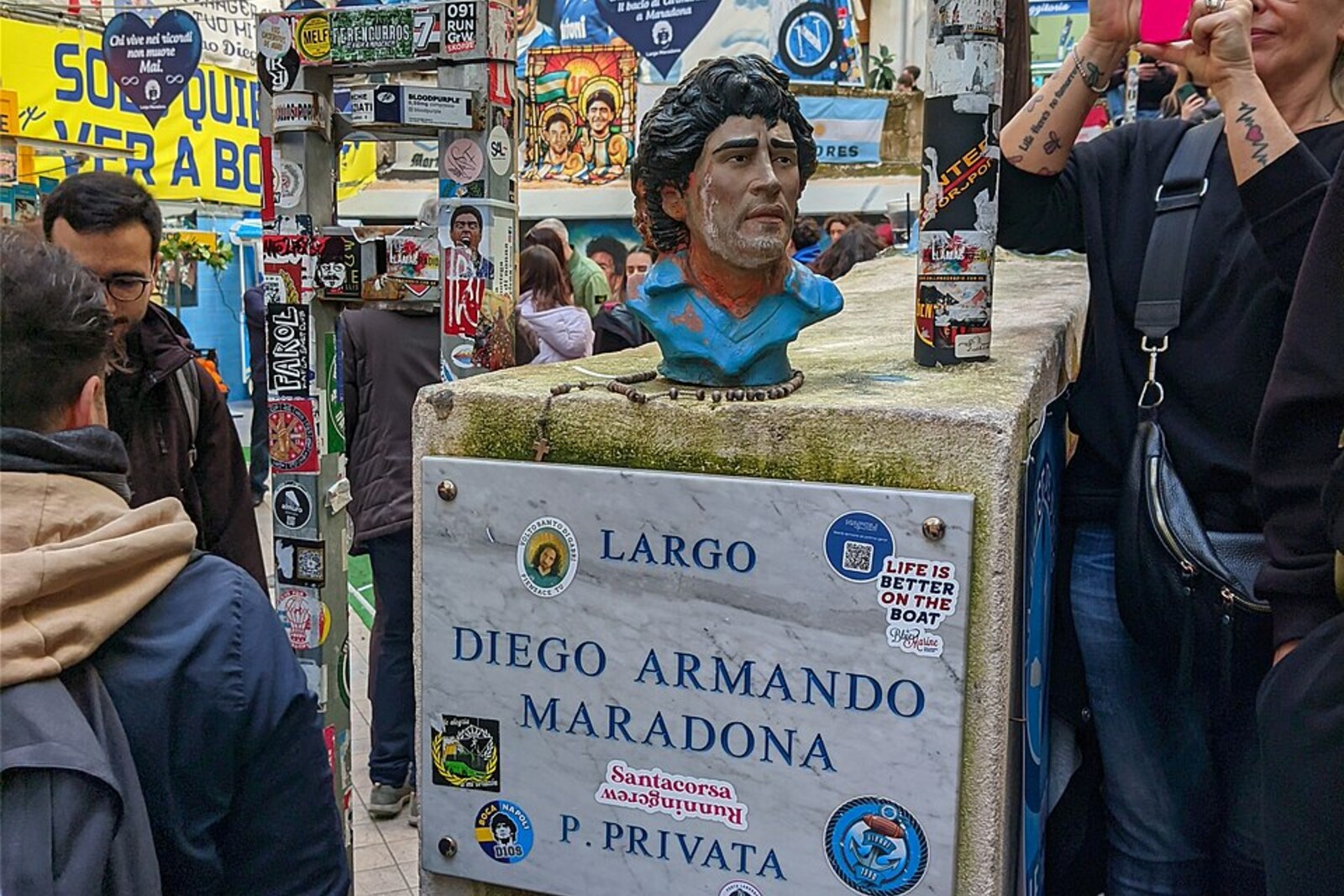
Look around first
What to notice
- The ten-meter portrait of Diego Armando Maradona
- Wooden shutters in place of the face
- The altar beneath the wall
The story of the place
Beside a residential building in the Spanish Quarter, a cramped small square has become a place where fans bring scarves, jerseys, balls, flowers, and candles. A ten-meter portrait of the Argentine player in a blue kit, with the number ten and a ball, fills the entire windowless wall of six stories. This place was once known as the artists' square, and the objects left beneath the wall form a permanent altar here.
In the spring of nineteen ninety, Mario Filardi climbed the scaffolding beside the windowless wall of a six-story building. The twenty-three-year-old resident of the Spanish Quarter earned his living as a waiter and painted for himself. Now local fans had commissioned from him a ten-meter portrait of Diego Armando Maradona—the Argentine captain and Napoli's leading player, who was guiding the club toward its second Italian championship.
Three years earlier, Diego Armando Maradona had already helped Napoli become national champions for the first time. In the spring of nineteen ninety, the team was again competing for the title, and the fans needed a portrait that could not be removed after a single day of celebration. They collected money for paint, passed supplies to Filardi, and illuminated the wall at night with car headlights. He worked for two nights and three days on unsteady scaffolding. His sister remained below, afraid that her brother would fall or that pipes would collapse onto him. When the portrait was finished, Diego Armando Maradona filled the entire wall—in a blue kit, with the number ten, moving with the ball.
By the end of the nineties, the paint had faded, and a window had been cut into the wall exactly where the face was. Filardi died in two thousand ten and did not save his Diego Armando Maradona. Six years later, the local carpenter and restorer Salvatore Iodice decided to restore the painting. He asked permission from Filardi's mother and sister, collected money from shopkeepers and fans, obtained a lift, and repainted the almost vanished figure.
The window opening remained: behind it was the bathroom of a residential apartment. Iodice cut two shutters from the side panel of a discarded cabinet and continued the face onto them. In two thousand seventeen, the Argentine artist Francisco Bosoletti, who was working on the neighboring wall, asked permission to make Diego Armando Maradona's features more recognizable. That is how the present face came to be painted over the wooden shutters that the residents still use to close their window.
On the twenty-fifth of November, two thousand twenty, Diego Armando Maradona died in Argentina. Fans gathered at the portrait and brought jerseys, scarves, flowers, candles, photographs, and balls. They set up an altar beneath the wall, and the small square formerly known as Largo degli Artisti—the artists' square—came to be called Largo Maradona. People continue to come here as to a secular shrine precisely because the residents created this image for him during his lifetime.
When the shutters are open, the ten-meter portrait of Diego Armando Maradona loses its face. When the residents close the bathroom window, the portrait becomes whole again.
Useful on site
Around the clock, on the street; it is more comfortable and respectful to come during the day, when it is easier not to disturb residents.
Checked: June 29, 2026. Check the official source before visiting.The courtyard can be crowded: do not block the residents' passage, and distinguish personal offerings from souvenir stalls. No special reservation is required for viewing from outside.