 Guide On Map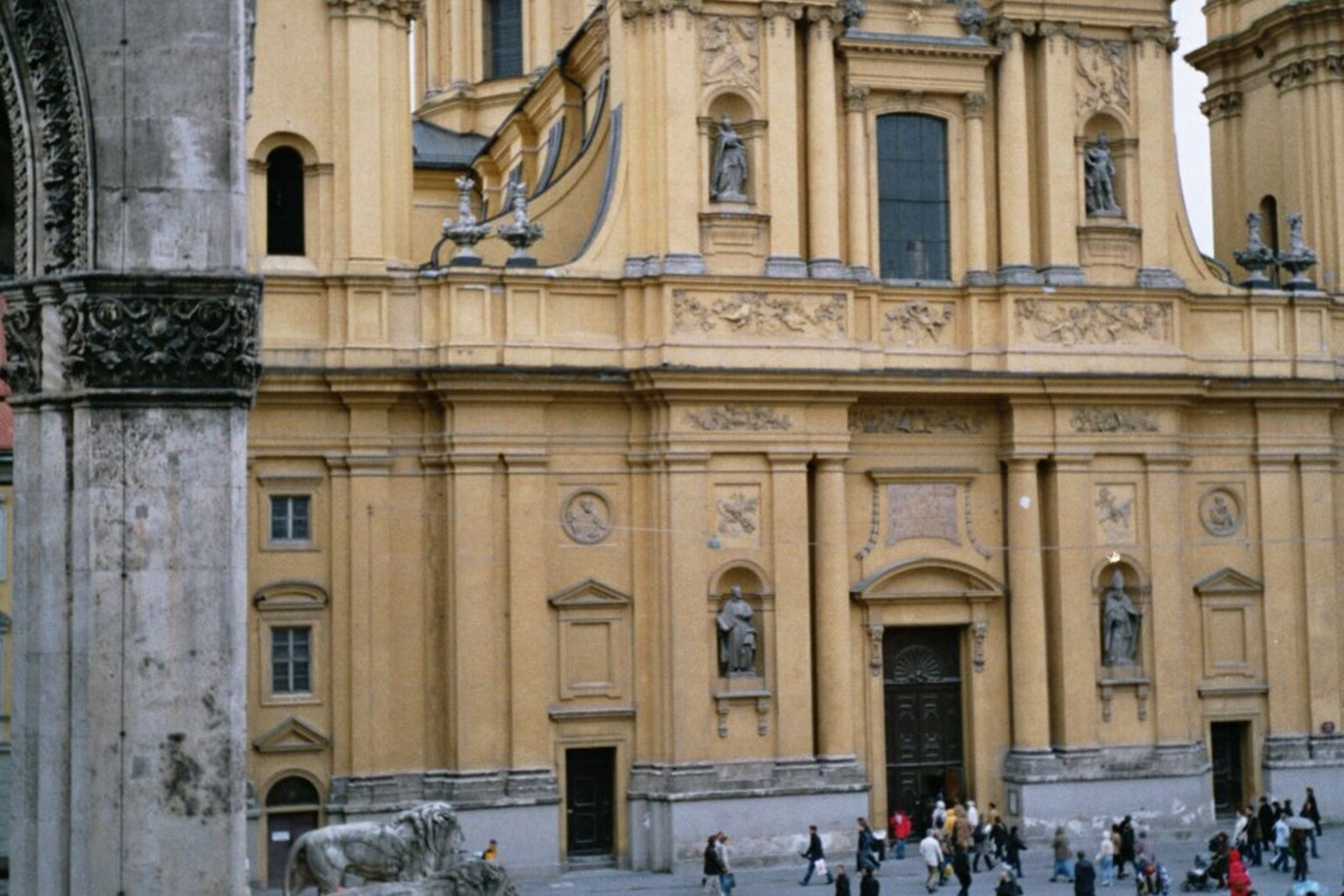
Look around first
What to notice
- Façade of the Munich Residenz
- Feldherrnhalle
- Bronze strip in Viscardigasse
- Plaque bearing the police officers' names
The story of the place
For more than four centuries, the Bavarian ruling House of Wittelsbach lived in the Munich Residenz and governed the country from here; the palace halls and treasury are now open as a museum. The open loggia with arches and vaults is called the Hall of Commanders: King Ludwig I commissioned it in memory of the Bavarian army, and figures of its commanders were placed in the niches. The square's name remained from the Odeon, a concert and ballroom on the northwestern side. After wartime bombing, the Odeon's façade was restored, its auditorium was turned into an inner courtyard, and the Bavarian Ministry of the Interior was housed behind the wall.
Twenty-seven-year-old Lieutenant Michael von Godin positioned police officers across the exit from Residenzstraße onto Odeonsplatz. He commanded a unit of the Bavarian State Police—an armed police formation—and had been ordered not to let a column of rebels onto the square. The street was squeezed between the wall of the Munich Residenz and the eastern side of the Feldherrnhalle. It was in this passage, on the morning of November ninth, nineteen twenty-three, that the fate of the putsch was decided—a putsch its organizers intended to continue in Berlin.
The Munich Residenz on the right gave the street its name. For more than four centuries, the House of Wittelsbach lived here and governed Bavaria; the palace apartments and treasury are now a museum. The open loggia on the left is called the Feldherrnhalle—the Hall of Commanders. King Ludwig I commissioned it as a monument to the Bavarian army. Beneath its vaults stand Count Tilly, who commanded the forces of the Catholic League in the Thirty Years' War, and Prince Wrede, who commanded the Bavarian army during the Napoleonic Wars.
The square itself took its name from another building. The Odeon was a concert and ballroom built by Leo von Klenze on the square's northwestern side. After the bombing of the Second World War, architects restored the façade, but turned the former auditorium into an inner courtyard. The Bavarian Ministry of the Interior now operates behind the old outer wall.
Adolf Hitler, leader of the National Socialist Party, wanted to overthrow the republican government of Germany. The previous evening, he had burst into a meeting in a Munich beer hall with armed supporters, fired at the ceiling, and forced Bavaria's leaders to declare their support for the coup. General Erich Ludendorff, one of Germany's best-known military commanders of the First World War, was meant to use his name to draw the army and conservatives to the putschists' side.
At night, the released Bavarian leaders withdrew the promises extracted by threats. Officials retained control of the institutions, and the police occupied the streets. Nevertheless, Hitler and Ludendorff led about two thousand supporters from the beer hall into the center. They expected that this show of force would bring soldiers and townspeople over to them. Their goal was not the Feldherrnhalle: farther along Ludwigstraße stood the district military command, occupied by allies of the putschists.
At the Feldherrnhalle, the column encountered Godin's men. The front ranks tried to push through the police line. Shooting began; historians have been unable to establish reliably who fired first. Within a few moments, fifteen putschists, one bystander, and four police officers were killed. The column scattered. Hitler fled and was arrested two days later. Ludendorff was detained on the spot.
The party was banned, but the court gave Hitler a platform for speeches and imposed a comparatively mild sentence—five years of fortress imprisonment. He was released early in December of the following year. At Landsberg Prison, he worked on the book Mein Kampf, and after his release he re-established the party and abandoned a new armed putsch in favor of elections and legal procedures, while retaining the intention of destroying the republic.
For Michael von Godin, the consequences of the shots at the Munich Residenz did not end that day either. After the National Socialists came to power in the country, he was imprisoned in Dachau concentration camp. Later he went to Switzerland, and after the war he returned and headed the Bavarian State Police.
The Nazis erected a memorial to the fallen putschists on the eastern side of the Feldherrnhalle and posted a permanent guard in front of it. Passersby were forced to give the Hitler salute. Those who did not wish to do so turned behind the hall into Viscardigasse; their detour is now marked by a strip of bronze paving stones. Munich residents threw the memorial to the putschists from its pedestal in June nineteen forty-five. On the façade of the Munich Residenz opposite, another plaque remains—with the names of the police officers Friedrich Fink, Nikolaus Hollweg, Max Schobert, and Rudolf Schraut, who were killed here while stopping the column.
Useful on site
The route ends outdoors; the Munich Residenz museum rooms require a separate visit and time of their own. On the square, watch the flow of people and do not stop in the middle of the passage.