 Guide On Map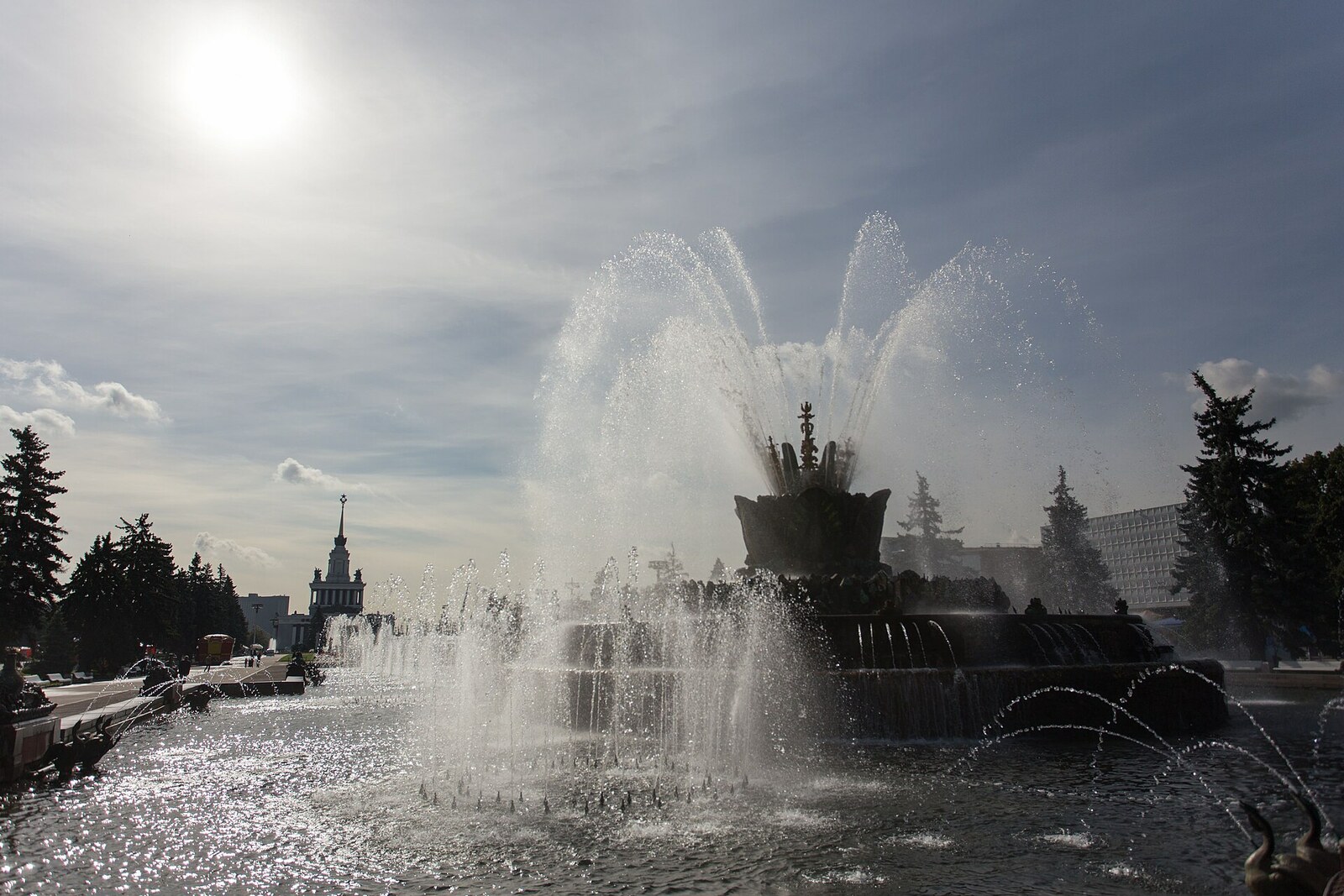
Look around first
What to notice
- Concrete petals covered with smalt
- Jets emerging from the petals
- Sixteen tables
- Bronze fruit and vessels
The story of the place
At the center of the fountain is an open concrete bud with broad petals from which jets of water rise. The smalt cladding is arranged to resemble malachite, jasper, lapis lazuli, and other gemstones. Sixteen tables with bronze fruit, ears of grain, and vessels stand around it, preserving the harvest theme at the base. During the restoration, about one-third of the earlier glass was retained, while the rest was made anew based on the cleaned fragments.
In nineteen fifty-one, the exhibition organizers moved the Golden Sheaf to the Central Pavilion. Engineers had already installed a hydraulic system at this site. They decided not to dismantle the completed pipes and water outlets: architect Konstantin Topuridze and sculptor Prokopy Dobrynin were commissioned to devise a different composition for them.
Three years remained before the opening. Topuridze was responsible for the fountain’s design, and Dobrynin for its central sculpture. They found the new form in the tales of writer Pavel Bazhov. Their protagonist, the stone carver Danila, tries to carve a flower from malachite but sees lifeless stone in his work. In pursuit of an unattainable model, he asks the Mistress of the Copper Mountain to show him the flower from her underground garden. Afterward, he smashes his own bowl and disappears into the mountain. This is the origin of the fountain’s name and the open bud at its center.
Dobrynin assembled the flower from large concrete petals. Mosaic artists from the Academy of Arts covered them with multicolored smalt—glass depicting malachite, jasper, lapis lazuli, and other gemstones. Water emerges directly from the petals. Sixteen tables with bronze fruit, ears of grain, and vessels survive around the flower: the new fairy-tale composition took the place of the former sheaf, but the creators retained the theme of the harvest at its base.
A later account is associated with the first activation, but no documentary confirmation of it has yet been found. While those assembled were waiting for the ceremony to begin, Dobrynin climbed inside the flower with a brush and paint: the sculptor wanted to touch up the seams and fill the cracks before the official acceptance. The operators did not know that the creator was inside and switched on the pumps. Water struck Dobrynin from below; he emerged soaked and staggering in full view of the public. The fountain was nevertheless opened on schedule, and the Main Exhibition Committee awarded the sculptor the Small Gold Medal for his work at the exhibition.
After the restoration, about one-third of the original smalt remained in the cladding. The rest of the glass was made anew based on the cleaned fragments. The concrete bud still opens above the spot where the already completed hydraulics forced the two creators to abandon the sheaf and seek a different form for the water.
Useful on site
As of the verification date: daily 07:00–00:00; operation is seasonal.
Checked: date not specified. Check the official source before visiting.Walk around the basin and change your viewing angle: the smalt reflects the light differently. When the jets are off, the individual mosaic scenes are easier to see.