 Guide On Map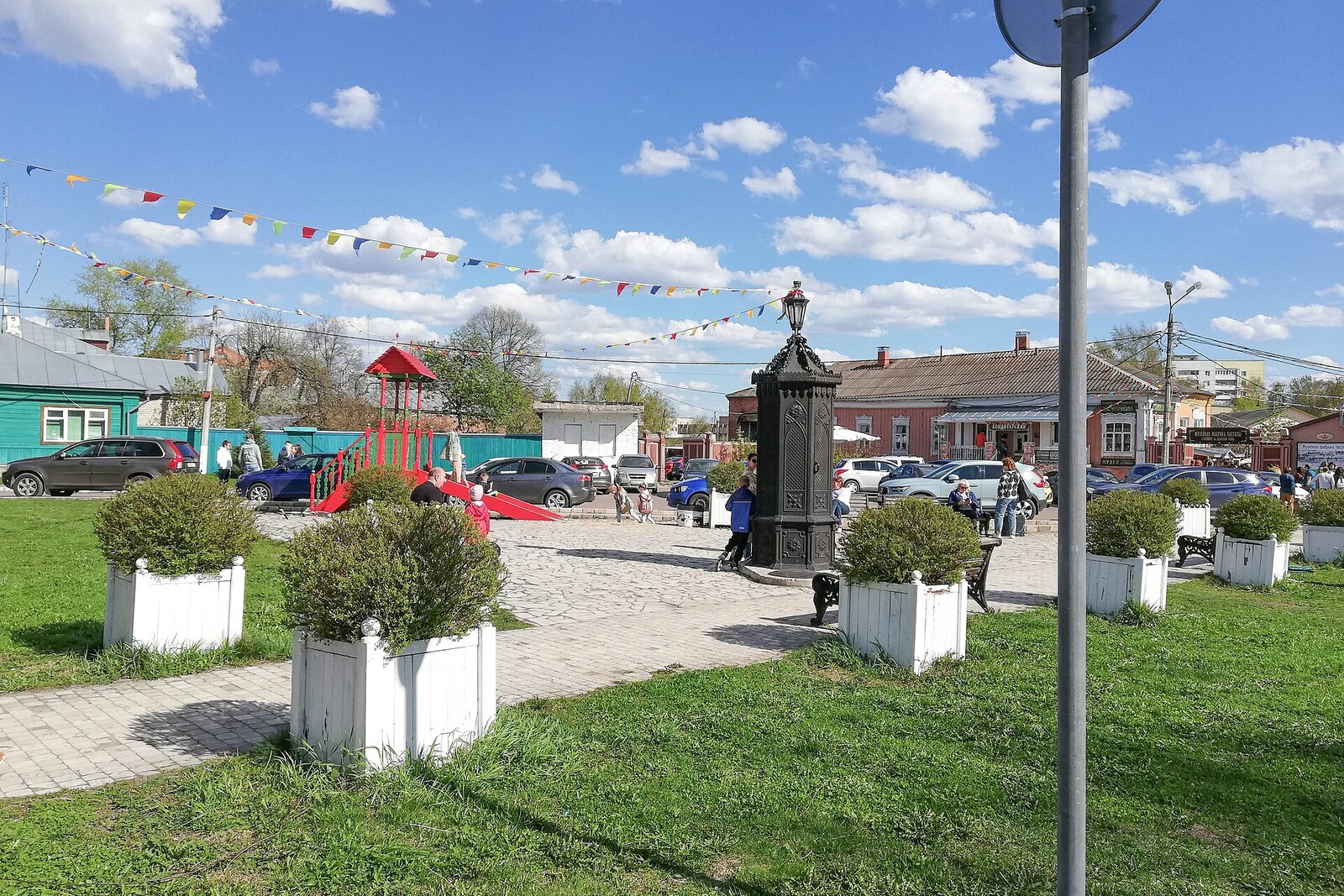
Look around first
What to notice
- Octagonal cast-iron water standpipe
- Tap
- Dedicatory inscription bearing Maria Shevlyagina’s name
The story of the place
The octagonal cast-iron tower with a tap is a water standpipe. In Kolomna, such standpipes were called basseyki, and they became known as Shevlyagin Water Standpipes after the woman who paid for the city waterworks.
The money came from the cattle business. The merchant Nikolai Shevlyagin drove herds from the Astrakhan steppes; the animals were slaughtered in Kolomna, the meat was salted and sent to Moscow and St. Petersburg. In his will, he set aside fifty thousand rubles for building the waterworks. It fell to Maria Shevlyagina, the merchant’s widow, to carry out his wishes. After her husband’s death, she managed the family capital herself and wanted to bring clean water to the city.
At the time, Kolomna residents drew water mainly from the rivers. The city treasury could not afford a large waterworks system, so whether the project went ahead depended on Shevlyagina’s terms. There were two conditions. Residents had to receive water from street standpipes free of charge. And Maria entrusted oversight of how the donation was spent to her trusted relative, Mikhail Posokhin. For this purpose, the City Duma elected him city head, as the elected head of the city was then called.
In eighteen ninety-seven, drilling began on two artesian wells by the Kolomenka River. Water was found at a depth of one hundred twenty meters and, after testing, was declared drinkable. Shevlyagina added money for a pumping station, a water tower, and street pipes. In nineteen oh two, water was supplied to six basseyki; one stood here, in what was then Milk Square.
Of Kolomna’s roughly thirty thousand residents, about twenty-four thousand used the new waterworks. Most came to the basseyki with their own containers and paid nothing. Wealthier homeowners could have a pipe installed to their homes, but their consumption was then measured by a water meter. Annual maintenance of the system cost about ten thousand rubles: the city and homeowners together covered two thousand, while Shevlyagina paid the remaining eight thousand.
The old basseyki were later dismantled. The present standpipe was made from pre-revolutionary drawings and opened on the former site in twenty thirteen, connected to the modern waterworks. On one of its sides, a dedicatory inscription bearing Maria Shevlyagina’s name has been reproduced. In twenty seventeen, the former Milk Square was also given her name. None of the original cast iron from nineteen oh two remains here; what remain are the same water-dispensing point and the surname of the woman who insisted that water from it should not be sold.
Useful on site
The open urban space is accessible at any time; the standpipe’s working condition and the safety of its water for drinking have not been confirmed.
Checked: date not specified. Check the official source before visiting.View the water standpipe as part of the city waterworks system; do not assume that the water is currently safe to drink.