 Guide On Map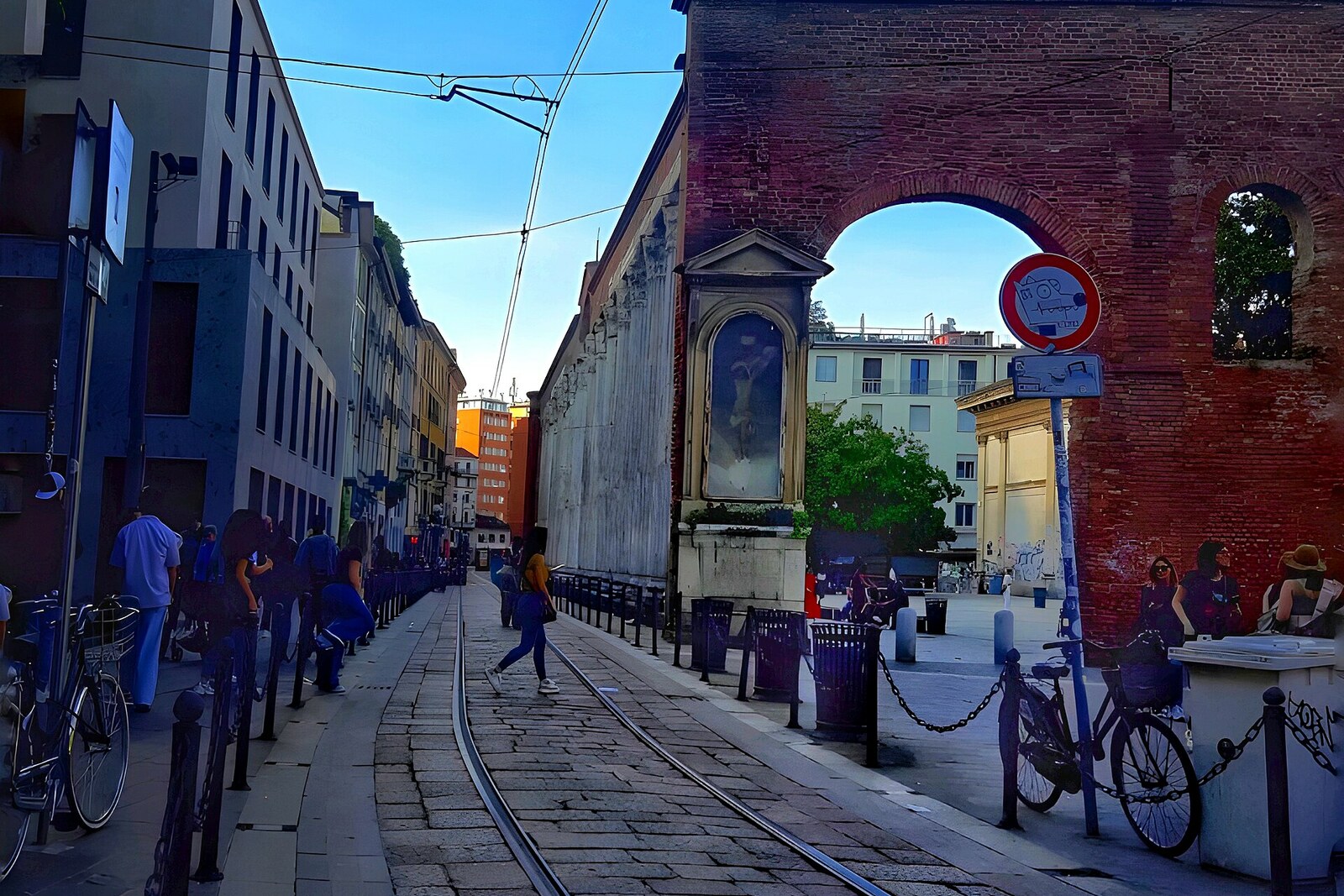
Look around first
What to notice
- A row of sixteen marble columns
- Corinthian capitals
- The central arch with a cross
- The gridiron ornament on the basilica's pilasters
The story of the place
In the evenings, young Milanese and students meet by the sixteen marble columns. They gather in the open space between the colonnade and the basilica. Until nineteen thirty-five, an entire block of residential houses stood here: it was demolished to reopen the view from the street toward the church. The present meeting place appeared after this clearance.
In fifteen forty-eight, the colonnade was nearly destroyed. Ferrante Gonzaga, governor of Milan, was preparing the ceremonial entry of Philip, Duke of Milan and future King Philip II of Spain. The Milanese were already paying special levies to fortify the city, and now they were also paying for the ruler's reception. Gonzaga was widening squares, putting streets in order, and ordering the removal of loggias, balconies, and awnings that projected over the road. The old Church of Santa Tecla was dismantled for this purpose. Corso di Porta Ticinese was also to be widened for Philip's passage—the columns stood in the way.
When Gonzaga was informed of the planned demolition, he cancelled it. The colonnade was decorated with an arch and a temporary ceremonial portico. At the beginning of December, Philip entered Milan and passed through this very spot. The festive decorations were dismantled, but the row of marble remained.
Gonzaga preserved a structure that by then already consisted of elements from several eras. The columns and Corinthian capitals were made in the second century for a large Roman public building; archaeologists have not yet established exactly which one. At the end of the fourth or beginning of the fifth century, builders moved them here and made them the street-facing side of an enormous four-sided courtyard in front of the present Basilica of San Lorenzo Maggiore. Nothing remains of the courtyard's other sides. The stone base, brick inserts, and central arch with a cross appeared in the Middle Ages.
The basilica itself was built around the same time that Milan served as the residence of the western emperors. No inscription bearing the patron's name has been found, and the building's original purpose remains disputed. Even its dedication to Saint Lawrence is mentioned in written sources only from the sixth century.
Lawrence was an archdeacon of Rome's Christian community and managed its donations. During the persecution of Christians under Emperor Valerian in the third century, the Roman prefect demanded that Lawrence hand over the Church's treasures. According to Church tradition, Lawrence gave the money to the poor and then presented them to the prefect as the community's true wealth. He was executed for refusing to hand the funds over to the imperial treasury. Ambrose, bishop of Milan, later wrote that Lawrence died on a red-hot gridiron, although historians consider the exact method of execution unproven. Inside the basilica, a gridiron recurs as an ornament on the upper part of the pilasters.
The Milanese call the columns San Lorenzo because they formed the entrance to the basilica's courtyard. Ferrante Gonzaga's temporary portico disappeared; Philip passed through the surviving row of marble after the governor cancelled its demolition.
Useful on site
The square with the columns is accessible as an open public urban space. According to the verified schedule, Basilica of San Lorenzo Maggiore is open Monday through Friday from 08:00 to 12:30 and from 15:00 to 18:30, and Saturday and Sunday from 09:00 to 13:00 and from 15:00 to 19:00; services may limit visits.
Opening hours by day
Start with the overall view, then approach the columns and compare the details up close. Enter the basilica and the Chapel of Sant'Aquilino only when access is open, without disturbing the service.