 Guide On Map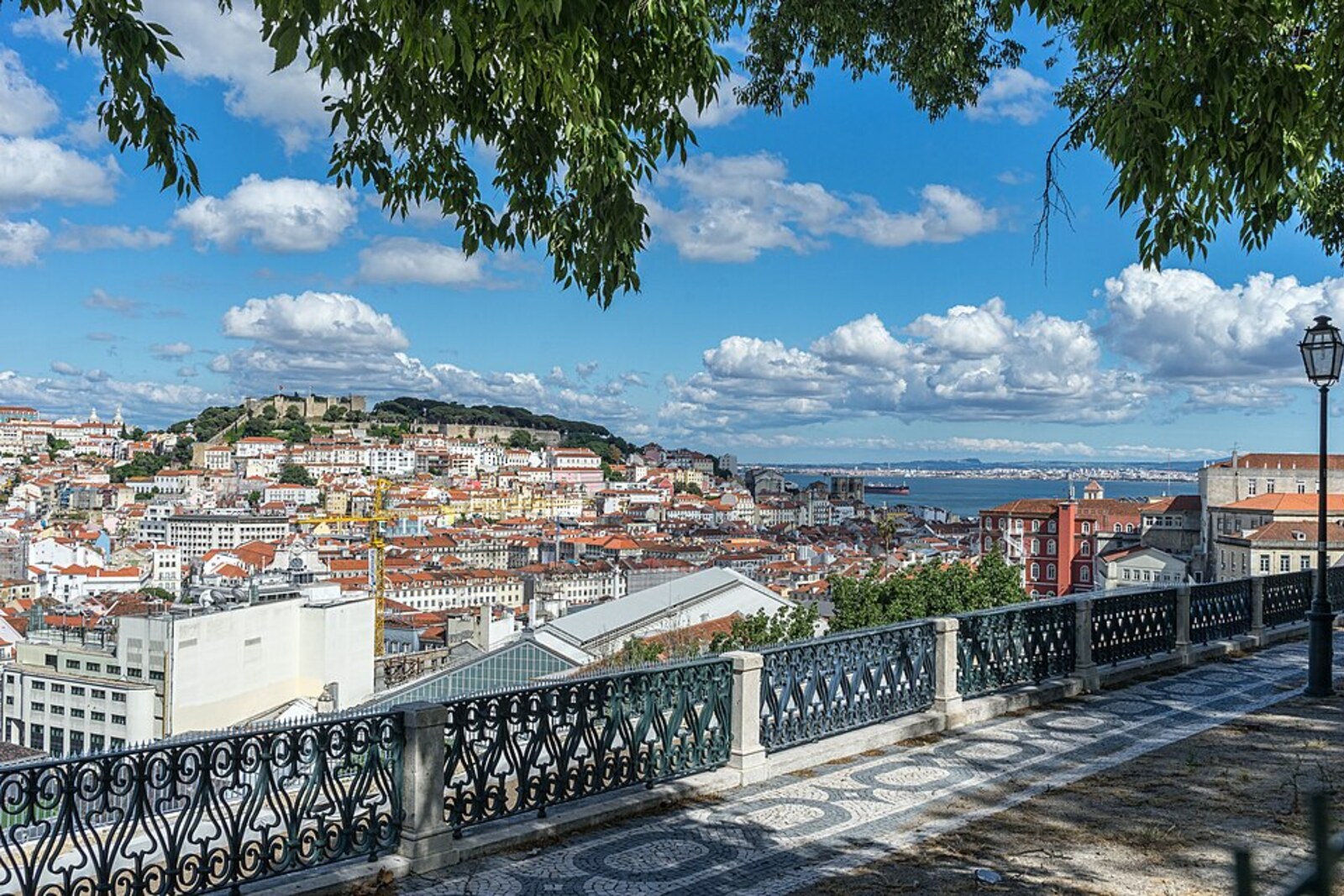
Look around first
What to notice
- Two terraces
- Retaining wall
- Marble basin
- Tiled panorama
The story of the place
The two terraces of São Pedro de Alcântara are held up by a retaining wall about twenty meters high. It was built for a structure that was never here.
In the first half of the eighteenth century, the Portuguese king João V tried to supply Lisbon with water from springs northwest of the city. Most residents drew water from public fountains. They paid for the new aqueduct through a special levy on olive oil, wine, and meat—the cost of construction was included in the price of essential goods.
The water moved by gravity, so the king needed a high distribution point. On this slope, he ordered a site prepared for a huge reservoir. From here, João V planned to extend an arcade over the Rossio valley to the eastern districts and the hill of Graça. Workers began building the wall in seventeen thirty-eight, filled in earth behind it, and created a level platform above the steep descent.
By seventeen fifty-four, water was already flowing from the local fountain, but there was not enough for the planned reservoir and the continuation of the aqueduct. Then the earthquake of seventeen fifty-five cracked the wall's southern corner. The reservoir was not built, no arches appeared across the valley, and the finished platform remained.
People began throwing trash and dead animals over the wall. In eighteen twenty-two, residents of the lower streets submitted a petition demanding that it stop. A few years later, the site was occupied by the Guarda Real da Polícia: its barracks were nearby, and its personnel made a vegetable garden on the vacant lot. Only in eighteen thirty-five did the municipality gain control of the city's public promenades and waterworks. Officials took over the police vegetable garden, fenced in the upper platform, laid out side stone stairways, created a garden below, and built a cascade with a semicircular basin into the old wall. Lisbon residents gained a public promenade in place of a reservoir that was never built.
The site's name existed even before the royal project. São Pedro de Alcântara is Saint Pedro de Alcântara, a sixteenth-century Spanish Franciscan who sought to return the order to strict poverty and took part in its reform in Portugal. The convent in front of this site bore his name.
The convent appeared after a military vow. In sixteen sixty-five, António Luís de Meneses, commander of the Portuguese army, was preparing to stop Spanish troops at Montes Claros. Defeat would have reopened the road into the interior of the country for the enemy. Meneses promised to found a convent in honor of Pedro de Alcântara if the Portuguese won. His army won the decisive battle of the Portuguese Restoration War, and, in fulfillment of the vow, Franciscans were settled nearby. From their convent, the name passed to the street, the fountain, the garden, and the viewpoint.
The marble basin at the center of the upper terrace does not belong to the royal reservoir: it was moved here from Bemposta Palace when the garden was laid out. What remains of the water project is the wall and the platform it raised. People now stroll here, sit by the kiosk, and compare the houses on the opposite hills with the tiled panorama. Beneath your feet lies the place for water that was insufficient here; beyond the railing, you can see eastern Lisbon, where they intended to send it.
Useful on site
The garden is open around the clock; individual areas may close for repairs, and the cafés keep their own hours.
Checked: June 17, 2026. Check the official source before visiting.First explore the lower garden, then compare the labeled panorama with the real view; do not block the passage at the edge of the terrace.