 Guide On Map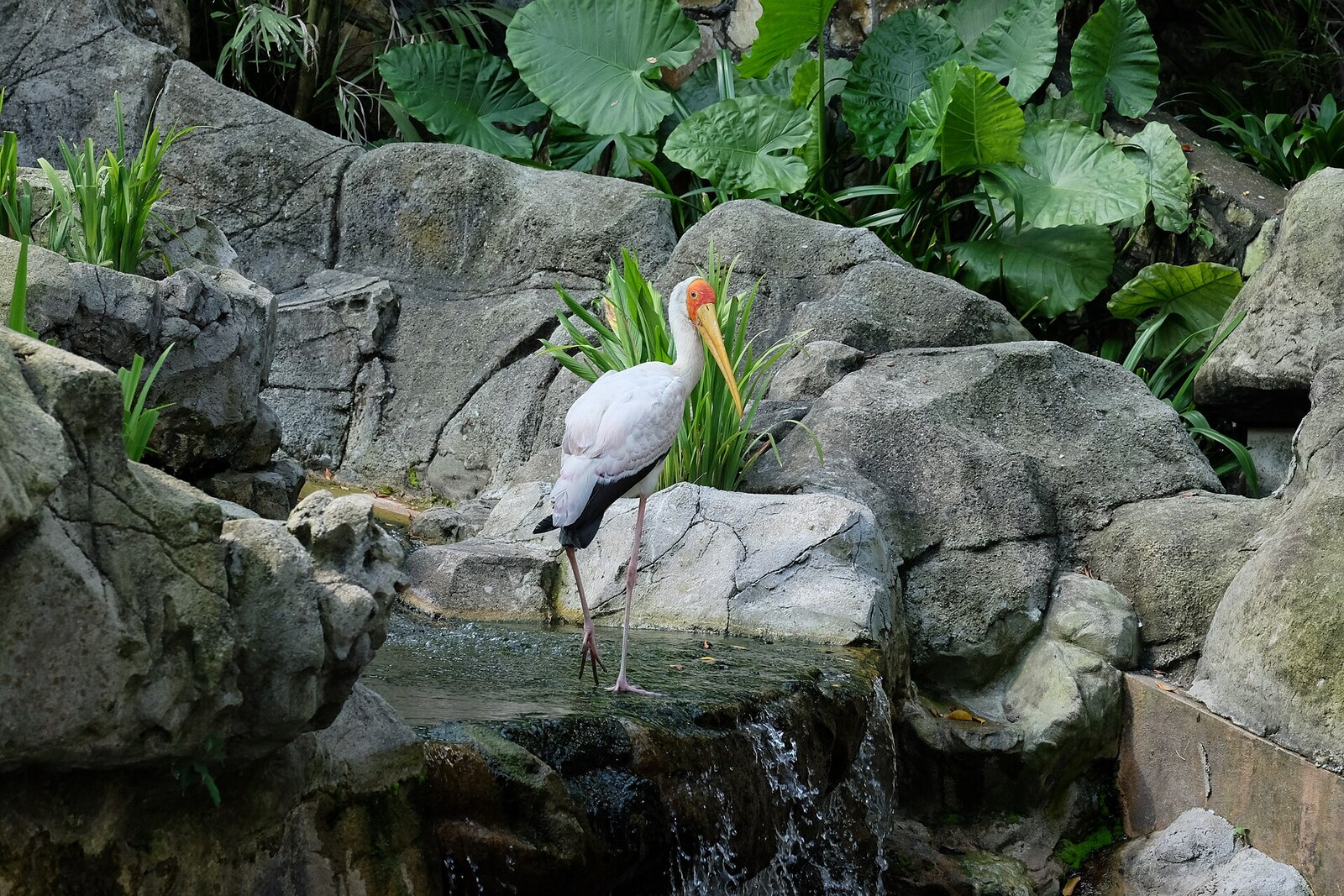
Look around first
What to notice
- The aviary's netted roof
- Trees and bodies of water
- Bird nests
- Artificial waterfall
The story of the place
In the old Lake Gardens, city services set aside a green valley for a large aviary. A netted roof is stretched above the trees and bodies of water, and beneath it birds fly, gather twigs, and build nests. The park was created for free flight, so the space under this roof was left shared, while separate enclosures were provided for some species. The boundary here runs high above the canopy: the garden still resembles an ordinary valley, but belongs entirely to the birds.
In two thousand five, one milky stork chick hatched in this park's main aviary. The result seems modest until you learn the starting figures. In the nineteen eighties, between one hundred and one hundred fifty such storks were counted in Malaysia's mangrove forests. Twenty years later, researchers found fewer than ten. By then, young birds had not been seen in the country's wild since nineteen eighty-three.
Tan Yu Keong, the Bird Park's general manager, was responsible for the flock here. Maintaining the collection and breeding rare species were part of his everyday work. In two thousand two, staff at the state zoo, Zoo Negara Malaysia, handed him ten milky storks. Tan placed them in the main aviary—beneath a netted roof, but among trees, bodies of water, and available nesting material.
For three years, the birds produced no offspring. For an endangered species, a lost season meant more than an empty nest: the wild storks were aging, and no new ones were appearing in Malaysia. At last, in two thousand five, a chick hatched here. In a report on the species' status, Tan already listed eleven birds instead of the ten he had received. Specialists also recorded another detail separately: painted storks, a related species, sometimes perched outside on the netted roof, but no mixed pairs were found inside.
The enormous roof itself had been conceived earlier for visitors. In nineteen eighty-seven, under Mayor Elyas Omar, city services planned to turn part of the old Lake Gardens into a free-flight space. Omar, a career municipal administrator, sought to improve the capital, and during his tenure a whole group of gardens was created—orchid, butterfly, deer, and bird gardens. Work on the bird park began the following year. Instead of a row of small cages, an existing green valley was covered with netting, and on November fifteenth, nineteen ninety-one, Queen Tuanku Bainun opened the park.
The netting explains the freedom here more precisely than advertising promises do. In the first three zones, birds choose trees, gather twigs, and build nests, but remain inside the enormous aviary; rare species are kept separately. The park still keeps milky storks in the aviary with an artificial waterfall. At four o'clock, they are fed where one chick once increased the entire flock here from ten birds to eleven.
Useful on site
Open urban space; choose a viewing point that does not obstruct pedestrian flow.
Checked: date not specified. Check the official source before visiting.The park requires separate admission and a considerable time allowance. Do not feed or touch the birds without staff permission, keep your distance from large species, and follow instructions on site.