 Guide On Map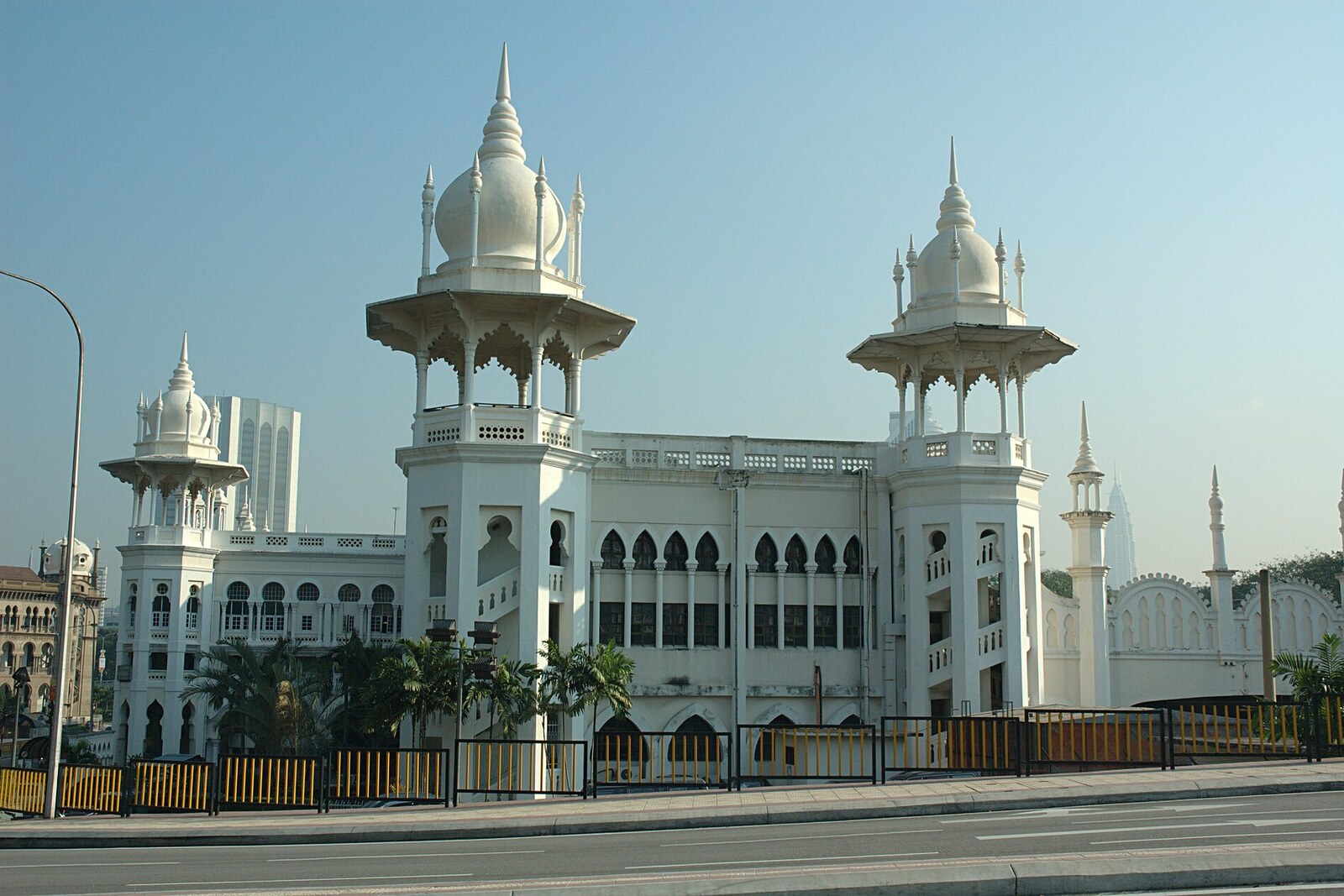
Look around first
What to notice
- White main facade
- Arched openings
- Domed turrets
The story of the place
This is where the lines of a city enriched by exporting tin to Port Klang converged: the former station could no longer hold the traffic, and the railways needed a new urban hub. Behind the white arches and domed turrets were platforms, ticket offices, waiting rooms, a restaurant, and a luggage tunnel; passengers of different classes were separated into different rooms. Later, the main flow of trains moved to KL Sentral, but the old station continues to receive commuter trains and some long-distance electric trains.
On May first, nineteen ten, twenty-six-year-old Philip Russell sent his family a postcard with a photograph of the station under construction. The image showed only the main facade; Philip invited them to admire it and the contract that he and his older brother Archie had undertaken. Behind the calm caption lay a job that officials had nearly awarded to another contractor.
The new station was needed by a growing Kuala Lumpur. The first line had connected the city with Port Klang as early as eighteen eighty-six: tin was carried out along it, and the proceeds from its export financed the laying of further tracks. By the beginning of the new century, the separate railways had been consolidated, the former station had become too small, and in nineteen six the administration decided to build the city’s third station here. The architect Arthur Benison Hubback was tasked with bringing platforms, a ticket hall, waiting rooms, and a hotel together under one roof. That is why the facade is long, with arches and domed turrets: behind it were entirely practical spaces for passengers and luggage.
The contract for the above-ground section was tendered twice. The winner of the first competition declined the work. In the second, the lowest bid came from a man who had not even looked at the plans and admitted that an acquaintance had suggested the amount. The Russell brothers came next. John Archibald, or Archie, was responsible for the money; Philip was to supervise construction. He had learned the trade from contractors in Malta and had already managed private work in Kuala Lumpur, but he had not yet built a single major public building.
The official comparing the bids wrote plainly: Philip’s abilities were praised, but his knowledge and experience might not be enough for a contract of this size. A reliable competitor had asked for about ten thousand dollars more. The decision was made by the British High Commissioner, John Anderson. On August eleventh, nineteen nine, he approved the Russell brothers and allocated the additional funds required. Philip now had to disprove, through this facade, the doubt recorded in official correspondence.
Nine months later, he sent the postcard. By then, the exterior walls had risen to the level of the hotel rooms, and the brothers were already being noted for the rapid progress of the work. In the summer of nineteen eleven, the station began receiving passengers. Inside were separate ticket offices and waiting rooms for first and third class, a restaurant, a luggage tunnel, and even a room where an arriving passenger could wash and change without renting a room. The hotel above opened soon afterward. The newspaper reporting the start of service named Archie and Philip separately and praised them for their thoroughness and speed. They completed successfully the contract that had been considered too large for the younger brother.
After the main flow of trains moved to KL Sentral in two thousand one, the hotel stood empty, and this station came to be called old. It still receives commuter trains and some long-distance electric trains. The white above-ground section in front of the tracks is precisely the Russell brothers’ contract that twenty-six-year-old Philip put on the postcard, when officials still did not know whether he could handle the work.
Useful on site
Open urban space; choose a viewing point without obstructing pedestrian flow.
Checked: date not specified. Check the official source before visiting.This is an active transport environment: view the building without blocking passenger routes, and do not expect all the historic rooms to be accessible.