 Guide On Map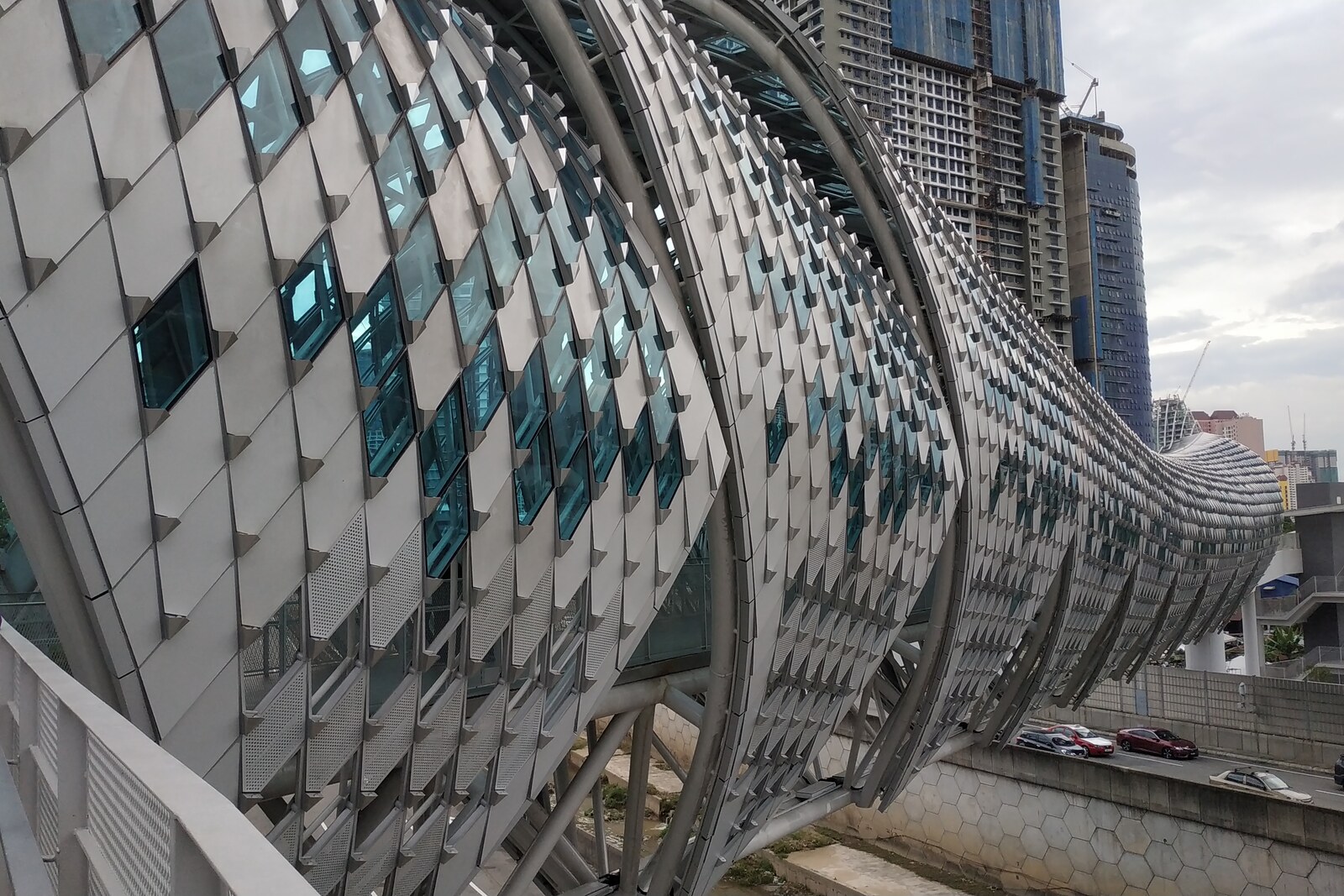
Look around first
What to notice
- Diamond-shaped panels
- Metal casing
- Pedestrian deck
- Petronas Twin Towers in the opening
The story of the place
Above the Klang and the elevated highway rises a pedestrian deck in a metal casing, connecting Kampung Baru with the Kuala Lumpur City Centre (KLCC) district. It is three hundred seventy meters from one end to the other; residents of the district, people from the metro station, cyclists, and visitors to the neighboring streets use this route. Four thousand one hundred diamonds on the shell overlap in the pattern of a wedding offering made of betel leaves, so Malay tradition has entered the construction of the new crossing. The Petronas Twin Towers appear in the opening of the casing, while the southern side leads to the fence of the Muslim cemetery.
Between Kampung Baru and the Kuala Lumpur City Centre (KLCC) district, there are only a few hundred meters as the crow flies. Before this crossing appeared, a pedestrian spent more than half an hour on the way: they had to go around the Klang River and cross several busy streets. When the six-lane Ampang–Kuala Lumpur Elevated Highway (AKLEH) began to be laid along the riverbank in nineteen ninety-six, it cut off the former short route across the river.
Affendi Zahari, chairman of the Kampong Bharu Development Corporation, proposed restoring it. He sought direct access from the district to the center and the metro station: residents were to walk to the towers without a detour by car, while visitors were to reach Kampung Baru on foot. The corporation commissioned VERITAS Architects to design the project, and city agencies supported the construction.
The crossing opened on February fifth, two thousand twenty. A journey that had taken more than thirty minutes was reduced to about seven. The full length of the route raised above the ground is three hundred seventy meters; its main span, sixty-nine meters long, crosses both the river and the elevated highway. Residents, metro passengers, cyclists, and visitors to Kampung Baru use it. Many stop for the Petronas Twin Towers in the opening of the metal casing, but the photo spot came as a consequence: Affendi Zahari first set out to solve the ordinary task of providing a pedestrian passage.
The architects assembled the casing from four thousand one hundred diamond-shaped panels. Their overlapping rows reproduce sirih junjung—a composition of betel leaves presented as a gift in a Malay wedding ceremony. That is why the form of the crossing refers specifically to Malay Kampung Baru on the opposite bank.
Saloma (Salmah Ismail) did not build this bridge. Saloma was the stage name of Salmah Ismail, a singer and film actress who, while still a teenager, earned money performing in clubs and at weddings, and who, after nearly thirty years on stage, became the first recipient of the Malaysian honorary title “Singer of the Country.” Her name is here because of the place to which the crossing leads.
In nineteen eighty-three, Saloma was buried beside her husband, the singer and director P. Ramlee, in the Muslim cemetery by Jalan Ampang. The southern end of the crossing runs along its fence. Even the floor finish was laid in the direction of the qibla, continuing the orientation of the graves. After a seven-minute journey, the name on the illuminated casing leads to Saloma herself: her grave remains by the exit from the bridge.
Useful on site
Access is usually open from early morning until late at night, but the exact nighttime schedule and lighting need to be checked on notices at the entrance. Passage is free; the elevator and separate approaches may close for maintenance.
Checked: June 29, 2026. Check the official source before visiting.On narrow sections, do not hold up the flow of people for a photograph, and do not lean on the railings. If the passage or elevator is unavailable, do not look for a detour through the roadway.