 Guide On Map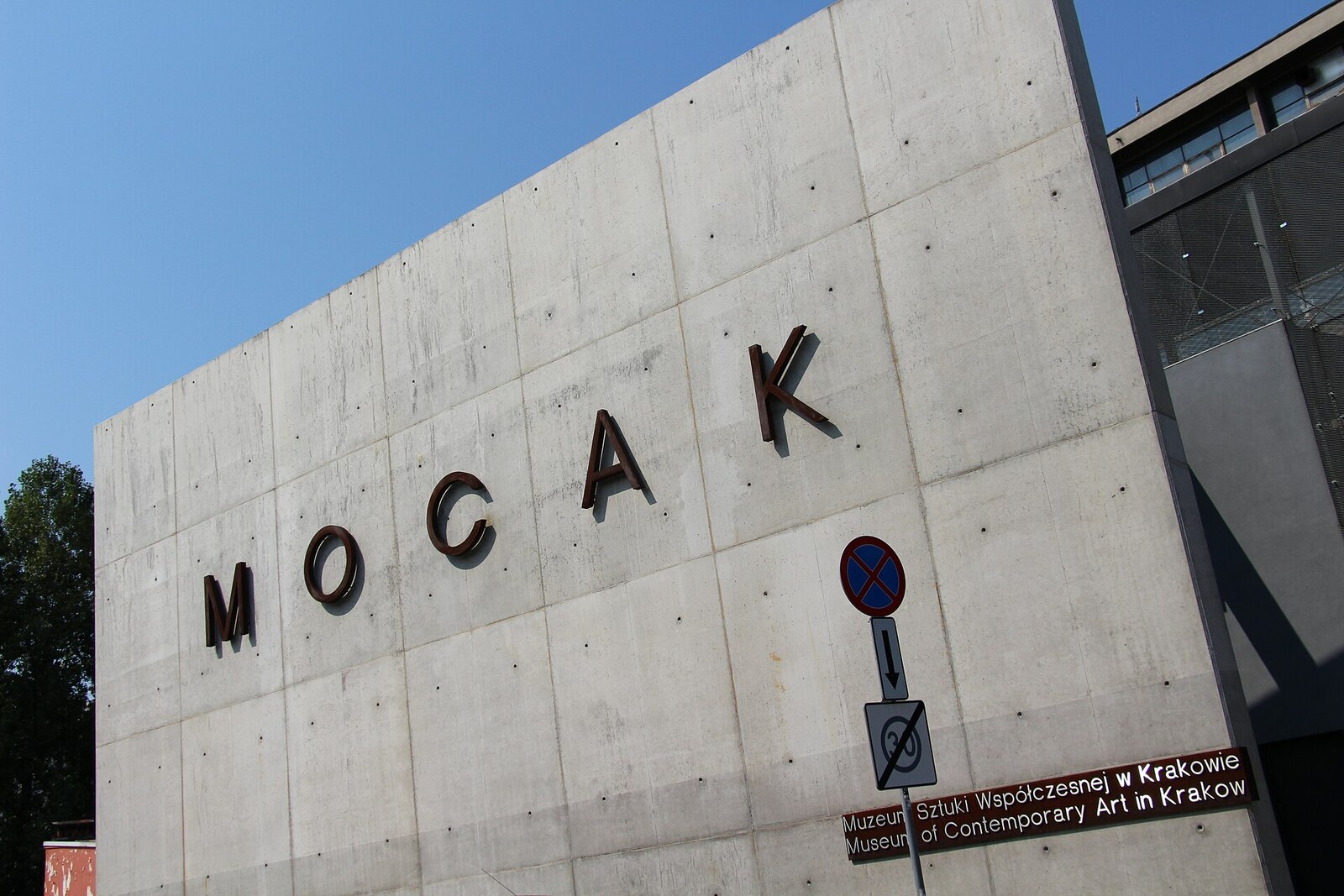
Look around first
What to notice
- White wall with the inscription “MOCAK”
- Sawtooth roofs
- Old factory buildings
- New building
The story of the place
MOCAK is written on the white wall. It is an abbreviation of the English name, Museum of Contemporary Art in Krakow. Art from the past few decades is collected here, temporary exhibitions are organized, artists’ archives are kept, and the museum tries to explain to visitors why works whose meaning is rarely clear at first glance are needed.
The museum had quite a homegrown beginning. In nineteen seventy-two, Maria Anna Potocka, then a student of Polish philology, opened Pi Gallery in her own apartment with a colleague. They needed a place for contemporary art, which found it difficult to enter the state exhibition halls of the Polish People’s Republic. The gallery did not provide Potocka with a salary; she made her living as an appraiser at a state company that traded in works of art.
Beginning in nineteen seventy-three, Potocka collected artists’ works with one purpose she had chosen in advance: to give them to a Krakow museum of contemporary art one day. No such museum existed in the city. She was unable to persuade municipal officials to create one on the basis of a private collection, and Potocka continued opening small galleries. She ran the last of them, Potocka Gallery, for almost a quarter of a century.
The city returned to the idea of a museum by its own route. At the end of two thousand four, the municipality bought the land and buildings of the former Schindler’s Factory on Lipowa Street. The neighboring administrative building was given to the Museum of Krakow, while the production premises were intended for contemporary art. Mayor Jacek Majchrowski secured a state subsidy, after which an international jury selected the design by Claudio Nardi and Leonardo Maria Proli. The architects preserved and adapted six factory buildings, added one new building, and extended the distinctive sawtooth roof of the old workshops over the new section.
In two thousand ten, Potocka became the first director of the museum that had been created. That same year, the first works began to enter its collections. She transferred her collection to the institution in two parts—in two thousand eleven and two thousand fourteen. The paintings, photographs, and objects that had been listed as the private property of the gallery owner for decades became the basis of the public collection.
The largest part of the museum’s collection is still called the Potocka Gallery Collection. It is now kept and exhibited beneath the sawtooth roofs of the former production workshops, just a few steps from the factory’s administrative building.
Useful on site
On the day of the check, MOCAK listed Tue–Sun 11:00–19:00, Monday closed, free collection admission on Thursdays, and HUSH TIME on Wednesdays 16:00–19:00.
Checked: June 26, 2026. Check the official source before visiting.You can take in the exterior architecture without making a full museum visit. MOCAK exhibitions require a separate ticket and time; do not try to squeeze them in at the end of the walk if you are already tired.