 Guide On Map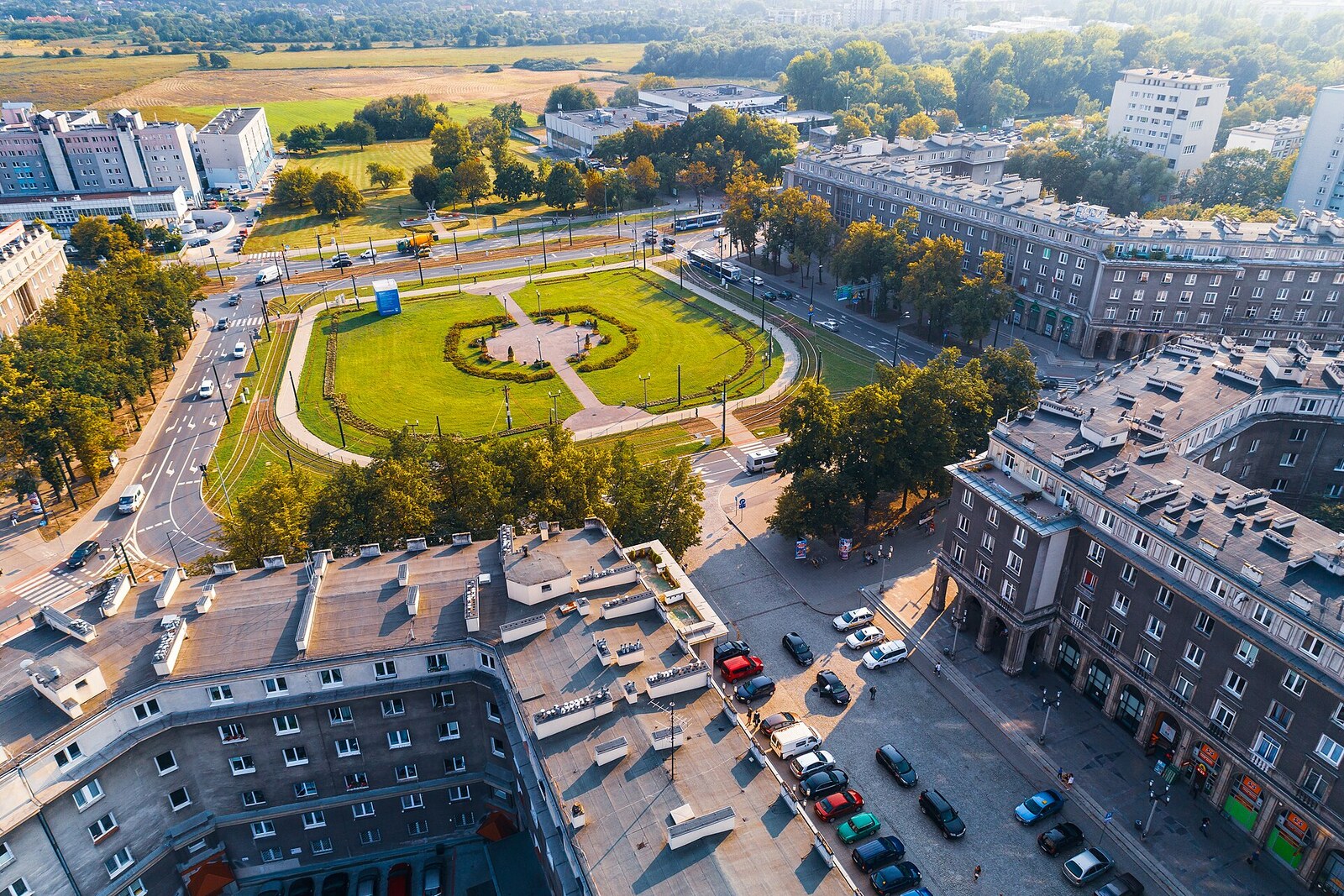
Look around first
What to notice
- The pentagonal space of the square
- Arcades of residential buildings
- The lawn in the center
- The slope toward the Nowa Huta Meadows
The story of the place
The square is laid out on the upper terrace above the Vistula Valley, and five avenues radiate from its five sides. Residential buildings surround the space with arcades: from the beginning, the lower level was set aside for commerce, while the open middle was prepared for city gatherings. This center was conceived so that, after a shift, everyday needs, rest, and sports would remain close to home. The lawn in the middle of the square, the trams along its edges, and the shops operating under the arches preserve this part of the vision designed for life.
In nineteen fifty-seven, Tadeusz Binek struck an eighty-hectare lake from the project for the center of Nowa Huta. Binek held the post of deputy director for investment preparation and decided which drawings would receive state funding and make it to construction. The lake was to begin immediately beyond the southern edge of Central Square.
The chief planner of Nowa Huta, Tadeusz Ptaszycki, sought to ensure that, after a shift, a worker could relax, play sports, and spend free time close to home. He used the fourteen-meter slope above the Vistula Valley as the boundary of the city center. A pentagonal square was laid out on the rise, and five broad avenues were led from it. Shops opened under the arcades of residential buildings, while the middle was left for mass gatherings. Beyond it, a descent to the water was planned.
In the lake, the planners set aside space for swimming and rowing courses. They wanted to build stands on the slope, with a stadium nearby. To pay for this construction, they devised a way to use the excavation itself: remove an almost two-meter layer of peat for medical institutions, and send the sand and gravel to a reinforced-concrete-products plant.
The calculation did not work. Neither the medical institutions nor the plant wanted to invest money. The lake was supported by Krakow sailing enthusiasts, but they had no funds. The abbots of the old Cistercian Monastery in Mogiła feared that the shallow water would breed swarms of mosquitoes. An expert assessment commissioned by them did not give an unequivocal answer, but it recognized that such a risk was possible.
By then, the state budget could no longer sustain the previous scale of construction. The ministry demanded savings, while about sixty thousand people lived in Nowa Huta: they needed apartments, schools, and clinics. Binek stopped further development of the lake. Ptaszycki did not get the water center that was meant to complete his project of a city for rest and work.
Now a lawn occupies the middle of the square, trams and cars run around it, and shops still operate under the arcades. Beyond the southern edge stand the buildings of the Nowa Huta Cultural Centre, and below lie the Nowa Huta Meadows. Where a descent to the water was meant to open from Central Square, the lake remained only on the drawings.
Useful on site
Open urban space; the best viewpoints are along the edges of the square and under the arcades.
Checked: July 1, 2026. Check the official source before visiting.Do not stand in the paths of traffic and bicycles. Walk around the square along its edge: its scale and its missing completions are best understood in motion.