 Guide On Map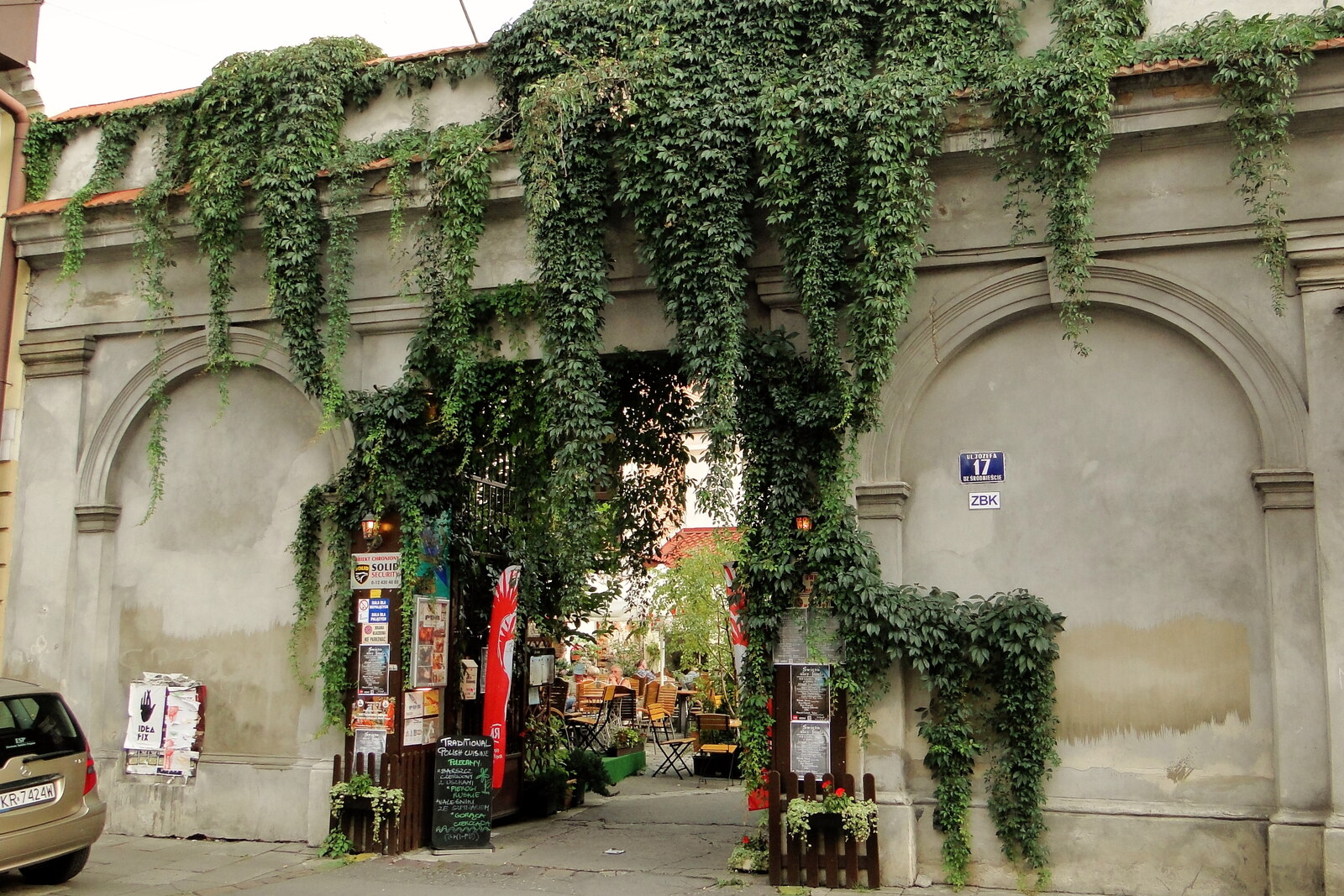
Look around first
What to notice
- Open galleries
- Outdoor stairways
- Niche beneath the stairs
- Through passageway
The story of the place
The through passageway between Józefa Street and Meiselsa Street once served as an inn for travelers. Later, a close-knit residential world formed around it: apartments stood alongside storerooms, shops, and workshops. The open galleries and outdoor stairways were everyday corridors for the residents, while now cafes and exhibition spaces operate between them.
In two thousand eighteen, Max Friedman sat on these steps, opened his laptop, and started Schindler's List. He had come from New York to investigate one of his mother’s stories. Frida Friedman survived the Holocaust, but she described her prewar life in such a way that her son could no longer tell where memory ended and invention began.
Frida assured her children that she had grown up in a well-off family and that her first husband owned his own workshop. Documents showed otherwise. In nineteen nineteen, eight-year-old Frimet Entenberg—as she was called then—moved into number twelve Józefa Street with her family. She remained here after getting married. Her husband made suitcases and earned little; Frida took in other people’s laundry so that the family would have enough to eat.
This through courtyard connects Józefa Street and Meiselsa Street. An inn operated here from eighteen oh two; later, apartments, storerooms, shops, and workshops were established around the courtyard. The open galleries and stairways served the residents as ordinary corridors. For Frida, this was the only home she had known since childhood.
In the spring of nineteen forty-one, the German occupiers ordered Krakow’s Jews to move into the ghetto established in Podgórze, on the other bank of the Vistula River. All the Jewish residents still living at number twelve Józefa Street were evicted; other people were moved into the apartments, and later the Germans took over the building. Frida ended up in the Krakow Ghetto, then at Płaszów concentration camp; from there she was sent to Auschwitz and Bergen-Belsen. Her first husband was killed at Auschwitz. She survived the camps, reached Sweden after liberation, met another former prisoner there, and gave birth to Max.
Almost half a century later, director Steven Spielberg was filming a picture in Krakow about Oskar Schindler, a German industrialist who saved more than one thousand Jewish workers. Frida was not among them. The film crew used the surviving houses of Kazimierz in place of the much-changed streets of the former ghetto. That is why, in the film, German soldiers throw the belongings of evicted residents down from these very galleries, while in the niche beneath the stairs, a boy hides a woman and her daughter.
The historical ghetto was not here. But the eviction that actors reenacted in this courtyard in nineteen ninety-three really did happen to this house’s Jewish residents, including Frida. After the film was released, tours began coming here, and the passage acquired the unofficial name Schindler's Passage. Now cafe tables stand between the stairways, and shops and exhibition spaces are open.
Max avoided the film for a long time: as a child, he woke his parents after camp nightmares and did not want to enter their past again. After his mother’s death, he tried to tell his young grandson about her and discovered that he knew almost nothing reliable. For five years, he searched for documents and testimony. The house on Józefa Street turned out to be the only surviving address of Frida’s that he could confirm.
On the steps where actors portrayed the expulsion of another family, Max Friedman found the only surviving address of his own.
Useful on site
The courtyard is usually accessible during the day, when the cafes and workshops are open, but the gates may be closed in the evening or during private work. This is a semi-residential space, so access is not guaranteed as it is at a museum.
Checked: June 29, 2026. Check the official source before visiting.This is a semi-residential courtyard, not a film set: pass through quietly, do not look into apartments, do not block entrances, and do not stage photos on the stairways.