 Guide On Map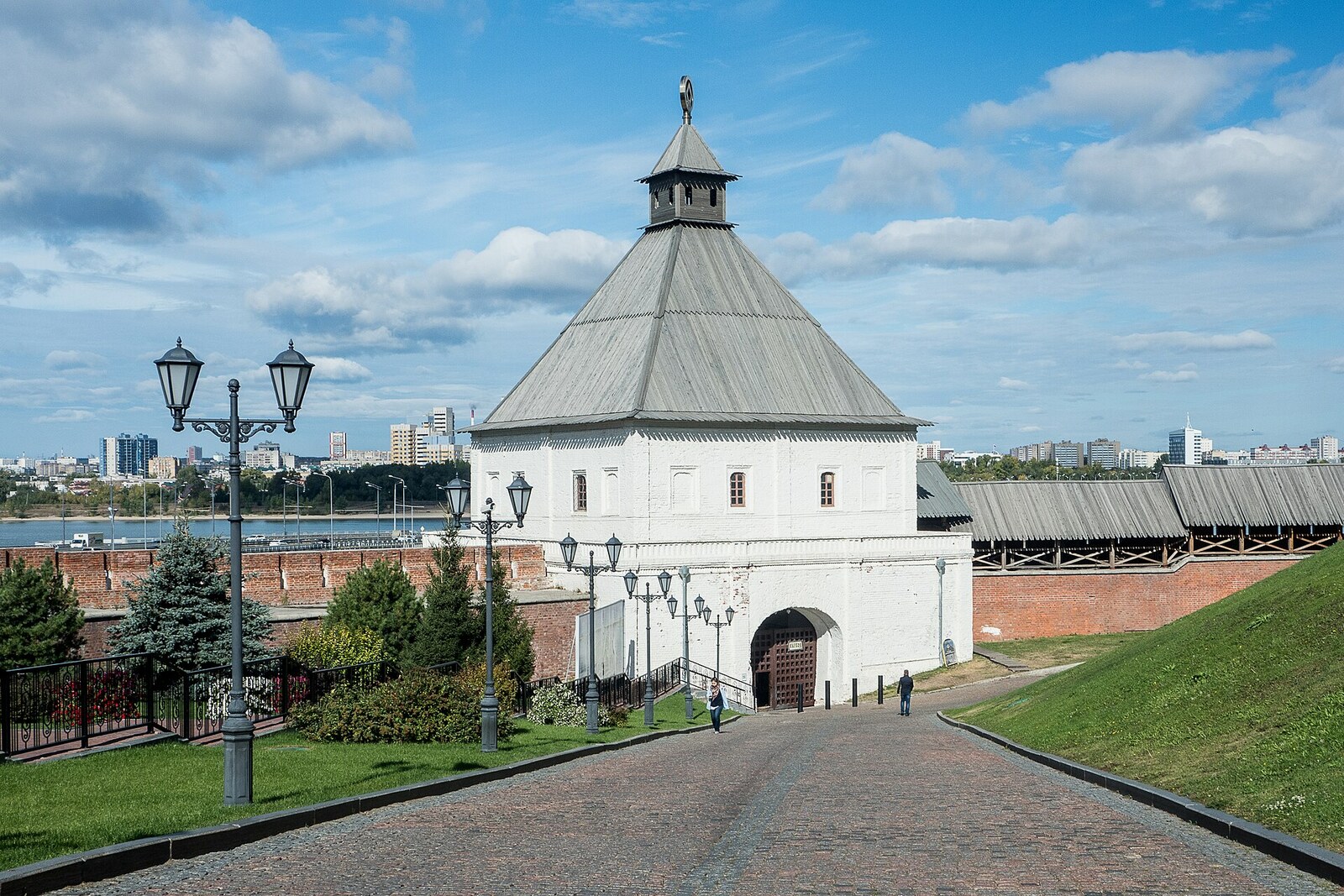
Look around first
What to notice
- White-stone gateway tower
- Dogleg passage
- Kremlin wall
- Slope down to the Kazanka
The story of the place
The white-stone tower at the northern edge of the Kazan Kremlin serves as a gateway through the wall, and its dogleg passage runs above ground toward the slope of the Kazanka. Pskov masters built the present tower in place of the former one. At first it was called Nikolskaya Tower, after the neighboring Church of St. Nicholas the Wonderworker. The name Taynitskaya Tower became established later; at that time, water was still drawn at the foot of the hill from a spring lined with stone.
At the end of August fifteen fifty-two, the defenders of Kazan continued to obtain fresh water, although the besiegers had already occupied the bank of the Kazanka. From the khan's tower at the northern edge of the fortress, an underground passage descended to a spring. People could go for water without appearing beyond the wall.
According to the chronicle account, the secret was revealed by Kamai Murza, a Kazan nobleman who had gone over to the camp of Ivan IV. His information was confirmed by Russian prisoners who escaped from the city. They explained where the passage began and where the besieged drew their water.
Prince Vasily Serebryany, voevoda of the Watch Regiment, was assigned to destroy the hidden passage. He could not break through to it directly. So a counter-mine was driven from a stone bathhouse captured at the foot of the hill. The work was directed by a foreign military engineer, recorded in the chronicles under the name Rozmysl. His men dug for ten days. Serebryany himself went underground and heard above his head the voices of people walking through the hidden passage for water. That was how he understood that the miners had reached exactly beneath the passage.
Eleven barrels of gunpowder were rolled into the mine. The charge was detonated on September fourth. People in the hidden passage were killed, and part of the wall and the former tower collapsed. Russian detachments tried to break in through the breach, but the Kazan defenders repelled the attack and drove them back.
Access to the fresh spring could no longer be restored. The inhabitants dug the ground inside the fortress until they found a small stream with foul water. The chronicler reports that people fell ill, swelled up, and died. Yet the city held out for almost four more weeks. The decisive assault on October second began at other mines and breaches.
The white-stone gateway tower standing here now was built by Pskov masters only after the siege. At first it was called Nikolskaya Tower, after the nearby Church of St. Nicholas the Wonderworker. The name Taynitskaya Tower became established in the nineteenth century. At that time, Kazan residents still used the spring itself at the foot of the hill and even lined it with stone.
The spring has not survived to this day. The dogleg passage of the present tower leads through the wall above ground; the destroyed hidden passage once ran from here underground to the Kazanka.
Useful on site
The access page indicates summer passage from 06:00 to 22:00 and winter passage from 06:00 to 20:00; the general rules give an earlier closing time. Check the day of your visit.
Checked: date not specified. Check the official source before visiting.The hidden passage and the spring have not survived for viewing, so do not look for a descent underground; listen to the account by the accessible part of the tower.