 Guide On Map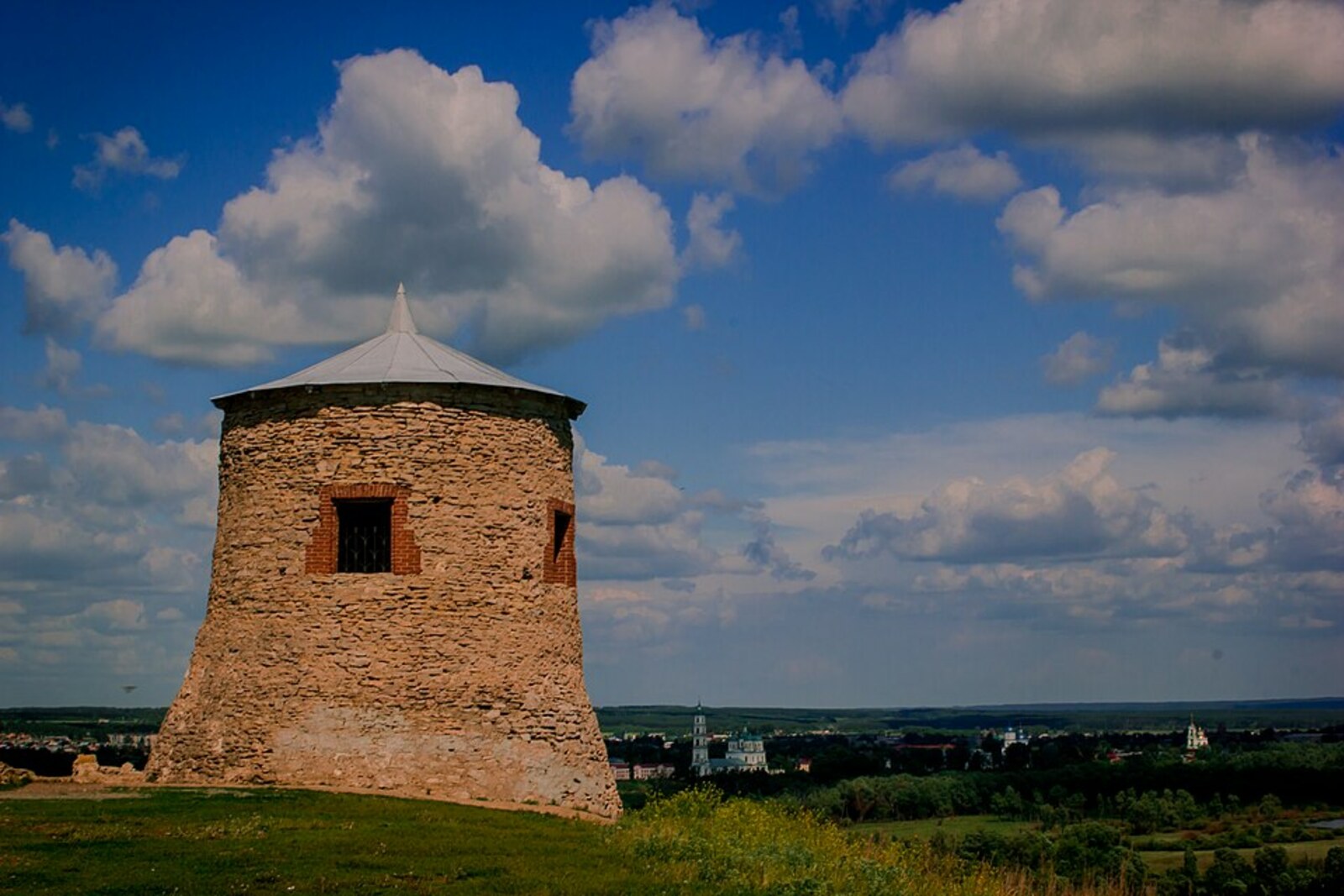
Look around first
What to notice
- Round stone tower
- Arched entrance
- Window above the arch
- Northern masonry of uncut stone
The story of the place
The round stone tower on the high promontory marks the edge of an ancient fortified settlement above the place where the Toyma River flows into the Kama. In the early Middle Ages, the Volga Bulgars built a mosque with defenses here: walls enclosed a rectangular area, and towers stood at the corners. From this height, they watched river traffic and protected the northern route of major trade. The hillfort preserves not a single house, but the entire trace of life on the promontory: remains of structures, ramparts, ditches, and foundations.
In eighteen fifty-five, Ivan Vasilyevich Shishkin, a former town mayor and grain trader, came here to find out what could be saved from the ancient structure. His son Ivan, already studying to become an artist, drew a plan of the area and sketched the surviving masonry. In the drawing, where the present tower now stands, there is a single wall with an arched entrance and a window.
Researchers believe that in the tenth through twelfth centuries, the Volga Bulgars built a mosque-citadel on this promontory. Its height above the place where the Toyma River flows into the Kama allowed them to watch movement on the river and protect the northern branch of a major trade route. Stone walls formed a square, with towers at the corners; one served as the base of a minaret. Archaeologists use the word hillfort for the entire fortified settlement: foundations, ramparts, ditches, and the traces of human life that have accumulated in the ground.
A local legend explains the name “Devil’s Hillfort.” It says that before the Bulgars, an oracle serpent lived here, later called the devil. It foretold people’s fates and disappeared before the ancient kingdom perished. This is a legend: excavations confirm the existence of fortifications and structures, but not the serpent or its prophecies.
After the Trinity Monastery that stood here was closed, people dismantled the old walls for stone. By the beginning of the nineteenth century, only one corner tower remained, and in eighteen forty-four it too collapsed. Only the northern section with its openings stood firm, and the young Ivan Shishkin sketched it.
His father spent twelve years studying the exposed foundations and restoring the plan of the citadel. He made his living from the grain trade: he bought grain in villages near the Kama and sent it by ship along the Kama and the Volga River. In eighteen sixty-seven, Shishkin invested his own money in work that brought no profit. Stonemasons raised a tower on the old foundation and covered it with an iron roof.
They reproduced its medieval appearance only approximately. They made the upper tier round, although the original shape was probably hexagonal; they added a buttress and four rectangular windows. Shishkin’s spending on municipal projects was one reason why, by the end of his life, he was registered as a petty townsman rather than a merchant.
In the present tower, the only ancient part is the northern masonry of uncut stone, with its arched entrance and window. The round upper section, the other walls, and the metal roof appeared with the grain trader’s money in eighteen sixty-seven.
Useful on site
Open area; visit during daylight hours. Passability depends on ground conditions, precipitation, and wind on the promontory.
Checked: date not specified. Check the official source before visiting.The promontory is exposed to the wind, and the ground can be slippery. Do not leave the safe path or try to descend the steep slopes for a different view.