 Guide On Map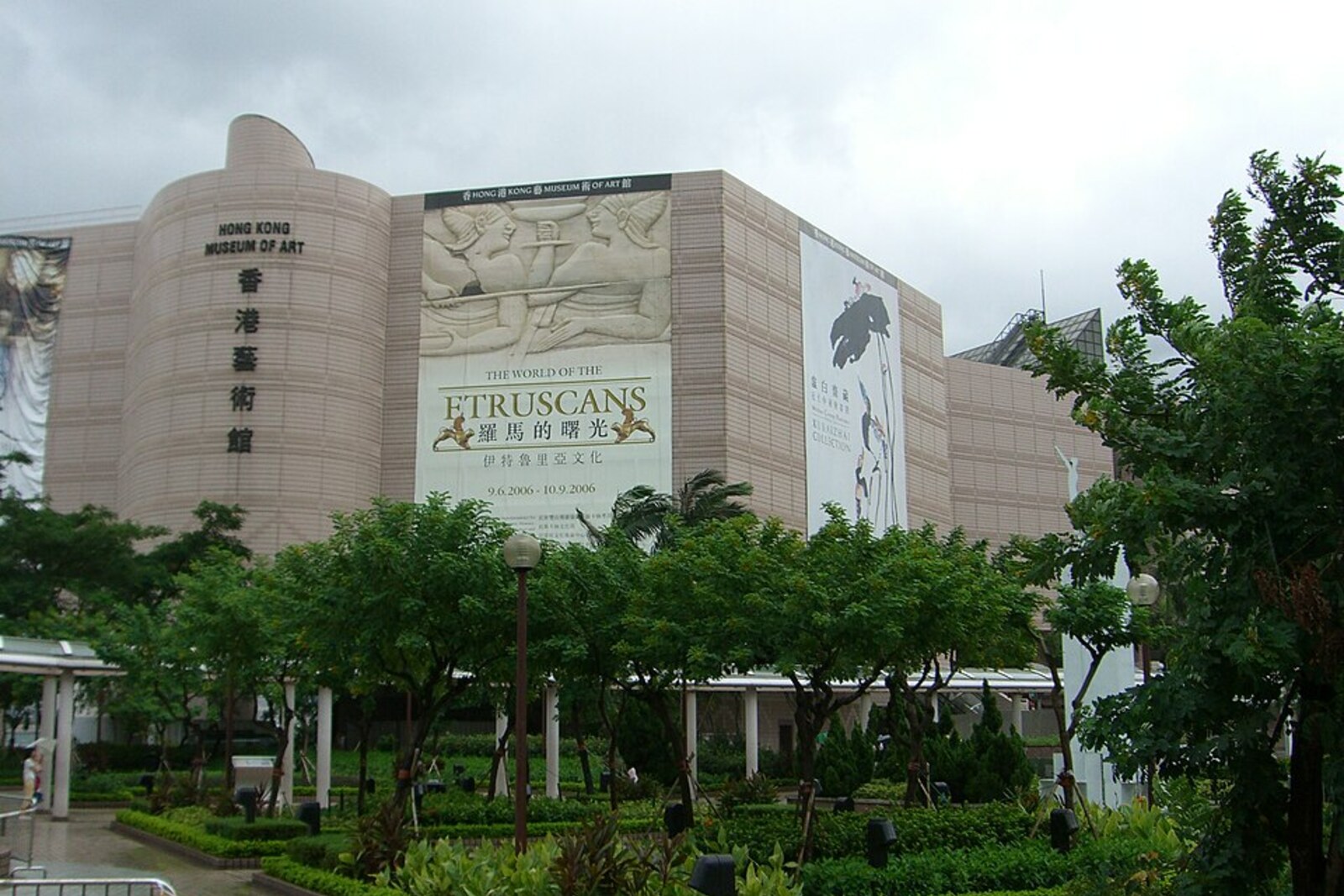
Look around first
What to notice
- The museum facade
- Outdoor sculpture area
- Panorama of Victoria Harbour
The story of the place
Hong Kong's first public art museum was established in nineteen sixty-two. Its collections moved into the building on the promenade in nineteen ninety-one. The harbour's proximity once enabled museum staff to arrange a lesson no one had seen before.
On March twenty-third, two thousand two, Wu Guanzhong appeared on the outdoor sculpture area. He was an eighty-two-year-old artist who had painted landscapes from life for decades. The curators asked him to show young painters the entire process, from the first touch of the brush to a finished sheet. Wu Guanzhong had refused such appearances all his life. Working in front of spectators turned into a performance for him, and made it impossible to concentrate on the landscape. Here, one hundred fifty people and a video camera were waiting for him; the camera was meant to record every movement for the museum archive.
The artist agreed only because the staff explained that young artists were going out to paint from life less and less often and no longer knew where to begin. He called the coming demonstration a service and made clear in advance that he was not undertaking to create a successful painting. But the most demanding subject had been chosen: a panorama of Victoria Harbour directly in front of the museum.
At the appointed hour, it began to rain, and fog reduced visibility to about fifty meters. The skyscrapers on the opposite shore disappeared. Wu Guanzhong could barely make out the ferries and the lines of the piers either. The spectators waited, but there was nothing to show them.
Then the artist began painting the harbour from memory. He recreated on paper the buildings, water, and ferries that he could no longer see before him. For the lesson, this proved more precise than the original plan: the spectators watched as the painter chose the order of the lines, kept the balance of the patches of color, and assembled what he had seen earlier, instead of copying an accidental view. The camera recorded the only public drawing demonstration of Wu Guanzhong's life.
He trusted this particular museum after a retrospective held here. The curators placed three of his works from different years side by side: Two Swallows, Former Residence of Qiu Jin, and Memories of Jiangnan. In this way, they showed how the white walls and black roofs of the region native to the artist gradually became almost abstract planes in his work. Wu Guanzhong said that the staff had revealed his innermost thoughts to the public and understood the work of several decades. He called the three paintings his favorite daughters and decided to give them to this, in his words, good family.
That same year, the artist gave the museum twelve works and manuscripts. Among them were Two Swallows and Victoria Harbour, the sheet created in the rain. Later, Wu Guanzhong and his family continued making donations; the collection grew to more than four hundred fifty works, sketches, documents, and the artist's personal belongings.
After the renovation, the staff opened a permanent gallery bearing his name on the fourth floor. Victoria Harbour still shows the buildings and ferries that the artist could not make out from the museum's sculpture area through the fog on the day of his only public lesson.
Useful on site
Usually open Monday–Wednesday and Friday 10:00–18:00; Saturday, Sunday, and public holidays 10:00–21:00; closed Thursdays, except public holidays, and on the first two days of Lunar New Year. Closes at 17:00 on Christmas Eve and New Year's Eve. Admission to the permanent collection is free; special exhibitions may charge admission.
Checked: June 29, 2026. Check the official source before visiting.You can finish the story by the building; seeing the collections requires a separate visit and checking which exhibitions are available.