 Guide On Map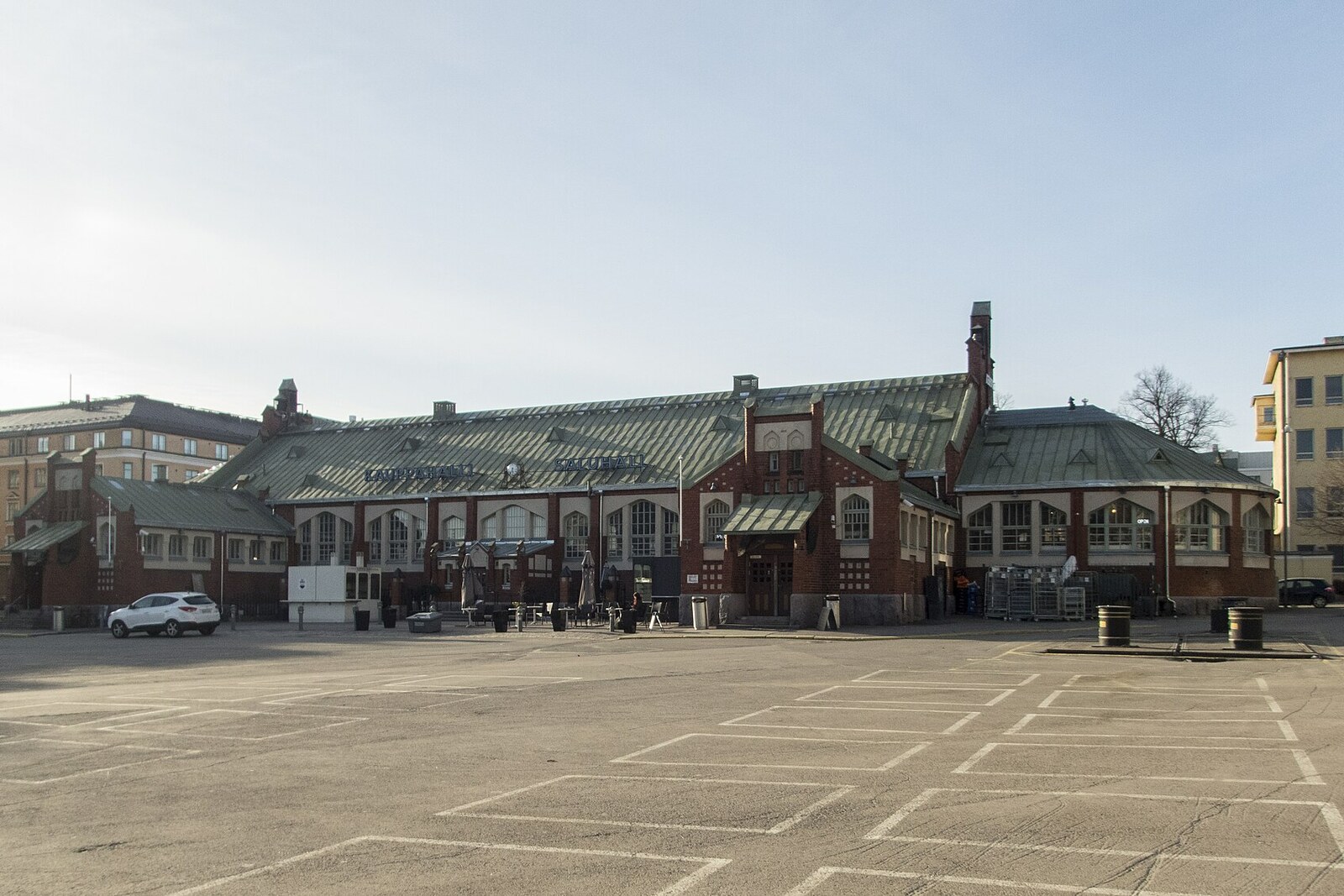
Look around first
What to notice
- Red-brick market hall
- Open market square
- Rows of market tables
The story of the place
The red-brick market hall by the broad open square was designed for perishable food: the former earthen trading ground did not protect meat, butter, and milk from dust and heat. When the hall opened in nineteen oh three, the city gathered food under its roof, leaving fish and household goods outside—crockery, brushes, and brooms. Two different markets thus took shape side by side: people bought food in the hall and chose household items in the square. This boundary between the brick walls and the rows of tables lasted for almost the whole twentieth century.
In the summer of nineteen eighty, Tapio Sademies proposed replacing the cars parked in this square with rows of market tables. Sademies worked in the city real-estate administration and was responsible for market halls and street trading. His task was to bring shoppers back to the emptying square and the red-brick hall beside it.
The reason for the decline lay in the way city trade was organized. In nineteen oh three, Helsinki opened a market hall here to remove food from the dusty, unpaved square, where meat, butter, and milk spoiled quickly. After the hall opened, the city prohibited the sale of nearly all food outdoors; fish was the exception. Crockery, brooms, brushes, and other household goods remained in the square, while food moved under the roof. This division kept traders supplied with customers until the nineteen seventies.
Then more offices appeared nearby, residents began buying food in ordinary shops, and tenants left the hall. Cars gradually took over the square. In a photograph from nineteen seventy, a parking lot covers almost all of it. By the time Sademies took up the matter, the city had acquired two problems at the same address: emptying counters inside and a car park outside.
Sademies brought here a model he had seen in London. The city’s residents themselves were to trade in their own used belongings, without a permanent shop or professional stock of goods. The first season opened as early as July nineteen eighty. At first, people came to look at the new urban oddity: in Finland, charity sales and school bazaars were known at the time, but private sellers renting a table for the contents of their apartment were rare.
Sademies insisted on a boundary between the flea market and ordinary trade. Only items used by the seller or the seller’s family could be placed on a table. New goods were prohibited, and the number of trading days for one person was limited. This meant the square could not quietly turn into a row of permanent shops: the space passed from one household cupboard to another.
Buyers soon stopped finding the idea strange. Hietalahti became established as a summer flea market, and selling one’s own belongings from a rented table became familiar in other Finnish cities as well. Sellers gained the opportunity to set their own prices and take the proceeds home immediately; the city once again gave the square to people rather than cars.
That was enough for the neighboring hall only briefly. In the early two thousands, city managers tried to gather organic-food traders under its roof. There were few customers, and in nineteen oh three the hall was handed over to sellers of antiques and art objects. Food returned ten years later, when traders from the Old Market by the South Harbour needed temporary premises during renovations. For some, the number of customers almost doubled after the move, and they no longer wanted to return. Later, cafés and restaurants came to dominate the hall.
Now the square’s old rule can be read literally. Food is once again sold behind the brick walls, while outside, city residents lay out belongings from their own homes. Between these two kinds of trade remains the stretch that Tapio Sademies cleared of parked cars in nineteen eighty.
Useful on site
Mon–Tue 8:00–18:00, Wed–Thu 8:00–21:00, Fri–Sat 8:00–23:00, Sun 10:00–18:00; in summer, a flea market operates in front of the building.
Checked: June 17, 2026. Check the official source before visiting.Look inside if the hall is open; the presence of outdoor sellers depends on the day and the season.