 Guide On Map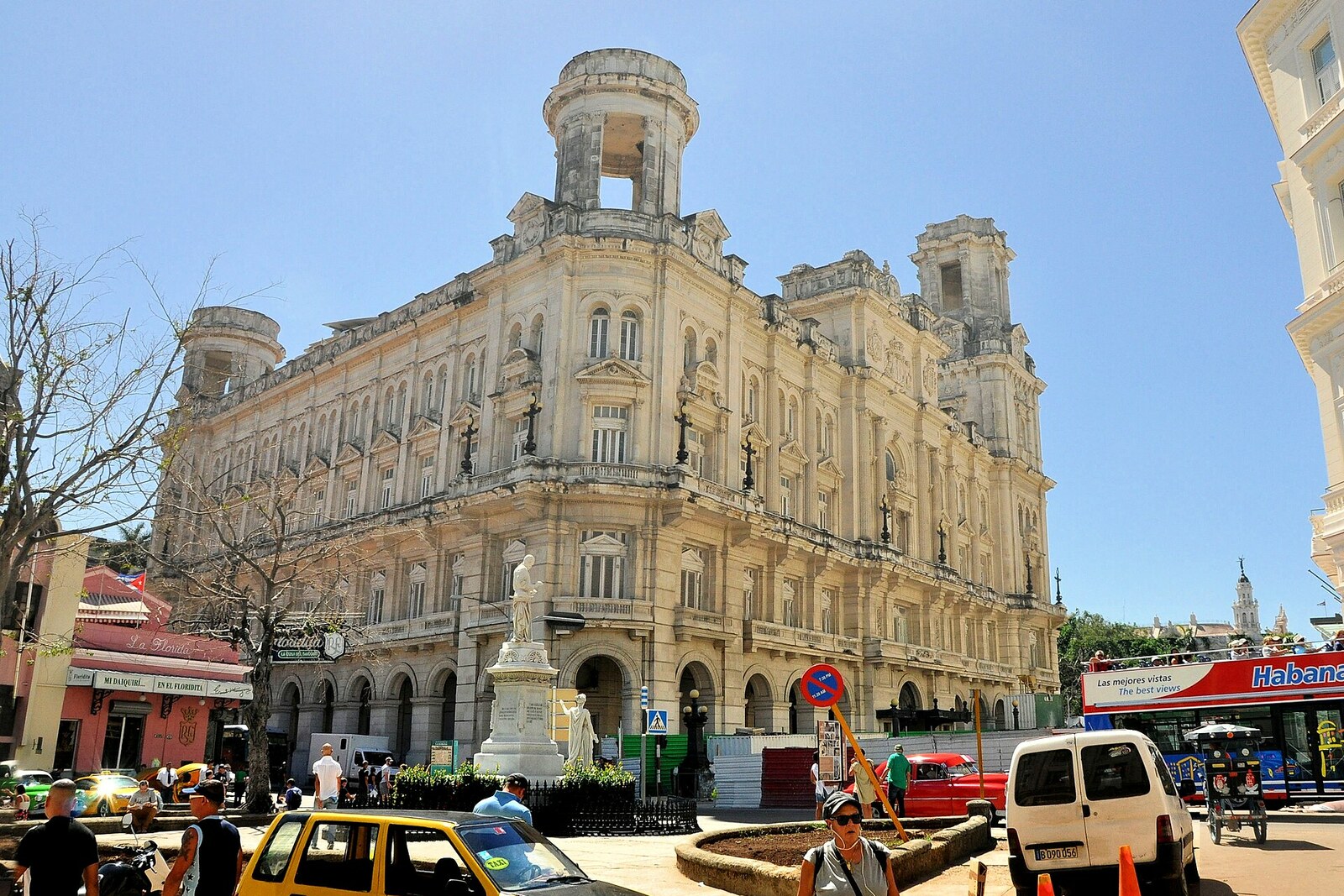
Look around first
What to notice
- Facade of the Palace of Fine Arts
- Galleries of Cuban art
- Paintings by Wifredo Lam
- Works by René Portocarrero
The story of the place
Inside this palace is the Cuban section of the National Museum of Fine Arts of Cuba; foreign art is displayed in the former Asturian Center. Behind the facade facing the street are galleries with paintings by Wifredo Lam and René Portocarrero. The building itself was constructed specifically for the museum, rather than adapted for it after a different life.
When this palace first opened to the public in May nineteen fifty-four, paintings by many of Cuba's foremost artists were absent from here. The artists themselves had refused to bring them.
The building was erected specifically for the National Museum of Fine Arts of Cuba, and it was decided to open it with the Second Hispano-American Biennial of Art. The exhibition was organized by the Institute of Hispanic Culture, created under the dictatorship of Francisco Franco. Its Cuban co-organizer was Fulgencio Batista, a general who had seized the presidency in a coup two years earlier. Batista sought a major international event for the new palace; the Spanish organizers presented the biennial as a gathering of the unified cultural world of the former empire.
The opening was originally scheduled for January twenty-eighth, José Martí's birthday. For forty-two Cuban artists, this was decisive: the republican legacy of José Martí was to be honored through a joint event of two dictatorships. Wifredo Lam, René Portocarrero, Mario Carreño, Mariano Rodríguez, Víctor Manuel, and their fellow artists refused to take part. They gave up the country's main official platform, the chance to receive a cash award, a commission, or secure a buyer.
On the appointed day, the artists opened their own exhibition at the Havana Lyceum. It was called Contemporary Cuban Art in Honor of José Martí, but it went down in history as the Anti-Biennial. Different generations and movements came together in it; the young abstract artists of Los Once (The Eleven) were especially prominent. The exhibition was then taken around the island.
Meanwhile, the builders delayed the palace's completion by nearly four months. In May, Batista nevertheless opened the official biennial here: more than two thousand works from eighteen countries. The organizers added a national salon with cash prizes and retrospectives of established masters. The absence of Havana's avant-garde could not be concealed. Later, one of the Spanish organizers, while inviting Cuba to the next biennial, acknowledged the weakness of the Cuban section presented here.
The National Museum of Fine Arts of Cuba is now divided among several buildings. Foreign art is kept in the former Asturian Center, while this palace is devoted to Cuban art. The permanent exhibition includes Wifredo Lam and René Portocarrero—artists whose paintings were not here on the day of the first opening.
Useful on site
Tue–Sat 10:00–18:00, Sun 10:00–14:00, Mon closed
Checked: June 19, 2026. Check the official source before visiting.This account concerns primarily the Cuban collection; the museum has a separate building for foreign art. If you want to see the works mentioned, check the exhibition's availability in advance and do not combine the two buildings into one short visit.